

 Français
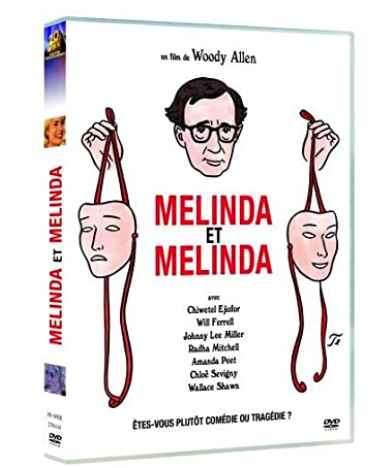
Melinda and Melinda
Synopsis
During a dinner conversation, a group of New York writers debates whether human existence is fundamentally tragic or comic. To illustrate their opposing views, two writers imagine different versions of a story involving a woman named Melinda. In one version, Melinda arrives unexpectedly at the home of old friends, carrying emotional problems and a complicated personal history. In the other, she becomes involved with a married couple whose relationship is already unstable. Radha Mitchell portrays the same central character in both narratives, while the surrounding circumstances lead to very different outcomes. Through humor, romance, disappointment, and personal confusion, the film examines how perspective can transform the meaning of the same events.
The Film's Origins
Woody Allen developed Melinda and Melinda from an idea about the relationship between comedy and tragedy. The project grew out of his long-standing interest in storytelling, human relationships, and the absurdity of everyday life. Rather than adapting a novel or a true story, Allen created an original screenplay structured around two competing interpretations of the same character. The central premise allows the director to explore how circumstances and narrative choices influence the audience's emotional response. Allen also wanted to return to an ensemble-based New York comedy featuring writers, artists, and complicated romantic relationships. Radha Mitchell was selected to portray Melinda in both versions, creating a direct visual connection between the parallel stories. The film was produced by Letty Aronson and distributed internationally through a collaboration involving several production companies. It opened the San Sebastián International Film Festival in 2004.
Critical Reception
Professional Reviews: Critics generally appreciated the originality of the film's central concept and its examination of comedy and tragedy. Radha Mitchell received positive comments for her ability to portray two distinct versions of the same woman. Wallace Shawn and Will Ferrell also attracted attention for their performances. Some reviewers admired the intellectual structure but felt that the two narratives were not equally convincing. Others considered the film a familiar example of Allen's recurring interest in romantic uncertainty and artistic personalities. The dialogue and theatrical construction were widely recognized as central elements of its identity.
Audience Reception: Melinda and Melinda attracted an audience particularly interested in Woody Allen's style of filmmaking. Its unusual structure appealed to viewers who enjoy stories built around ideas and parallel narratives. However, it did not achieve the same commercial impact as some of the director's most successful earlier productions. Audiences had different reactions to the balance between the comic and dramatic sections. The film nevertheless remains an interesting example of Allen's exploration of the relationship between humor and human suffering.
Awards and Recognition: The film opened the 52nd San Sebastián International Film Festival in 2004. Woody Allen received the festival's Donostia Award during the same edition in recognition of his career. The event also presented a retrospective devoted to the filmmaker. Radha Mitchell's performance and Vilmos Zsigmond's cinematography received attention from critics. Although the film did not become a major international awards contender, its festival presentation gave it significant visibility.
Behind-the-Scenes Stories
Director's Inspirations: Woody Allen was interested in the philosophical question of whether life should fundamentally be understood through comedy or tragedy. He developed the two versions of Melinda as a way of demonstrating that identical circumstances can produce completely different emotional interpretations. The idea also reflects the influence of theatrical storytelling, particularly the contrast between comic and dramatic structures. Allen wanted the audience to recognize how much narrative perspective influences its understanding of a character. The film therefore functions partly as a reflection on the creative process itself.
Production Challenges: One of the principal challenges was maintaining a clear distinction between the two narratives while preserving the impression that they concerned the same woman. The production had to coordinate an ensemble cast appearing in different dramatic contexts. The actors also needed to adjust their performances to the changing emotional atmosphere of each storyline. Filming in New York required careful organization of locations and schedules. The director additionally needed to ensure that the transitions between comedy and tragedy felt natural rather than mechanical.
Memorable Scene: The opening dinner conversation is central to the entire film. The writers discuss the nature of drama before beginning to imagine their competing versions of Melinda's story. This sequence establishes the intellectual framework of the film and explains why two different narratives will unfold. It also invites viewers to question whether the emotional tone of a story depends on the events themselves or on the way they are presented. The conversation gives the film a theatrical quality that distinguishes it from a conventional romantic comedy.
Originally Considered Casting: Radha Mitchell ultimately received the challenging role of portraying both versions of Melinda. Will Ferrell plays Hobie in the comic storyline, while Chloë Sevigny and Amanda Peet appear in the ensemble. Wallace Shawn also plays an important role as one of the writers discussing the nature of drama. The production assembled actors with different comic and dramatic backgrounds to support the film's contrasting styles. There is no sufficiently documented complete list of alternative casting choices for the principal roles.
Themes Explored
Melinda and Melinda explores the relationship between comedy and tragedy, the instability of romantic relationships, loneliness, artistic creation, and the influence of perspective. Its central premise suggests that the same event can appear devastating or amusing depending on how it is interpreted. The film also examines the difficulty of finding happiness in relationships marked by insecurity and conflicting expectations. Melinda represents a character whose personal history influences every new encounter. The surrounding writers serve as a reminder that human experiences are constantly transformed into stories. The film questions whether comedy and tragedy are genuinely separate categories or simply different ways of understanding existence. It also highlights the contradictions between intellectual theories and the unpredictable nature of real emotions. Ultimately, it suggests that life rarely fits neatly into a single dramatic category.
Ending Explained
The film concludes without offering a single definitive interpretation of Melinda's experiences because its two narratives are deliberately independent. The tragic version emphasizes emotional instability, disappointment, and the difficulty of escaping personal problems. The comic version uses misunderstandings, romantic complications, and unexpected opportunities to create a lighter conclusion. Both versions demonstrate how the same basic character can become the center of very different stories. The writers' original debate therefore remains unresolved in a philosophical sense. Neither comedy nor tragedy can completely explain human existence. The audience is left to consider how much the way a story is told determines its emotional meaning. The ending reinforces the idea that life contains both absurdity and genuine suffering.
Meaning of the Title
The title Melinda and Melinda refers to the two versions of the same central character. Although both women share a name and a similar starting point, their lives develop in different directions because of the contrasting narratives imagined by the writers. The repetition of the name emphasizes the film's central experiment with perspective. The word and also suggests a comparison between two possible identities rather than a single continuous biography. The title therefore expresses the idea that one person can be interpreted in multiple ways depending on the story being told.
Original Soundtrack
The film uses a selection of jazz and classical recordings rather than relying on a conventional dramatic score. Duke Ellington and his orchestra contribute to its distinctive New York atmosphere, while recordings by Erroll Garner provide additional musical character. Jazz helps establish the relaxed, conversational tone of the lighter scenes. Classical music contributes to the more serious emotional passages. This musical approach reflects Woody Allen's long-standing interest in jazz and its relationship with urban life. The soundtrack also reinforces the contrast between the film's comic and tragic narratives.
Similar Movies
Films with comparable narrative experimentation include Crimes and Misdemeanors, another Woody Allen production examining moral uncertainty and human behavior. Match Point explores the unpredictable relationship between personal decisions and their consequences. Sliding Doors presents alternative versions of a woman's life following a seemingly ordinary event. The Family Man also examines different possible paths and the influence of personal choices. Stranger Than Fiction explores the relationship between storytelling and the lives of ordinary people. These films share an interest in perspective, narrative construction, and the complexity of human relationships.