

 Français
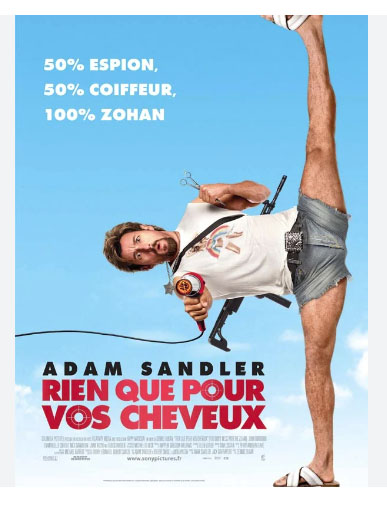
You Don't Mess with the Zohan
Synopsis
Zohan Dvir is an elite Israeli counter-terrorist commando who secretly dreams of abandoning military conflict to pursue a peaceful career as a hairstylist in New York City. Faking his own death during a mission, Zohan slips away to Manhattan and secures a job at an aging beauty salon run by a Palestinian immigrant. Using his unique physical talents and alternative hair-styling methods, he quickly becomes a sensational success among older women in the neighborhood. However, his hidden past catches up with him when local residents and old enemies discover his true identity.
The Making of the Film
Director Dennis Dugan helmed this high-concept slapstick comedy from a screenplay co-written by Adam Sandler, Robert Smigel, and Judd Apatow. The production was designed as a vehicle for Adam Sandler's signature brand of absurdist humor, blending political satire with juvenile gags. Filmmakers sought to use broad comedy to promote a message of coexistence and peace between Israelis and Palestinians in New York. The project featured an extensive ensemble of comedic actors and elaborate stunt choreography.
Critical Reception
Critics offered mixed-to-negative reviews, noting that the film's relentless juvenile humor, crude gags, and cartoonish caricatures tested the patience of mainstream reviewers. However, many critics acknowledged that its underlying political message advocating for peace and cultural understanding was surprisingly heartfelt and ambitious. Some reviewers praised Adam Sandler's infectious comedic energy and physical commitment to the outrageous role. It became a polarizing entry in Sandler's comedic filmography.
Audiences embraced the movie with immense enthusiasm, turning it into a box office success and a beloved cult classic among comedy fans. Viewers loved the endless stream of quotable one-liners, absurd action sequences, and high-energy silly humor. The satire surrounding Middle Eastern politics combined with hair salon shenanigans resonated strongly with fans of slapstick comedy. It remains one of Sandler's most frequently quoted films.
While mainstream film academies bypassed the comedy, it secured multiple nominations at the Teen Choice Awards and MTV Movie Awards. Adam Sandler's comedic performance earned warm fan appreciation. The film cemented its status as a major commercial hit in the comedy genre.
Behind-the-Scenes Stories
Star and co-writer Adam Sandler drew inspiration from his own fascination with Israeli counter-terrorism agents and a real-life Israeli hairstylist who immigrated to New York. He wanted to create a character who uses hair scissors instead of weapons to resolve geopolitical hatred. The production team designed colorful 1980s-inspired wardrobe and ridiculous prosthetic hair styling to build the comedic aesthetic.
Executing the over-the-top stunt sequences, including catching bullets and scaling walls, required rigorous physical training and stunt coordination for the cast. Maintaining a lighthearted, improvisational tone on set allowed comedic actors to riff freely during dialogue scenes. Balancing political satire with pure slapstick comedy demanded careful editorial control.
During the hair-washing and styling sequences, Adam Sandler underwent special cosmetology training to make his comedic hairstyling look surprisingly professional on camera. The crew frequently broke into laughter during absurd fight scenes involving hummus and blowtorches. These playful conditions energized the entire production.
Adam Sandler led the cast as Zohan, supported by John Turturro, Emmanuelle Chriqui, Nick Swardson, and Rob Schneider. The casting process focused on gathering Sandler's regular comedic collaborators alongside talented dramatic actors willing to play broad comedy. The resulting ensemble delivered non-stop comedic chaos.
Themes Explored
The film explores cultural coexistence, the absurdity of endless ethnic conflict, immigrant solidarity, and following unorthodox personal dreams. It examines how ordinary people from warring backgrounds can live peacefully together when separated from political dogma. The narrative ultimately champions friendship and hummus over warfare.
Ending Explained
Zohan and his Palestinian rival-turned-friend Phantom unite their neighborhoods to save their block from corporate real estate developers trying to displace local immigrant businesses. With the community working together in harmony, the old political hatreds dissolve into a joyful neighborhood dance party. Zohan happily opens his dream hair salon, finally achieving peace. The ending delivers a heartwarming, silly resolution to the geopolitical comedy.
Meaning of the Title
The title "You Don't Mess with the Zohan" serves as a boastful, comedic warning highlighting the invincible, legendary combat status of the protagonist. It sets a confident, playful tone for the action-comedy antics. The title became an instant catchphrase among fans.
Original Soundtrack
Featuring an eclectic mix of pulsing Middle Eastern techno beats, 1980s disco classics, and upbeat party anthems, the soundtrack is an explosive comedic energy boost. The catchy musical cues amplify the ridiculous action sequences and salon dance numbers, delighting viewers.
Latest News
The film continues to enjoy a vibrant cult following and frequent streaming rewatches as a classic Sandler comedy.
Similar Films
Fans of Adam Sandler comedies will enjoy Talladega Nights (2006), Pineapple Express (2008), Tropic Thunder (2008), and Anchorman (2004), all featuring absurd comedy.