

 Français
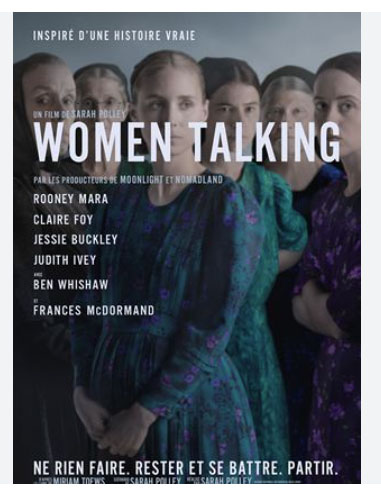
Women Talking
Synopsis
Set in 2010 inside an isolated, ultra-conservative Mennonite religious colony, the women discover a horrifying, systemic truth: for years, the men of the colony have been drugging them with animal tranquilizers at night and sexually assaulting them in their sleep. When the men temporarily leave the colony to post bail for the arrested perpetrators, the women gather secretly in a hayloft to debate their future. They face an agonizing, monumental choice: do nothing, stay and fight, or leave the only home they have ever known to build a new life. Over forty-eight hours, they engage in profound, impassioned philosophical debates about faith, forgiveness, and freedom.
The Making of the Film
Director Sarah Polley adapted the powerful drama from Miriam Toews's acclaimed bestselling novel, inspired by real-life horrific events in Bolivia. Polley crafted the screenplay to focus not on the graphic abuse itself, but on the intellectual, emotional, and spiritual recovery of women reclaiming their agency. The production utilized a desaturated, sepia-toned visual palette to evoke a timeless, isolated religious world. The project was built as a monumental, thought-provoking chamber drama.
Critical Reception
Critics offered widespread critical acclaim, praising Sarah Polley's visionary direction, stellar ensemble cast, and the film's profound philosophical depth regarding trauma and forgiveness. Reviewers commended the movie for transforming a harrowing real-life horror into an inspiring, hopeful cinematic discussion about democracy, autonomy, and female solidarity. Some critics noted its heavy theatrical stage origins, yet lauded its urgent emotional resonance and brilliance. It emerged as a major awards-season powerhouse.
Audiences were deeply moved by the film's intellectual rigor, emotional power, and powerhouse performances from Rooney Mara, Claire Foy, and Jessie Buckley. Viewers found the respectful debate over pacifism, faith, and justice deeply inspiring and relevant to modern discussions surrounding consent and survival. The film sparked important conversations across international screening audiences. Many praised it as a masterclass in modern drama.
The film achieved ultimate awards-season triumph, winning the Academy Award for Best Adapted Screenplay for Sarah Polley and earning a prestigious nomination for Best Picture. The ensemble cast earned universal critical praise. The project cemented its status as an immortal cinematic milestone.
Behind-the-Scenes Stories
Director Sarah Polley was determined to make a film about trauma that focuses entirely on hope, healing, and the construction of a better future rather than graphic violence. She worked closely with author Miriam Toews to translate the intense debate scenes into cinematic language. The production team collaborated with Mennonite cultural advisors to ensure authentic costume and speech patterns.
Shooting almost entirely within a single hayloft set required creative camera blocking and muted lighting to emphasize the passage of forty-eight hours. Managing heavy emotional dialogue scenes demanded rigorous rehearsal and emotional focus from the star-studded ensemble. Maintaining a desaturated color palette required careful cinematography.
During the intense debate sequences, Rooney Mara, Claire Foy, and Jessie Buckley performed with raw theatrical brilliance, bringing immense emotional weight to their philosophical arguments. The sole male actor, Ben Whishaw, brought gentle vulnerability to his role as the sympathetic scribe. These practical efforts resulted in masterclass cinema.
Rooney Mara, Claire Foy, Jessie Buckley, and Frances McDormand led the legendary cast, supported by Ben Whishaw. The casting process gathered powerhouse talent. The resulting ensemble delivered peerless dramatic chemistry.
Themes Explored
The film explores systemic sexual abuse survival, female autonomy, democracy, pacifism, religious faith, and forgiveness. It examines how traumatized communities can rebuild their moral foundation through open dialogue and mutual respect. The narrative ultimately champions freedom and hope over vengeance.
Ending Explained
The women vote decisively to leave the colony, refusing to accept the men's insincere demands for hollow religious forgiveness without structural change. In a triumphant, moving conclusion, the women and their young children walk across the open plains in horse-drawn carts toward the outside world to build a safe, self-governed society. The young boys are taken along to be raised without toxic patriarchal violence. The ending offers a breathtaking, hopeful liberation.
Meaning of the Title
The title "Women Talking" directly summarizes the core revolutionary act of the narrative: women finally gathering to speak, listen, and govern together without male permission. It symbolizes reclaiming voice and democracy. The concise title sets a powerful dramatic tone.
Original Soundtrack
Composed by Hildur Guðnadóttir, the musical score is a haunting, minimalist masterpiece featuring melancholic cello arrangements and atmospheric choral hums that elevate the emotional intimacy of the hayloft debates. The soaring melodies amplify the journey toward freedom, delighting music lovers.
Latest News
- The film remains an immortal milestone in contemporary cinema, celebrated for Sarah Polley's Oscar-winning screenplay and powerhouse ensemble performances.
Similar Films
Fans of powerful dramas about survival and justice will enjoy Spotlight (2015), 12 Angry Men (1957), The Handmaid's Tale (2017), and She Said (2022), all exploring truth.