

 Français
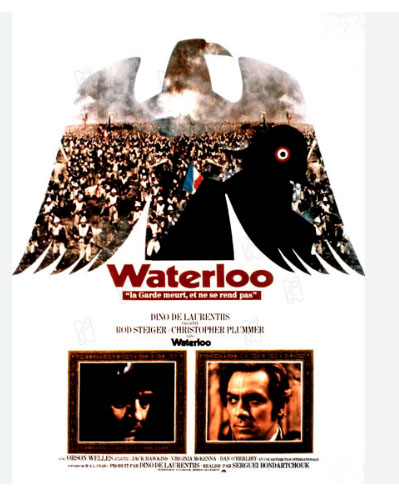
Waterloo
Synopsis
In June 1815, the legendary French Emperor Napoleon Bonaparte faces his ultimate military defeat on the battlefields of Belgium against the Duke of Wellington and the allied European armies. Following his brief exile, Napoleon rallies his devoted troops for one final campaign to reclaim his empire and alter the course of history. As torrential rains turn the muddy fields into a grueling strategic nightmare, thousands of soldiers clash in one of history's bloodiest military engagements. The film provides a sweeping, meticulously detailed recreation of the legendary battle.
The Making of the Film
Director Sergei Bondarchuk helmed this monumental historical war epic, backed by legendary Italian producer Dino De Laurentiis and Soviet studio financing. The production aimed to recreate the historic 1815 battle with unprecedented historical authenticity and massive practical scale without digital effects. Filmmakers utilized thousands of real Soviet army soldiers dressed as French and British troops to stage authentic tactical maneuvers. The project was built as a majestic cinematic monument to military history.
Critical Reception
Critics offered mixed reviews upon its 1970 release, praising the staggering scale of the battle sequences, costume design, and Rod Steiger's intense portrayal of Napoleon. Reviewers commended Sergei Bondarchuk's astonishing logistical achievement in choreographing thousands of extras across open Ukrainian fields. Some critics noted that the massive military focus left the human drama somewhat cold and episodic. Overall, it was regarded as an unmatched logistical triumph in war cinema.
Audiences drawn to historical military epics appreciated the incredible scale and historical accuracy of the tactical combat maneuvers. Viewers were mesmerized by the sweeping cavalry charges and artillery barrages that brought history to life. The film achieved massive status among military history enthusiasts and historical reenactors. Many praised it as the most realistic battle film ever produced.
While major mainstream Academy awards bypassed the international epic, it earned high acclaim and BAFTA awards for its outstanding art direction and costume design. The film's technical achievement remains legendary among cinema historians. The project secured its legacy as a landmark war film.
Behind-the-Scenes Stories
Director Sergei Bondarchuk was inspired to create the ultimate cinematic representation of Napoleonic warfare, insisting on absolute historical and tactical fidelity. He enlisted real Soviet army cavalry regiments and infantry units to serve as background troops for months of grueling physical training. The production team constructed massive replica farmhouses and battle earthworks on location in Ukraine.
Shooting massive battle sequences involving thousands of extras required complex military coordination, pyrotechnics, and extensive safety protocols. Managing the enormous logistical operation across Soviet borders presented unique communication hurdles for the international crew. Maintaining historical accuracy in every uniform and cannon model required rigorous archival research.
During the brutal cavalry charge sequences, hundreds of horses and stunt riders galloped across explosive battlefields under strict safety supervision. Rod Steiger delivered his commanding imperial orders with intense emotional focus. These practical efforts created cinema history.
Rod Steiger and Christopher Plummer led the iconic cast as Napoleon Bonaparte and the Duke of Wellington, supported by Orson Welles and Jack Hawkins. The casting process gathered international stars. The resulting ensemble delivered epic historical gravity.
Themes Explored
The film explores the tragedy of war, the hubris of empire, military strategy, tactical leadership, and the devastating cost of human ambition. It examines how political empires rise and fall based on single afternoon engagements. The narrative ultimately champions historical realism over romanticized glory.
Ending Explained
Napoleon's elite Imperial Guard is famously repulsed by Wellington's steadfast British lines as Prussian reinforcements arrive to crush the French flank, sealing a decisive allied victory. Napoleon surveys the catastrophic carnage of his ruined army, realizing his reign is permanently over as he retreats into history. A closing epilogue summarizes the heavy human toll and the end of the Napoleonic era. The ending offers a sobering, monumental historical conclusion.
Meaning of the Title
The title "Waterloo" refers directly to the historic Belgian town where the legendary battle took place, becoming an immortal synonym for ultimate defeat. It signals an epic historical confrontation. The concise title sets a monumental war-film tone.
Original Soundtrack
Composed by Nino Rota, the musical score is a majestic orchestral triumph featuring rousing military marches, somber brass dirges, and sweeping European orchestral themes. The stirring melodies elevate the epic scale of the battlefields, delighting music lovers.
Latest News
- The film remains celebrated by military historians and cinephiles as the undisputed pinnacle of practical-effects war filmmaking.
Similar Films
Fans of historical war epics will enjoy Gettysburg (1993), War and Peace (1966), Braveheart (1995), and Master and Commander (2003), all exploring military history.