

 Français
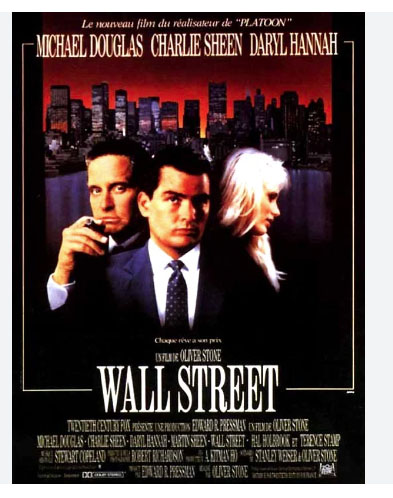
Wall Street
Synopsis
Bud Fox is an ambitious, junior stockbroker on Wall Street in 1980s New York who desperately wants to make it big under the mentorship of financial titans. Eager to impress the ruthless, legendary corporate raider Gordon Gekko, Bud feeds him insider information obtained illegally through his father's union-mechanic contacts. Gekko takes Bud under his wing, introducing him to unimaginable wealth, luxury apartments, and high-stakes corporate takeover greed. As Bud crosses moral boundaries to satisfy his ambition, he faces a devastating ethical reckoning.
The Making of the Film
Director Oliver Stone helmed this razor-sharp financial drama, co-writing the screenplay with Stanley Weiser as a passionate critique of 1980s corporate greed and deregulated capitalism. Stone drew inspiration from his own father's stockbroker background and infamous real-life insider trading scandals of the era. The production utilized authentic New York stock exchange offices and luxury Manhattan locations to capture corporate opulence. The project was built to be a definitive cultural portrait of the decade.
Critical Reception
Critics offered generally favorable reviews, praising Michael Douglas's legendary, Oscar-winning performance as Gordon Gekko and Oliver Stone's energetic, kinetic direction. Reviewers commended the film's brilliant articulation of 1980s corporate excess, materialism, and the mantra "Greed, for lack of a better word, is good." Some critics noted that the melodrama occasionally tipped into heavy-handed moralizing, yet universally lauded Douglas's magnetic screen presence. It emerged as a defining cultural milestone.
Audiences embraced the movie with immense enthusiasm, turning it into a box office hit and a massive cultural touchstone that ironically inspired an entire generation of real-life young brokers to enter finance. Viewers were mesmerized by Gordon Gekko's slick suspenders, sleek brick-sized mobile phones, and ruthless business philosophy. The famous "Greed is good" speech became an immortal pop-culture quote. Fans continue to celebrate its sharp financial critique.
The film achieved ultimate awards-season triumph, winning the Academy Award for Best Actor for Michael Douglas. Oliver Stone's direction captured global critical acclaim. The project cemented its status as an immortal classic of 1980s cinema.
Behind-the-Scenes Stories
Director Oliver Stone wanted to capture the frantic, cocaine-fueled energy and moral rot of 1980s Wall Street trading floors with absolute authenticity. He consulted with real white-collar criminals and financial experts during script development. The production team collaborated with high-end tailors to design Gordon Gekko's iconic power suits.
Shooting across authentic New York financial districts and trading floors required complex crowd coordination and permits. Managing fast-paced financial jargon dialogue demanded rigorous rehearsal from the cast. Maintaining a glossy, high-roller visual palette required careful cinematography planning.
During the famous "Greed is good" shareholder meeting speech, Michael Douglas delivered his lines with commanding theatrical authority, creating a chilling cinematic moment. Charlie Sheen brought youthful desperation to his ethical downfall. These practical efforts resulted in masterclass cinema.
Michael Douglas and Charlie Sheen led the cast as Gordon Gekko and Bud Fox, supported by Daryl Hannah, Martin Sheen, Terence Stamp, and Hal Holbrook. The casting process gathered powerhouse talent. The resulting ensemble delivered peerless dramatic chemistry.
Themes Explored
The film explores unchecked corporate greed, insider trading, the corruption of the American Dream, father-son relationships, and ethical integrity. It examines how absolute wealth can warp human morality and destroy families. The narrative ultimately champions honesty over material corruption.
Ending Explained
Bud realizes the full destruction Gekko has caused—including ruining his father's airline company—and wears a wire for the SEC to trap Gekko in an illegal insider trading conversation. Gekko is arrested by federal agents outside his office, while Bud faces his own day in court, cooperating with authorities to salvage his soul. Walking out of the courthouse with his father, Bud faces an uncertain legal future but a clear conscience. The ending offers a powerful, moral resolution.
Meaning of the Title
The title "Wall Street" directly names the legendary New York financial district that serves as the epicenter of global capitalism, ambition, and moral corruption in the film. It symbolizes wealth and power. The concise title sets an iconic financial-drama tone.
Original Soundtrack
Composed by Stewart Copeland (drummer of The Police), the musical score is a fantastic electronic-rock triumph featuring pulsing synthesizer beats, sleek basslines, and brass motifs. The modern musical cues amplify the high-stakes trading floor anxiety, delighting music lovers.
Latest News
- The film remains an immortal milestone in cinema, celebrated for defining the cultural ethos of 1980s corporate finance and introducing Gordon Gekko.
Similar Films
Fans of financial dramas and corporate corruption will enjoy The Wolf of Wall Street (2013), Margin Call (2011), Boiler Room (2000), and The Big Short (2015), all exploring money.