

 Français
Triangle of Sadness
Synopsis
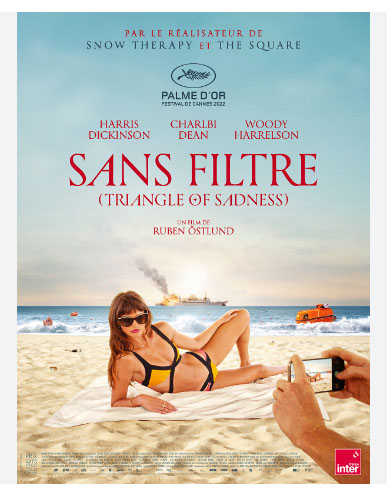
A celebrity model couple, Carl and Yaya, are invited onto a luxury superyacht for a lavish cruise alongside a collection of ultra-wealthy, eccentric passengers. Headed by an unhinged, perpetually intoxicated captain who quotes Marx and Twain, the cruise appears to be the ultimate display of elite excess. However, a violent storm triggers catastrophic sea sickness during a gala dinner, turning the luxury voyage into a grotesque, projectile-vomiting disaster. Stranded on a deserted island following a shipwreck, the social hierarchy completely inverts when a lowly cleaning lady proves to be the only one with survival skills.
The Making of the Film
Writer and director Ruben Östlund crafted this biting satirical dark comedy as a scathing critique of modern capitalism, superficial beauty, and class privilege. Östlund spent years researching the luxury yacht industry and social hierarchy dynamics to construct the three-act narrative structure. The production utilized real-life luxury yachts and remote Greek island locations to capture authentic opulence and rugged isolation. Filmmakers aimed to blend uncomfortable social realism with explosive, laugh-out-loud dark comedy.
Critical Reception
Critics hailed the film as a brilliant, razor-sharp masterpiece of social satire, praising its audacious humor, fearless performances, and Ruben Östlund's visionary direction. Reviewers commended the legendary, fifteen-minute sea-sickness dinner sequence as one of the funniest and most grotesque cinematic set pieces in decades. Some critics noted that the third act's social inversion tropes felt slightly drawn out, yet lauded its provocative intellectual bite. It became an instant critical darling on the international festival circuit.
Audiences embraced the movie for its shocking dark comedy, unpredictable narrative swings, and delicious skewering of the ultra-rich. Viewers found the class reversal on the deserted island endlessly fascinating and darkly hilarious. The breakout performance of actress Dolly de Leon as the bathroom manager generated massive online buzz and acclaim. It became a surprise arthouse box office hit worldwide.
The film achieved ultimate critical triumph by winning the prestigious Palme d'Or at the 2002 Cannes Film Festival. It went on to capture multiple Academy Award nominations, including Best Picture, Best Director, and Best Original Screenplay. Ruben Östlund cemented his status as one of Europe's most daring satirical filmmakers.
Behind-the-Scenes Stories
Director Ruben Östlund drew inspiration from his wife, a fashion photographer, and his own observations regarding how physical beauty acts as currency in modern society. He wanted to test what happens to arrogant elites when their wealth and status become completely useless in the wild. The production team spent weeks engineering the practical mechanics for the yacht's rolling motion during the catastrophic dinner scene.
Filming the multi-day sea-sickness sequence required meticulous coordination of special effects, stunt vomit rigs, and precise comedic timing from the ensemble cast. Managing international actors on a floating yacht in open water presented constant physical and logistical challenges. Maintaining a sharp satirical tone amidst chaotic physical comedy demanded rigorous directorial discipline.
During the infamous gala dinner scene, actors performed amidst cascading waves of realistic prop vomit and flying food, maintaining deadpan expressions of aristocratic horror. The crew maintained a joyful, collaborative atmosphere despite the grotesque subject matter. These practical efforts resulted in one of the most memorable sequences in modern cinema.
Harris Dickinson, Charlbi Dean, and Dolly de Leon led the ensemble cast, supported by Woody Harrelson as the Marxist captain. The casting process spanned multiple countries to find actors who could embody vapid modeling culture and billionaire absurdity. The resulting cast delivered pitch-perfect satirical performances.
Themes Explored
The film explores modern capitalism, class privilege, the commodification of physical beauty, gender power dynamics, and societal hypocrisy. It examines how quickly civilized behavior collapses when basic survival needs take over. The narrative ultimately lampoons the fragility of elite entitlement.
Ending Explained
On the deserted island, Abigail the cleaning lady establishes herself as the absolute dictator because she alone knows how to fish and forage. Yaya attempts to manipulate Abigail into becoming her personal assistant in exchange for privileged status back in civilization. As Yaya walks up a forest path, unaware that Abigail is approaching her with a rock to protect her newfound power, the screen abruptly cuts to black. The ambiguous ending leaves the ultimate power struggle unresolved.
Meaning of the Title
The title "Triangle of Sadness" originates from a plastic surgery industry term referring to the furrowed frown between a person's eyebrows caused by stress. In the film, it serves as a satirical jab at the superficial anxieties of the fashion modeling industry. The title encapsulates the vanity that drives the opening of the narrative.
Latest News
- The film remains a modern touchstone for discussions surrounding class satire and dark comedy in contemporary cinema.
Similar Films
Fans of biting social satires will enjoy Parasite (2019), The Menu (2022), Succession (2018), and The Square (2017), all skewering wealth and class.