

 Français
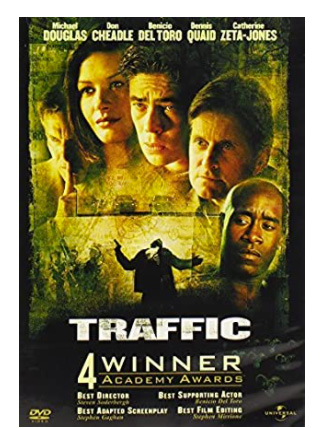
Traffic
Synopsis
Traffic weaves together several stories set around the international drug trade. In Ohio, a conservative judge named Robert Wakefield is appointed as the United States drug czar, unaware that his teenage daughter is secretly addicted. In Tijuana, an honest Mexican police officer named Javier Rodríguez finds himself caught between corruption and duty. In San Diego, two federal agents pursue a wealthy trafficker, while his pregnant wife discovers the truth about the family business. The film follows how these stories intersect and shows the human cost of a war that cannot be won.
The Making of the Film
Traffic is based on Traffik, a British television miniseries from 1989 that told the story of the heroin trade between Pakistan and Europe. Steven Soderbergh, who had recently finished Erin Brockovich, was drawn to the idea of adapting it to examine the American drug problem from several angles. The screenplay was written by Stephen Gaghan, who transposed the story to the border between the United States and Mexico and expanded it into a multilayered drama. Soderbergh wanted the film to avoid easy answers and to present the viewpoints of the people on all sides of the issue, from politicians to police officers to addicts. He acted as his own cinematographer, working under the pseudonym Peter Andrews, and credited the editing to Mary Ann Bernard, another pseudonym for himself. The cast included Michael Douglas, Benicio del Toro, Don Cheadle, Catherine Zeta-Jones, Luis Guzmán and Dennis Quaid, among others. The film used handheld cameras and natural lighting to give it the feel of a documentary. It was released at the end of December 2000 and quickly became one of the most acclaimed films of the awards season.
Critical Reception
Critics praised Traffic as an ambitious and intelligent film that treated the drug issue with nuance and seriousness. They admired the performances, particularly Benicio del Toro's quiet and powerful portrayal of the Mexican police officer. The film's structure, with its interwoven stories and distinct visual styles, was widely seen as a bold and effective choice. A few reviewers felt that some of the storylines were less compelling than others, and that the Ohio segment verged on conventional melodrama. Overall, the film was hailed as one of the best of the year and a landmark of modern American cinema.
The film was also a strong commercial success, earning around 200 million dollars worldwide, which was remarkable for such a serious and complex drama. Audiences were drawn by the famous cast and the film's urgent subject matter. It generated considerable public debate about drug policy and the effectiveness of the war on drugs. The film has remained a reference point for later works about the drug trade, and it is frequently cited in discussions of how cinema can handle political topics.
Traffic won four Academy Awards at the 2001 ceremony: Best Director for Steven Soderbergh, Best Supporting Actor for Benicio del Toro, Best Adapted Screenplay for Stephen Gaghan and Best Film Editing. It was also nominated for Best Picture, which went to Gladiator. Soderbergh was nominated for Best Director twice in the same year, for Traffic and for Erin Brockovich, and he won for Traffic. Del Toro's win confirmed him as one of the most respected actors of his generation. The film's success at the Oscars and other ceremonies reflected the admiration of the profession for its ambition and craft.
Filming anecdotes
Soderbergh gave each storyline its own look, with a cold blue tone for the Washington and Ohio scenes, a golden and grainy look for Mexico and a more naturalistic palette for San Diego. This visual coding helps the viewer to follow the different narratives without any explanation. A significant part of the film is in Spanish with subtitles, which was an unusual choice for a major American production at the time. Several real politicians, including senators Orrin Hatch and Barbara Boxer, appear as themselves in scenes in which Wakefield discusses drug policy. Harrison Ford was reportedly attached to play Robert Wakefield before Michael Douglas took the role. The film was shot with handheld cameras and often with natural light, which gives it the immediacy of a documentary.
Themes explored
At its heart, Traffic is a film about the failure of the war on drugs and the human consequences of a policy that treats a social and medical problem as a military one. It shows that supply and demand are inseparable, and that addiction can touch any family, including that of the person leading the fight against it. The film also explores corruption, in the police, in the military and in the political establishment, which complicates any attempt at reform. Several characters struggle with the conflict between duty and conscience, with each choosing a different path. The story highlights the border as a place where two worlds meet, and where inequality and violence are part of daily life. Family is another important theme, since the personal stakes for Wakefield, Helena Ayala and Javier are all rooted in their relationships. Soderbergh's approach avoids moralising and invites the audience to draw its own conclusions. The film's complexity reflects the complexity of the problem it describes.
Ending explained
In the closing sequence, Robert Wakefield attends a meeting in which he is expected to present his strategy, but he decides to abandon his position, saying that he cannot wage a war against his own family. His daughter Caroline, whose addiction has reshaped his view of the problem, is in rehabilitation, and the film suggests that her recovery will be long and uncertain. In Mexico, Javier Rodríguez agrees to cooperate with American agents on condition that they install lights at a baseball field in his neighbourhood, so that children can play at night. This small request becomes one of the film's most moving moments, a quiet gesture in favour of community life. In San Diego, Helena Ayala takes control of her husband's business and shows that the cycle of trafficking continues. The film closes on the image of the lit baseball field, which reflects a modest hope rather than a solution. The ending offers no neat resolution to the drug problem, but it suggests that small acts of conscience can still matter. It leaves the audience with a sense of ambiguity that matches the film's tone.
Meaning of the title
The word traffic has several meanings, and the film plays with all of them. It refers first to the traffic of drugs, the illicit trade that crosses borders and connects producers and consumers. It also evokes the movement of people and vehicles, particularly at the border between Mexico and the United States, where thousands of crossings take place each day. The word suggests a constant flow that is impossible to stop, which matches the film's view of the drug trade. It also refers to the circulation of power and money, which link the characters in ways they do not always understand. The film's original source, the British miniseries Traffik, used a similar play on words. The simplicity of the title makes it a perfect umbrella for the film's many storylines. It also reflects the film's structure, in which characters cross paths like vehicles on a busy road. In that sense, the title captures both the subject and the form of the film.
Similar Films
If you were impressed by Traffic, the first film to see is Soderbergh's own Erin Brockovich, released the same year. Sicario, by Denis Villeneuve, offers a more thriller-oriented view of the drug war along the Mexican border. Syriana, written and directed by Stephen Gaghan, uses a similar interwoven structure to explore the oil industry. Babel and Crash are other films that weave together several stories across borders and cultures. Narcos, the television series, follows the rise of the Colombian cartels from a different angle. The Wire, with its multiple viewpoints, offers a comparable portrait of the drug trade in an American city. City of God shows the drug world from the inside in Rio de Janeiro. Requiem for a Dream, released the same year, offers a more intimate look at the personal cost of addiction.