

 Français
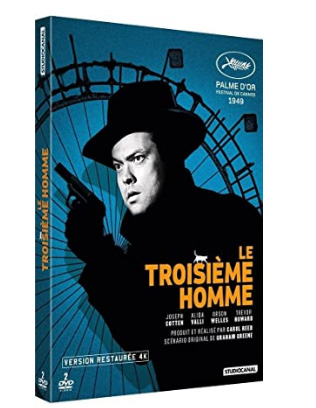
The Third Man
Synopsis
In the ruins of postwar Vienna, American pulp-fiction writer Holly Martins arrives to take a job offered by his old friend Harry Lime, only to learn that Lime has just been killed in a street accident. As Holly investigates the circumstances of his friend's death, he discovers that witnesses give conflicting accounts, and that a mysterious third man was present at the scene. His search leads him through a maze of shadows, black-market rackets and shifting loyalties. The truth about Harry Lime turns out to be far darker than he could have imagined.
The Making of the Film
The Third Man began as a novella written by Graham Greene, who wrote it as a preparation for the screenplay rather than as a finished work. Greene was inspired by a brief, evocative idea about a man who arrives to meet a friend and finds that friend has died. Producer Alexander Korda and director Carol Reed worked with Greene to develop the story, and Greene spent time in Vienna, absorbing the atmosphere of the divided, ruined city. Reed brought the story to life with a distinctive visual style and a daring musical choice. The film was released in 1949 and quickly became a classic.
Reviews and Reception
Summary of Professional Reviews
Critics acclaimed the film as a masterpiece of suspense, praising its atmospheric photography, its sharp dialogue and its remarkable performances. It has remained a fixture on lists of the greatest films ever made. In 1999, the British Film Institute voted it the best British film of the twentieth century.
Audience Reception
The film was a major success with audiences in Britain and abroad, and its zither theme became a worldwide sensation. Over the decades, it has been rediscovered by each new generation of film lovers. Its famous scenes and lines are widely quoted and imitated.
Awards Won
The film won the Grand Prix at the 1949 Cannes Film Festival, the top prize at the time. It also won the Academy Award for Best Cinematography in black and white, for Robert Krasker's striking photography. Carol Reed received an Oscar nomination for Best Director.
Filming Anecdotes
Director's Inspirations
Carol Reed wanted to capture the unsettling atmosphere of postwar Vienna, with its bomb-damaged streets and divided occupation zones. He used tilted camera angles, deep shadows and wet cobblestones to give the film a sense of unease and moral instability.
Production Difficulties
The film was shot on location in Vienna, which was still scarred by the war and split between four occupying powers. Many night scenes were filmed in the city's streets and, famously, in its sewers, which presented logistical challenges. The crew had to deal with poor weather, difficult lighting and the demands of working in a half-ruined city.
Anecdote About a Particular Scene
Orson Welles reportedly contributed the famous speech on the Ferris wheel, in which Harry Lime compares the Swiss cuckoo clock to the violence of the Italian Renaissance. The monologue became one of the most celebrated scenes in cinema history.
Casting initially planned
Producer David O. Selznick supplied Joseph Cotten for the role of Holly Martins, while Alexander Korda was determined to cast Orson Welles as Harry Lime. Welles appears on screen for only a short time, but his presence dominates the entire film.
Themes Explored
The Third Man is a story about friendship, betrayal and the moral ambiguity of a world shattered by war. It explores the corruption of postwar Europe, where black-market profiteering flourished among ruins and suffering. The film also examines the clash between idealism and cynicism, represented by the naïve Holly and the charming, ruthless Harry. Loyalty and conscience are central, as Holly must decide whether to betray his friend for the greater good. At its core, it asks whether friendship can survive the discovery of a terrible truth.
Ending Explained
After a thrilling chase through the sewers of Vienna, Holly is forced to shoot Harry Lime, ending his friend's criminal career. At the funeral, Anna, the woman who loved Harry, walks past Holly without a word or a glance, in one of the most famous final shots in film history. Holly stands alone, waiting for her, while the camera lingers on the empty, tree-lined avenue. The ending is bleakly ironic, denying the audience a conventional romantic resolution.
Meaning of the Title
The title refers to the mysterious "third man" who was present when Harry Lime was killed, a figure whose identity becomes the central puzzle of the story. The phrase also hints at the idea that there is always a hidden witness to the truth. It captures the film's atmosphere of secrets and unreliable accounts.
Original Soundtrack
Anton Karas's zither score is one of the most distinctive in film history. The playful, haunting "Harry Lime Theme" became a worldwide hit, and its quirky sound gives the film its unique, slightly unsettling character. The unusual choice of instrument was a daring decision by Carol Reed that paid off brilliantly.
Similar Films
- Touch of Evil: another noir classic featuring Orson Welles.
- Casablanca: a story of loyalty and sacrifice in a war-torn world.
- The Maltese Falcon: a classic detective story full of deception.
- Odd Man Out: another atmospheric thriller directed by Carol Reed.