

 Français
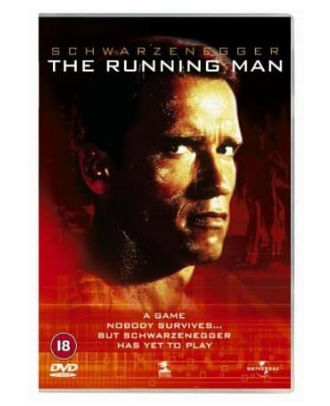
The Running Man
Synopsis
Set in a dystopian totalitarian America in the year 2017, the global economy has collapsed and society is controlled through violent government-run television propaganda. Ben Richards is a framed former police helicopter pilot who refuses to fire on starving civilian rioters and is subsequently sentenced to a brutal forced labor prison camp. After escaping prison, he is recaptured and coerced into participating in The Running Man, the nations most popular and lethal reality game show hosted by a ruthless megalomaniac named Damon Killian. Armed with high-tech tracking gear, contestants must survive against savage professional assassins known as Stalkers across a ruined urban wasteland. As millions of citizens watch live on television, Richards fights to expose the broadcast corruption and win his freedom.
The Making of the Film
Director Paul Michael Glaser adapted the film loosely from Stephen King dystopian action thriller novel published under his pseudonym Richard Bachman in 1982. TriStar Pictures financed the high-octane sci-fi action film as a star vehicle for Arnold Schwarzenegger, capitalizing on his massive 1980s box-office dominance. The production transformed Kings dark, satirical novel into a flashy, neon-lit 1980s action blockbuster.
Critical Reception
Critics gave the film mixed reviews upon its release, praising its prescient satire of reality television, energetic action sequences, and Arnold Schwarzenegger charismatic one-liners. Reviewers noted that while it strayed significantly from Stephen King darker source novel, its campy dystopian humor offered fun entertainment. Over time, critics appreciated how accurately it predicted modern reality television culture.
Public reception was warm, turning the sci-fi action thriller into a solid box-office success worldwide and an enduring 1980s cult classic. Audiences fell in love with the colorful wrestling-style Stalker assassins, witty banter, and dystopian spectacle. It remains a beloved retro sci-fi favorite.
The film did not receive major mainstream Academy Awards, reflecting its campy action standing. Its satirical prediction of ruthless reality television trash culture has been widely celebrated by pop-culture historians. Its retro legacy endures.
Behind-the-Scenes Stories
Director Paul Michael Glaser drew inspiration from classical gladiatorial combat, television game show culture, and Stephen King dystopian novel. He chose expansive soundstage sets and neon-lit backlots to create a futuristic dystopian Los Angeles. His direction pushed Arnold Schwarzenegger to deliver his signature heavy action hero quips.
Production went smoothly, though the physical demands of stunt choreography and complex pyrotechnics required rigorous safety protocols. Arnold Schwarzenegger performed many of his own action sequences alongside professional wrestlers cast as Stalkers. Richard Dawson brought incredible charismatic arrogance to his villainous game show host role.
A memorable sequence involves Ben Richards facing off against the electric-wielding assassin Dynamo in a neon gladiatorial arena while crowds roar. The scene captures the high-energy campiness of 80s action cinema. Schwarzenegger witty one-liner after victory became legendary.
The casting process capitalized on Arnold Schwarzenegger unstoppable action star status. Schwarzenegger was cast as Ben Richards, bringing unmatched muscular presence. Richard Dawson was specifically chosen by Stephen King to play the villainous game show host, bringing authentic television quiz-show charm.
Themes Explored
The film explores media propaganda, totalitarian control, reality television exploitation, state-sponsored violence, and rebellion. It satirizes how public entertainment numbs society to authoritarian cruelty. Freedom triumphs over media tyranny.
NULL
Meaning of the Title
The title refers directly to the lethal state-run television game show where condemned prisoners run for their lives across a ruined city while hunted by assassins. It highlights the deadly survival contest driving the plot.
NULL
NULL
Similar Films
Other similar films include The Hunger Games, Total Recall, and Battle Royale.