

 Français
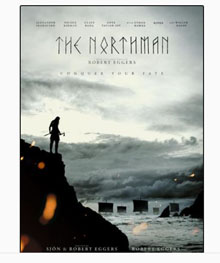
The Northman
Synopsis
In the tenth century, young Prince Amleth sees his father, the king, murdered by his uncle, who then takes the throne and his mother. Amleth escapes and swears an oath: to avenge his father, save his mother and kill his uncle. Years later, now a fearsome Viking warrior, he learns that his uncle has been exiled to a remote farm in Iceland. He joins a group of slaves bound for the farm, determined to fulfill his destiny.
The Making of the Film
The Northman is inspired by the Scandinavian legend of Amleth, which is also the source of Shakespeare's Hamlet. Director Robert Eggers, known for The Witch and The Lighthouse, wrote the screenplay with the Icelandic poet and novelist Sjón. Eggers had long dreamed of making a Viking film, and Alexander Skarsgård, who had been looking for a similar project, approached him to make it together. The two worked for years on the script, and Eggers consulted historians and archaeologists to make the film as accurate as possible. Nicole Kidman, Claes Bang, Anya Taylor-Joy, Ethan Hawke, Willem Dafoe and the singer Björk joined the cast. The film was shot in Northern Ireland and released in April 2022.
Critical Reception
Summary of professional reviews
Critics were largely enthusiastic. They praised Eggers's immersive vision, the stunning cinematography and the physical commitment of Alexander Skarsgård. Many described it as a brutal, mythic epic unlike any other big-budget film. Some reviewers found the story simple and the dialogue heavy-handed, but most admired its ambition.
Public reception
The film was a critical hit but struggled at the box office, earning less than its large budget. Over time it has built a devoted following, particularly among fans of historical epics.
Behind-the-Scenes Stories
Director's inspirations
Eggers drew on Icelandic sagas, Norse mythology and the archaeology of the Viking Age. He wanted to show a world in which magic and ritual were part of everyday life, rather than a fantasy version of history.
Production difficulties
Filming in the rough landscapes of Northern Ireland meant dealing with mud, rain and cold. The crew had to coordinate large battle scenes and elaborate sets that were built from scratch.
Anecdote about a particular scene
The raid on a village, which was filmed in a long, continuous take, is one of the film's most striking sequences. It required precise choreography between the actors, the stunt performers and the camera.
Themes Explored
The film is about vengeance, fate and the cycle of violence. Amleth is driven by a vow that gives his life purpose but also traps him. It examines masculinity and power in a world where honor is measured through bloodshed. The story also explores destiny, since the characters believe that the Norns weave their fates. Family and betrayal are at the heart of the drama, giving the film a tragic dimension.
Ending Explained
In the final confrontation, Amleth and his uncle Fjolnir fight on the edge of a volcano, in the place known as the gates of Hel. Amleth kills Fjolnir and is mortally wounded in the process. He had earlier decided to leave with Olga and their unborn children, but he chooses to complete his vow. As he dies, a Valkyrie appears to carry him to Valhalla, which fulfills the vision that has accompanied him throughout the film.
Meaning of the Title
The title refers to Amleth's identity as a Viking, a man of the North. It places the story within the mythic tradition of the sagas and suggests an archetypal hero.
Original Soundtrack
The score was composed by Robin Carolan and Sebastian Gainsborough, who used traditional instruments and chants to create a raw and ritualistic sound. The music gives the film a primal and hypnotic quality.
Similar Films
For other brutal historical epics, try Valhalla Rising, Apocalypto and Conan the Barbarian. Robert Eggers's The Witch and The Lighthouse are good companions. The Green Knight and Beowulf also draw on ancient legends.