

 Français
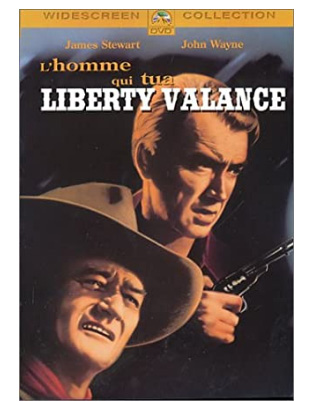
The Man Who Shot Liberty Valance
Synopsis
When Senator Ransom Stoddard and his wife Hallie return to the small Western town of Shinbone for the funeral of a seemingly forgotten rancher named Tom Doniphon, a local newspaper editor asks why such a distinguished man would attend. Stoddard answers by telling the story of his arrival years earlier as an idealistic young lawyer. He found a town terrorised by the outlaw Liberty Valance, and he dared to confront him with the law instead of a gun. The tale that follows reveals the truth behind the legend that made his career.
The Making of the Film
The Man Who Shot Liberty Valance is based on a short story by Dorothy M. Johnson, a writer famous for her tales of the American West. The screenplay was written by James Warner Bellah and Willis Goldbeck, who developed it into a reflection on the way myths are made. John Ford, the great director of Westerns such as Stagecoach and The Searchers, saw in it a chance to look back on the genre he had shaped. The film brings together two of Hollywood's biggest stars, James Stewart and John Wayne, who represent the new law and the old frontier. Lee Marvin was cast as the brutal outlaw, and his performance became one of the most memorable villains in the history of the genre. The film was shot in black and white, an unusual choice for a Western in the early 1960s, and mostly on studio sets. The sets gave the town of Shinbone a theatrical, confined atmosphere that suits the story's moral weight. It was released by Paramount Pictures in 1962 and has come to be seen as one of Ford's late masterpieces.
Critical Reception
At the time of its release, The Man Who Shot Liberty Valance received mixed reviews, with some critics finding it slow and stagey compared with Ford's earlier Westerns. Over the years, however, its reputation has grown considerably, and it is now regarded as one of the most important and thoughtful films in the genre. Critics today admire its mature reflection on myth, truth and civilisation, and the performances of Stewart, Wayne and Marvin. The black-and-white photography and the use of interior sets are now seen as deliberate choices that heighten the film's elegiac tone. Many consider it Ford's farewell to the Western as an art form.
The film was a moderate commercial success, and it has attracted generations of viewers on television and home video. It has been the subject of countless discussions among film lovers, who debate its meaning and its message. Its most famous line, about printing the legend when it becomes fact, has become part of the language of cinema. It is often cited as one of the greatest Westerns ever made, and one that speaks to the nature of storytelling itself.
The film's costume design earned an Academy Award nomination for Edith Head. It was later selected for preservation in the United States National Film Registry, which recognises films of cultural and historical importance. These honours reflect the film's lasting status as a landmark of American cinema.
Filming anecdotes
Unusually for a late Ford Western, the film was shot in black and white, with William H. Clothier's cinematography relying on shadows and enclosed spaces. The town of Shinbone was built on studio sets, which gave the production a stagey intimacy that suited the story's focus on dialogue and character. The film was a reunion of Ford with John Wayne, who had starred in many of his best-known films, and it paired him for the first time with James Stewart in a major role. The theme song by Burt Bacharach and Hal David, recorded by Gene Pitney, became a hit even though it does not appear in the film itself. Lee Marvin's menacing portrayal of Liberty Valance, with his whip and his sneer, helped establish him as one of the screen's great villains.
Themes explored
At its core, The Man Who Shot Liberty Valance is a film about the difference between truth and legend, and about the way societies choose which stories to remember. It explores the transition from the lawless frontier to the age of law and civilisation, a change the film presents with both admiration and nostalgia. The contrast between Stoddard, the lawyer who believes in books and courts, and Tom Doniphon, the gunfighter who solves problems with a revolver, embodies two different visions of justice. The story also deals with sacrifice, since Tom gives up his claim to the woman he loves and to the credit for his act of courage. Politics and media play an important role, as the newspaper editor decides what the public will read. The film asks whether a lie can be justified if it serves a greater good. Love and loss run through the story, particularly in Hallie's quiet sorrow. Beneath its Western trappings, the film is a meditation on how history is written.
Ending explained
In the final sequence, Stoddard reveals the truth to the newspaper editor: it was not he but Tom Doniphon who killed Liberty Valance, shooting from the shadows at the moment of the duel. Tom had acted to save Stoddard, knowing that the young lawyer represented the future of the territory. This secret allowed Stoddard to build a political career on the reputation of having shot Valance. After hearing the truth, the editor decides not to print it, saying that when the legend becomes fact, you print the legend. The scene shows the film's central idea in action, since the town prefers a comforting myth to an inconvenient reality. Stoddard and Hallie then leave on the train, with a feeling of regret for the man who made their life possible. The ending is bittersweet, as it honours the hero who was forgotten. It leaves us with the sense that civilisation is built on sacrifices that no one remembers.
Meaning of the title
The title The Man Who Shot Liberty Valance announces a mystery from its first words, since it implies that we will learn who the man was. It carries the tone of a frontier legend, the kind of story that is told in saloons and passed down through generations. The name Liberty Valance is itself loaded with irony, because the outlaw who bears the name of freedom is a man who terrorises others. The question of who shot him becomes the film's central puzzle, and its answer undermines the legend. By focusing on the act and not on the hero, the title also hints that the real identity of the shooter will matter. It is a title that prepares the audience for a story about the creation of myths. The simple, direct phrasing is typical of Ford's storytelling style. In that sense, the title is both a hook and a quiet warning that appearances can deceive.
Similar Films
If you enjoyed The Man Who Shot Liberty Valance, the obvious companion is The Searchers, John Ford's own masterpiece starring John Wayne. Stagecoach, which first made Wayne a star, offers a more classic and adventurous side of Ford's Westerns. Shane, with its mysterious gunfighter and its reflection on violence, shares much of the same spirit. High Noon tells another story of a lawman who stands alone for the principles of the town. Unforgiven, by Clint Eastwood, offers a darker and more critical look at the myths of the West. Once Upon a Time in the West, by Sergio Leone, is another elegy to the end of the frontier. My Darling Clementine, also by Ford, presents a different version of the legend of Wyatt Earp. Together these films form the core of the Western's reflections on history and myth.