

 Français
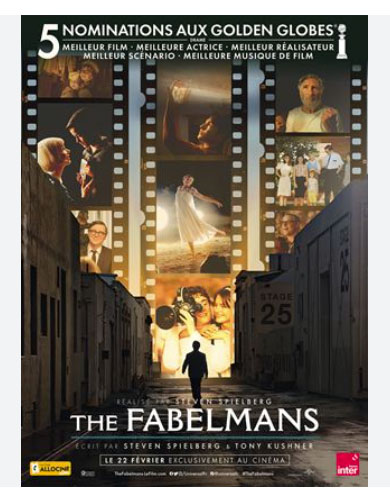
The Fabelmans
Synopsis
Growing up in post-World War II Arizona and California, young Sammy Fabelman falls hopelessly in love with the magic of cinema after his parents take him to see Cecil B. DeMille's *The Greatest Show on Earth*. Armed with his father's 8mm camera, Sammy begins making increasingly ambitious amateur movies with his younger sisters and neighborhood friends, discovering how the lens can capture truths that everyday life conceals. However, as Sammy grows into a sensitive teenager, his artistic passion becomes a heavy burden when he accidentally films a devastating family secret through his camera roll—revealing an unspoken affair between his mother Mitzi and his father's best friend Bennie. Navigating antisemitism, high school bullying, and his parents' painful impending divorce, Sammy learns that while filmmaking can heal the soul, it can also shatter illusions.
The Making of the Film
Directed by legendary filmmaker Steven Spielberg, this deeply personal coming-of-age drama was co-written by Spielberg and Pulitzer Prize-winning playwright Tony Kushner, serving as a semi-autobiographical cinematic memoir of the director's childhood. Spielberg had wanted to make this film for decades—fearing the emotional exposure of telling his parents' story—before finally committing to production with Kushner during the COVID-19 pandemic. The filmmakers meticulously recreated Spielberg's childhood homes, original 8mm camera setups, and early short films with astonishing physical precision. Principal photography took place in Los Angeles, utilizing detailed set builds and authentic mid-century wardrobe designs. The production captured the foundational traumas and inspirations that birthed one of cinema's greatest careers.
Critical Reception
Critics hailed the film as a masterclass in cinematic storytelling, praising its emotional vulnerability, exquisite craftsmanship, nostalgic warmth, and Gabriel LaBelle's stellar breakout lead performance as Sammy Fabelman. Reviewers highlighted how Spielberg balanced heartbreaking domestic drama with whimsical humor and a profound love letter to the power of the moving image. The supporting performances of Michelle Williams, Paul Dano, and Judd Hirsch received universal critical acclaim. Many commentators noted it as one of Spielberg's most emotionally naked and mature works.
Audiences and film buffs embraced the deeply personal biographical drama with immense reverence, driving strong critical word-of-mouth and sustained box office legs during awards season. Viewers were deeply moved by the tender, non-judgmental portrayal of parental imperfections and marital dissolution. Fan communities and cinephiles celebrated the brilliant meta-commentary on how framing a shot dictates emotional truth. The legendary final scene featuring director John Ford left audiences cheering.
At the Academy Awards, the film earned seven major nominations, including Best Picture, Best Director for Spielberg, Best Original Screenplay, Best Actress for Michelle Williams, and Best Supporting Actor for Judd Hirsch. It also won the prestigious People's Choice Award at the Toronto International Film Festival. Critics' circles worldwide named it one of the absolute best films of the year. It cemented Spielberg's legacy not just as a master entertainer, but as a deeply introspective cinematic artist.
Behind-the-Scenes Stories
Steven Spielberg admitted that writing and directing the film was an emotionally terrifying experience because it required him to confront the exact pain of his parents' divorce and his experiences with antisemitism on camera for the first time. He worked closely with cinematographer Janusz Kamiński to replicate the exact lighting and framing styles of 1950s and 60s home movies. Michelle Williams studied Mitzi Fabelman's real mannerisms and preserved family letters to capture her artistic, free-spirited essence.
Production faced unique emotional hurdles on set, as crew members often wept quietly during intimate family confrontation scenes, deeply moved by the raw personal honesty Spielberg poured into the direction. The art department meticulously rebuilt Spielberg's childhood desert home layout from memory blueprints. Prop masters tracked down vintage 8mm Bolex cameras and authentic editing splicing blocks. Sound designers blended warm orchestral string arrangements by John Williams with natural projector clatter.
During the filming of Sammy's harrowing high school screening of his desert camping movie, the young student actors broke into genuine, unscripted applause that mirrored the complex psychological terror felt by the character Paul Dano on screen. The costume department tailored exquisite mid-century dresses that tracked Mitzi's mental decline. Cameras utilized vintage lenses to soften image textures.
Casting Gabriel LaBelle as Sammy was a monumental discovery, as LaBelle captured Spielberg's physical mannerisms and sensitive artistic intensity flawlessly. Michelle Williams brought breathtaking, fragile theatricality to the mother Mitzi, while Paul Dano grounded the film with his quiet, loving portrayal of the father Burt. Judd Hirsch delivered an unforgettable, scene-stealing cameo as a seasoned uncle in the entertainment industry.
Themes Explored
The power of cinema as both a therapeutic escape and an emotional weapon that exposes uncomfortable truths forms the central thematic spine of the story. Parental imperfection, divorce, and forgiving adults for their human flaws are explored with profound empathy. Antisemitism, assimilation, and finding one's identity as an outsider in post-war American high schools shape Sammy's adolescent struggles. Additionally, artistic obsession versus familial duty defines the protagonist's coming-of-age.
Ending Explained
Following his parents' painful divorce and a depressing stint living in Hollywood where he endures severe antisemitic bullying in high school, Sammy manages to land a low-level entry job at a television studio. In a legendary climax, an intimidated young Sammy summons the courage to walk into a studio office and meet his ultimate idol, director John Ford. Ford imparts a brilliant, crusty piece of directorial wisdom regarding the horizon line in framing shots, inspiring a triumphant Sammy to stride confidently away into the studio backlot. The uplifting final shot of the camera tilting straight up symbolizes a bright cinematic future. The touching conclusion celebrates the birth of a master filmmaker.
Meaning of the Title
Refers directly to the fictionalized family surname (derived from Spielberg) at the heart of this autobiographical coming-of-age memoir.
Original Soundtrack
A sublime, delicate musical score composed by John Williams, featuring nostalgic piano and acoustic guitar arrangements that capture the bittersweet magic of childhood memories.
Similar Films
Cinema Paradiso, Belfast, Roma, Almost Famous, The Squid and the Whale.