

 Français
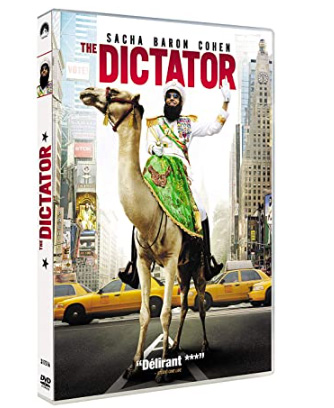
The Dictator
Synopsis
Admiral General Aladeen is the eccentric and ruthless ruler of the fictional Republic of Wadiya. When he travels to New York to address the United Nations, a political conspiracy removes him from power and replaces him with a lookalike. Stripped of his authority and unable to return home, Aladeen must survive in an unfamiliar world. With the help of a politically active shop owner, he discovers unexpected possibilities beyond dictatorship.
The Film's Origins
The Dictator was developed by Sacha Baron Cohen and his regular creative collaborators as a satirical comedy about authoritarian power. The central character was inspired by the exaggerated personalities and public images of several real-world dictators. Rather than adapting a particular historical figure or novel, the filmmakers created the fictional Republic of Wadiya. The screenplay uses absurd situations to explore the relationship between political authority, propaganda and international diplomacy. Larry Charles, who had previously directed Borat, reunited with Baron Cohen to develop the project's provocative comic style. The filmmakers wanted to move away from the mockumentary format and create a more conventional narrative comedy. The fictional country allowed them to criticise authoritarian regimes without limiting the story to a single historical or political context. The production combined elaborate costumes, exaggerated ceremonies and deliberately outrageous dialogue. The result was a political satire that uses absurd humour to expose the contradictions of absolute power.
Critical Reception
Professional reviews: Critics offered mixed assessments of the film, although Sacha Baron Cohen's performance attracted considerable attention. Some reviewers appreciated its willingness to challenge political conventions and use provocative humour. Others considered the jokes repetitive and the storyline less inventive than Borat. Larry Charles's direction was generally recognised for maintaining an energetic comic rhythm. The film's satirical approach was appreciated by some viewers but criticised by others for relying heavily on crude humour.
Audience reception: The film attracted considerable attention upon its international release and performed well commercially. Its provocative promotional campaign and Baron Cohen's public appearances generated widespread curiosity. Audiences were divided over its deliberately offensive jokes, but many appreciated its absurd political comedy. Its most memorable scenes and catchphrases helped it maintain a presence in popular comedy culture.
Awards: The film received recognition at the ASCAP Film and Television Music Awards, where composer Erran Baron Cohen won in the Top Box Office Films category in 2013. It also attracted nominations and recognition in various entertainment and comedy-related competitions. Its soundtrack received attention for combining original compositions with contemporary songs. Although it did not achieve major Academy Award recognition, its commercial visibility and distinctive satirical approach helped establish it as one of Sacha Baron Cohen's best-known projects.
Behind-the-Scenes Stories
Director's inspirations: Larry Charles and Sacha Baron Cohen drew inspiration from the public behaviour, rhetoric and extravagant lifestyles of authoritarian leaders. The character of Aladeen deliberately combines exaggerated traits associated with different dictators rather than representing one specific individual. The filmmakers also incorporated references to international diplomacy and the political image-making surrounding powerful rulers. Their objective was to expose the absurdity of absolute authority through comedy.
Production difficulties: The filmmakers had to create a convincing fictional dictatorship, including its national symbols, uniforms, ceremonies and political institutions. Filming in several international locations required careful coordination and substantial production design work. The production also faced the challenge of balancing political satire with a story that could appeal to a broad international audience. Baron Cohen's provocative humour required particular attention during promotional activities and public appearances. The finished film nevertheless maintained the deliberately exaggerated atmosphere that defined the project.
A memorable scene: One of the film's most recognisable moments occurs when Aladeen delivers a speech defending dictatorship while supposedly describing democracy. The scene uses deliberately contradictory statements to expose the hypocrisy of authoritarian political language. Another memorable sequence involves Aladeen attempting to adapt to ordinary life in New York. His inability to understand everyday social conventions creates much of the film's comedy. The contrast between his former power and his new circumstances is central to the character's development.
Original casting choices: Sacha Baron Cohen was always intended to play Admiral General Aladeen, as the project was designed around his comic persona. Anna Faris was cast as Zoey, the independent shop owner who challenges Aladeen's worldview. Ben Kingsley joined the production as Tamir, the ambitious political figure involved in the conspiracy. Several well-known performers also appear in supporting roles and cameo appearances. Their involvement helped the film combine political parody with mainstream comedy.
Themes Explored
The Dictator examines authoritarianism, propaganda and the abuse of political power through exaggerated comedy. Aladeen believes that authority gives him the right to control every aspect of public and private life. His experiences outside Wadiya gradually expose the absurdity of his worldview. The film also explores the relationship between democracy and political manipulation, questioning whether supposedly democratic systems are always free from hypocrisy. Personal freedom becomes an important theme as Aladeen encounters individuals who openly challenge authority. The contrast between wealth and poverty highlights the social consequences of corruption and inequality. The story also satirises celebrity culture, international diplomacy and the political use of national identity. Beneath its deliberately crude humour, the film asks whether individuals can change when they are confronted with a different social environment.
Ending Explained
Aladeen eventually discovers that the conspiracy against him was organised by Tamir, who intends to use the political transition to secure his own power. During the decisive public speech, Aladeen initially appears to defend democracy but gradually reveals his true understanding of political authority. He explains the advantages of dictatorship in a deliberately provocative comparison with democratic institutions. Rather than simply returning to his former behaviour, he introduces certain reforms while maintaining considerable control over the country. His relationship with Zoey has influenced his perspective, although it has not completely transformed his personality. The ending deliberately avoids presenting him as a conventional hero who has abandoned authoritarianism. Instead, it suggests that political systems can remain deeply flawed even when their leaders adopt more acceptable language. Aladeen's final position is therefore both comic and unsettling. The film leaves viewers questioning how much genuine change has taken place in Wadiya.
Meaning of the Title
The title The Dictator directly identifies the central character and the political system he represents. It refers to Admiral General Aladeen, whose absolute authority allows him to control the fictional Republic of Wadiya. The deliberately simple title contrasts with the film's elaborate political satire. It also signals that the story is concerned with the personality cult and institutional absurdities surrounding authoritarian leadership. The word dictator carries associations of domination, repression and political excess, all of which are exaggerated for comic effect. The title therefore establishes the central target of the film's humour before the story even begins.
Erran Baron Cohen composed the original score, combining orchestral passages with contemporary musical influences and deliberately humorous compositions. The soundtrack also includes several songs that reinforce the film's fictional national identity and comic atmosphere. Its musical approach supports the contrast between Aladeen's extravagant public image and the absurdity of his personal behaviour. The soundtrack received recognition at the 2013 ASCAP Film and Television Music Awards in the Top Box Office Films category.
Fans of The Dictator may enjoy Borat, another provocative political comedy starring Sacha Baron Cohen. Brüno combines social satire with deliberately uncomfortable humour. The Interview explores political absurdity through the story of an eccentric authoritarian leader. Wag the Dog offers a more politically focused comedy about propaganda and the manipulation of public opinion.