

 Français
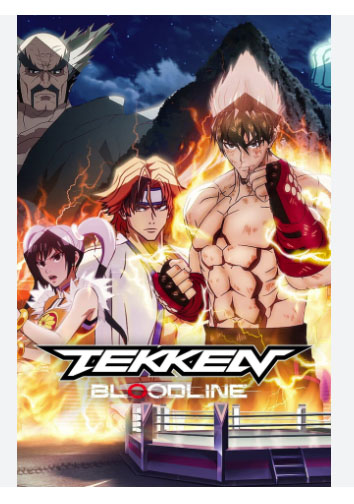
Tekken: Bloodline
Synopsis
Trained in the Kazama style of traditional martial arts by his devoted mother Jun in a secluded forest home, young Jin Kazama leads a peaceful life until tragedy strikes. When the monstrous ancient beast known as Ogre suddenly attacks their home and kills his mother, Jin is consumed by grief and fiery vengeance. Seeking answers and power, he tracks down his ruthless, wealthy grandfather Heihachi Mishima, who agrees to train Jin in the brutal Mishima fighting style. Entering the high-stakes King of Iron Fist Tournament, Jin faces deadly international fighters while battling the dark devil gene inherited from his missing father, Kazuya.
The Making of the Film
Directed by Yoshikazu Miyao, this animated martial arts series was produced by Netflix in collaboration with Bandai Namco Entertainment to adapt the lore of the iconic fighting game franchise. The filmmakers wanted to honor the rich, multi-generational soap-opera tragedy of the Mishima family bloodline while faithfully recreating signature character moves, outfits, and iconic arena stages from Tekken 3. The production utilized a sleek 3D-cel-shaded animation style that bridged the gap between classic anime aesthetics and modern video game rendering. The creative team worked closely with game developers to ensure fighting stances and special techniques satisfied longtime fans.
Critical Reception
Critics praised the series for its faithful adaptation of video game lore, fast-paced martial arts action choreography, and nostalgic nods to Tekken 3. Reviewers highlighted how the six-episode arc effectively streamlined a notoriously complex gaming mythology into an accessible, high-octane coming-of-age revenge story. The character designs and kinetic tournament fight scenes received widespread acclaim from anime critics. Many commentators noted that it was one of the strongest video game adaptations on streaming platforms.
Audiences embraced the anime enthusiastically upon its Netflix release, driving high viewing figures and sparking nostalgic discussions across gaming forums. Fans of the fighting game franchise particularly appreciated seeing deep-cut characters like King, Paul Phoenix, Hwoarang, and Nina Williams rendered with love and accuracy. Viewers praised the emotional stakes of Jin's tragic lineage and the brutal training sequences. Social media channels buzzed with praise for the faithful tournament bracket structure.
While streaming anime series rarely compete in traditional cinematic award ceremonies, the show earned strong praise within animation and gaming community award polls. Industry analysts highlighted its success as further proof of Netflix's growing mastery over video game intellectual property adaptations. Critics' circles commended its crisp pacing and respect for source material. It cemented itself as a beloved entry in gaming animation history.
Behind-the-Scenes Stories
Director Yoshikazu Miyao was a lifelong fan of the Tekken franchise, approaching the project with a strict mandate to respect game character movesets down to the exact frame timing. He collaborated directly with Bandai Namco supervisors to reference character motion-capture data from the games during intense tournament choreography sessions. Voice actors recorded their combat grunts and battle cries with extreme physical intensity to match the punishing blows on screen.
Production faced unique scheduling hurdles rendering large-scale tournament arena crowds alongside complex multi-character martial arts clashes simultaneously. The animation studios utilized advanced cel-shading software to ensure characters retained their iconic polygons-and-textures look while moving fluidly in 3D environments. Sound design engineers painstakingly sampled authentic arcade impact sounds from the games to punctuate every punch and kick.
During the recording of a grueling training montage where Jin is tested by Heihachi, voice actor Kaiji Tang performed physical pushups in the recording booth to authentically capture breathless vocal fatigue. The art department designed retro-inspired arcade menu transitions between episodes as a direct nod to players. Character modelers iterated dozens of times on Jin's iconic flame trousers.
Casting a talented voice ensemble brought passionate energy to the legendary fighters, with Kaiji Tang delivering fierce determination as Jin Kazama. Bridget Hoffman lent maternal warmth to Jun Kazama, while Jamieson Price brought thunderous authority to Heihachi Mishima. Supporting voice actors captured the distinct international personalities of the tournament roster.
Themes Explored
Vengeance, generational trauma, and the corrupting nature of toxic family bloodlines form the central philosophical core of the Mishima dynasty curse. Martial arts discipline, self-discovery, and overcoming inner demons are explored through Jin's rigorous tournament trials. Grief and the psychological scars of losing a parent drive the protagonist's initial quest for power. Additionally, destiny versus free will is tested as Jin fights to suppress his dormant devil gene.
Ending Explained
Following a brutal tournament bracket that culminates in an explosive final clash against the ancient monster Ogre, Jin unlocks his dormant devil powers to defeat the beast once and for all, avenging his mother. However, immediately after his victory, his treacherous grandfather Heihachi betrays him, shooting Jin in cold blood to test the limits of the devil gene. Jin's inner darkness awakens, allowing him to shatter the arena roof and easily defeat Heihachi before sparing his life and flying away into the night. The ominous final shots set the stage for eternal conflict within the corrupted Mishima bloodline.
Meaning of the Title
Refers to both the famous video game franchise and the central plot point focusing on the cursed martial arts lineage of the Mishima and Kazama families.
Similar Films
Castlevania, Arcane, DOTA: Dragon's Blood, Street Fighter II: The Animated Movie, Mortal Kombat Legends.