

 Français
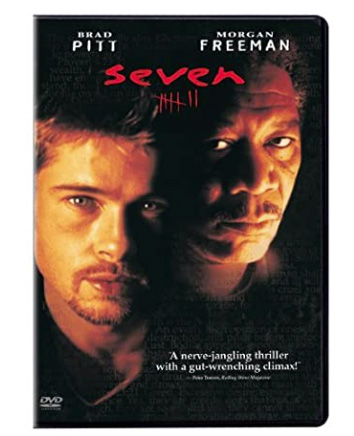
Se7en
Synopsis
Just days before his retirement, veteran detective William Somerset is paired with the young and impulsive David Mills in a rain-soaked, nameless city. Together they investigate a series of gruesome murders, each inspired by one of the seven deadly sins. The killer, who calls himself John Doe, plans every crime with chilling precision and leaves cryptic clues behind. As the two detectives close in, they realise that he is always one step ahead, and that the final act is still to come.
The Making of the Film
The film was born from the screenplay by Andrew Kevin Walker, who wrote it after working in a record store in New York City and feeling the oppressive weight of the city. His sense of urban despair gave the script its dark, nihilistic tone. Walker drew inspiration from the seven deadly sins of Christian tradition, as well as from literary works such as Dante's Divine Comedy and Milton's Paradise Lost. The script circulated in Hollywood for years and was admired for its originality and audacity. New Line Cinema finally took it on, and David Fincher, who had just come off a difficult experience on Alien 3, was hired to direct. Fincher was drawn to the dark atmosphere and the chance to make a thriller with real moral depth. He insisted on keeping the original, bleak ending, which was exactly what had attracted him to the project in the first place. The result is a thriller that has become a model for the genre.
Reviews and reception
Professional critics' summary
Critics were largely enthusiastic, praising the film's dark atmosphere, tight script and strong performances. They admired Fincher's stylish direction, especially the gloomy visual design and the sense of dread. Morgan Freeman and Brad Pitt were hailed for their contrasting chemistry as partners. Some reviewers found the violence disturbing, but most agreed that the film justified its darkness.
Audience reception
The film was a major box-office hit, earning more than 320 million dollars worldwide. Audiences were stunned by its shocking ending, which has become one of the most discussed in modern cinema. Over the years, it has gained a cult following and is regularly listed among the best thrillers of all time. The line about what might be in the box is still quoted by fans.
Awards
The film received an Academy Award nomination for Best Film Editing. It also won the MTV Movie Award for Best Movie and several other popular prizes. Its opening credits sequence, designed by Kyle Cooper, was widely praised and influenced a whole generation of title design. The film remains a reference point for dark crime cinema.
Filming anecdotes
Director's inspirations
Fincher wanted the film to have a visual style that matched its grim themes, drawing on photography and film noir. He asked cinematographer Darius Khondji to use a special bleach-bypass process, which gives the picture a desaturated and grainy look. The rain and perpetual darkness were meant to represent a city sunk in moral decay. Fincher was also inspired by the detective stories of the 1970s, in which the heroes faced overwhelming corruption.
Production difficulties
The studio was uneasy about the downbeat ending and pressed Fincher to change it, but he refused. Brad Pitt also supported keeping the original conclusion and reportedly threatened to leave if it was altered. Filming in Los Angeles took place in cold and damp conditions, with artificial rain often added to the scenes. Pitt injured his arm during a chase sequence, which led to the character wearing a cast in several scenes.
Anecdote about a particular scene
The final desert scene was shot in the Californian desert and was designed to contrast with the dark city setting of the rest of the film. The film conceals the identity of Kevin Spacey, who plays John Doe, by leaving him out of the opening credits. He appears only in the second half of the film, which makes his entrance all the more striking. The famous final line, from Somerset, quotes Ernest Hemingway.
Originally planned casting
Brad Pitt was cast as Mills, while Morgan Freeman took the role of Somerset, bringing calm authority to the role. Denzel Washington was reportedly offered the part of Mills, but he turned it down. Gwyneth Paltrow played Tracy, Mills's wife, and Kevin Spacey agreed to play John Doe without being credited.
Themes explored
The central theme is the presence of evil in a morally decaying society. The film asks whether people are inherently sinful, and whether anyone can truly escape corruption. It explores the contrast between experience and youthful idealism, represented by the two detectives. Another key theme is the idea of justice, as the murderer sees himself as a divine instrument. Faith and nihilism are in constant conflict, as Somerset struggles to find reasons to continue fighting. The story also reflects on the consequences of apathy, since the killer claims that society tolerates sin every day. It also examines the cost of violence and vengeance. In the end, the film suggests that evil can triumph if good people give in to anger.
Ending explained
After the first five murders, John Doe surrenders to the police, covered in the blood of his latest victim. He offers to lead the detectives to the final two victims, in exchange for his confession. In a deserted area under power lines, a van arrives with a package addressed to Mills. Doe reveals that he has envied Mills's life and that the box contains the head of Tracy, who was pregnant. Mills, devastated, is driven by rage and shoots Doe, fulfilling the sin of wrath. This completes Doe's plan, with himself as envy, Tracy as the victim of envy and Mills as wrath. Somerset arrives and stays by Mills's side as he is arrested. He closes the film by quoting Hemingway, saying that the world is a fine place and worth fighting for, and that he agrees with the second part.
Meaning of the title
The title Se7en uses the number seven in place of the letter V, directly referring to the seven deadly sins that structure the plot. The stylised spelling creates a visual identity that is both modern and menacing. It signals that the film is about a series of crimes that follow a strict and numerical pattern. The number seven also has a long symbolic history in religion and mythology, from the days of creation to the pillars of wisdom. In this context, it becomes a number of doom, as every victim corresponds to a sin. The title also reflects the film's countdown structure, which runs over seven days. It is a simple and effective title that has become part of popular culture.
Original Soundtrack
Howard Shore composed the score, creating an unsettling atmosphere of dread. The opening credits feature a remix of the Nine Inch Nails song Closer, which fits perfectly with the film's disturbing visuals. The sound design, with its use of rain, sirens and distant screams, is also essential to the film's mood.
Similar Films
The Silence of the Lambs is the classic psychological thriller with a brilliant killer. Zodiac, also directed by David Fincher, follows a real-life serial killer investigation. Memories of Murder and Prisoners offer chilling stories of police obsession. The Girl with the Dragon Tattoo and Gone Girl are other dark Fincher films.