

 Français
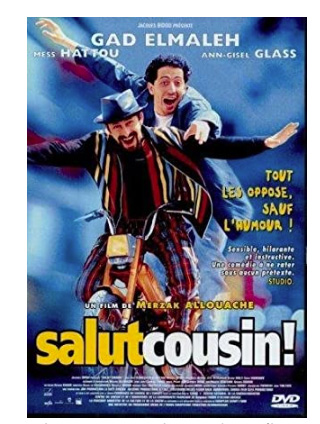
Salut Cousin!
Synopsis
Alilo arrives in Paris from Algiers with the intention of collecting a suitcase for a small trafficking operation. His cousin Mok, a Parisian of Algerian descent, welcomes him and promises to help him complete the mission. Unfortunately, Alilo loses the address of the person he is supposed to meet, forcing the two cousins to search the city for several days. Their adventure introduces Alilo to the difficulties of life in Paris and allows Mok to confront his own complicated relationship with his origins. Through their contrasting personalities, the film offers a humorous and sometimes critical portrait of immigration, identity and everyday survival.
The Film's Origins
Salut Cousin! was directed by Algerian filmmaker Merzak Allouache, who had already established an important reputation through films exploring contemporary Algerian society. The director was interested in examining the relationship between Algerians living in their homeland and those who had settled in France. The idea developed around the encounter between two cousins whose different experiences reveal contrasting perspectives on identity and belonging. The screenplay was written by Allouache in collaboration with Caroline Thivel. Rather than adapting a novel or a documented true story, the film was conceived as an original social comedy. Its setting in the Belleville district of Paris allowed the director to explore the daily lives of immigrant communities and their descendants. The character of Alilo represents someone discovering a new world with curiosity, while Mok embodies the contradictions of a younger generation trying to survive in the French capital. The film combines humor with observations about economic difficulties, cultural differences and social expectations. Its selection for the 1996 Directors' Fortnight at Cannes helped bring attention to the project. The result is a comedy that uses a simple search for a lost suitcase to examine a much broader social reality.
Critical Reception
Salut Cousin! received a generally appreciative but somewhat divided critical reception. Some reviewers praised Merzak Allouache for offering an original perspective on the experiences of Algerians on both sides of the Mediterranean. The film was appreciated for avoiding simplistic stereotypes and presenting its characters as ordinary individuals with complicated lives. Gad Elmaleh received particular attention for his natural screen presence and comic energy. Other critics considered the screenplay uneven and felt that the direction occasionally lacked cinematic dynamism. Nevertheless, its social observations and performances were widely recognized.
The film attracted attention among audiences interested in French-Algerian cinema and social comedy. Its humorous portrayal of the relationship between Alilo and Mok made the story accessible beyond its cultural setting. Viewers also appreciated its depiction of Paris as a city of opportunity and hardship. The film helped introduce Gad Elmaleh to a wider cinema audience before his later success as a comedian and actor. Its reputation has remained particularly relevant within discussions of North African and immigrant representation in French cinema.
Salut Cousin! received the Arab Critics Award at the 1996 Directors' Fortnight. It also received audience and jury distinctions at the Cinestival in Marseille and recognition at comedy festivals in Switzerland. These awards highlighted the film's ability to combine humor with social observation. Its selection at Cannes was an important milestone for Merzak Allouache. The film also contributed to the growing visibility of Gad Elmaleh as a performer.
Behind-the-Scenes Stories
Merzak Allouache drew inspiration from his interest in the relationship between Algerian society and the Algerian diaspora in France. He wanted to examine how people adapt to different cultural environments while maintaining connections with their origins. The contrast between Alilo and Mok allowed him to explore these questions through humor rather than conventional social drama. The director also used the streets of Paris as a living environment rather than simply as a picturesque backdrop.
The production required filming in several parts of Paris, particularly in areas associated with North African communities. The filmmakers needed to capture the everyday atmosphere of the city while coordinating the movement of the two main characters through numerous locations. The story also required a balance between comic situations and more serious observations about immigration and economic survival. Its relatively modest production approach contributed to the film's naturalistic atmosphere.
The search for the missing suitcase provides the narrative with its central comic mechanism. What begins as a simple practical problem gradually becomes an extended journey through Paris and its different social environments. The lost address forces Alilo to depend on his cousin and exposes him to situations he would never have experienced during a short visit. This device allows the film to explore the city through the eyes of someone discovering it for the first time.
Gad Elmaleh was cast as Alilo, while Mess Hattou played his cousin Mok. Magaly Berdy and Ann-Gisel Glass also appear in important supporting roles, alongside Jean Benguigui. The casting helped create a mixture of established performers and emerging talent. Gad Elmaleh's performance is particularly notable because it preceded his major success in French comedy. His natural comic timing became one of the film's most memorable qualities.
Themes Explored
Salut Cousin! explores immigration, cultural identity and the difficulties of adapting to a new society. Alilo and Mok represent two different experiences of belonging, one shaped by recent arrival and the other by growing up between cultures. Their relationship reveals the misunderstandings that can emerge even within the same family. The film examines economic survival and the informal activities people undertake when conventional opportunities are limited. It also challenges stereotypes about Algerian families and immigrant communities. Paris is presented as a city offering freedom and possibility while also creating loneliness and uncertainty. The contrast between the cousins highlights the complicated relationship between personal origins and social identity. Humor becomes a way of discussing serious issues without reducing the characters to symbols. The film also examines family solidarity and the importance of maintaining relationships despite differences. Ultimately, it presents cultural identity as something shaped by experience rather than by a simple distinction between countries.
Ending Explained
The conclusion of Salut Cousin! brings the extended search for the missing suitcase to its resolution. During their days together, Alilo and Mok have experienced numerous misunderstandings and discovered aspects of each other's lives. Alilo has gradually understood that Paris is not simply a place of wealth and opportunity, while Mok has been confronted with the difficulties and contradictions of his own existence. Their relationship becomes more meaningful through the shared adventure. The search for the suitcase serves as a pretext for exploring their different identities and circumstances. The film does not offer a simplistic solution to the social problems facing its characters. Instead, it emphasizes the complexity of everyday life on both sides of the Mediterranean. Their experiences reveal that neither country offers an ideal or uncomplicated existence. The ending leaves the audience reflecting on belonging, family and the search for a better future. The film's humor softens its social criticism without eliminating its seriousness. Ultimately, the journey matters more than the object that originally brought the cousins together.
Meaning of the Title
The title Salut Cousin! is a familiar and affectionate greeting that immediately establishes the family relationship at the center of the story. Its informal tone reflects the film's humorous and accessible style. The word cousin also symbolizes the connection between two generations and two different cultural experiences. The greeting suggests familiarity and solidarity, but the story gradually reveals the misunderstandings and differences that can exist even within a family. The title therefore captures both the warmth of the relationship and the cultural encounter that drives the narrative.
Films with similar themes include La Haine, Chouchou, Bye Bye, L'Esquive, The Visitor, Monsieur Ibrahim, Samba and Welcome. These films explore immigration, cultural identity, social integration, family relationships and the everyday experiences of people living between different cultures.