

 Français
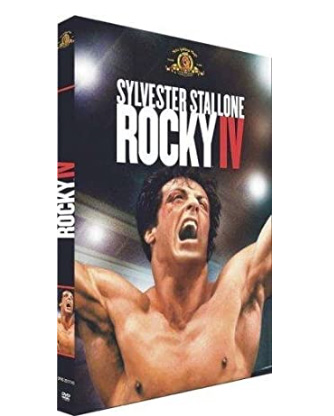
Rocky IV
Synopsis
Rocky Balboa is enjoying his life as heavyweight champion when his friend Apollo Creed announces his intention to return to the ring. Apollo wants to challenge Ivan Drago, an enormous Soviet boxer whose extraordinary physical power has attracted international attention. Their exhibition match ends in tragedy when Drago fatally injures Apollo. Devastated by the loss of his friend, Rocky decides to confront Drago in the Soviet Union. Preparing in the harsh Russian winter, he must rebuild his physical strength and emotional determination. The final fight becomes a symbolic confrontation involving friendship, revenge and the political tensions of the Cold War.
The Film's Origins
Rocky IV was conceived by Sylvester Stallone as a sports drama set against the political atmosphere of the Cold War. During the 1980s, tensions between the United States and the Soviet Union provided a powerful cultural backdrop for stories involving national identity and international competition. Stallone wanted to transform the boxing ring into a symbolic arena where two opposing political systems would confront one another. The screenplay introduces Ivan Drago, a Soviet fighter presented as the product of an extremely scientific and controlled training program. Rocky represents a more traditional approach based on personal discipline, determination and emotional commitment. The story also continues the friendship between Rocky and Apollo Creed, whose death becomes the emotional catalyst for the entire narrative. Unlike the first film, the fourth installment places considerably more emphasis on spectacular training sequences and political symbolism. The project was written and directed by Stallone and was not adapted from a historical boxing event. Its combination of action, music and patriotic themes helped make it one of the most recognizable films of the franchise.
Critical Reception
Rocky IV received mixed reviews from professional critics. Some praised its energetic direction, spectacular boxing sequences and memorable musical moments. Dolph Lundgren was particularly effective as Ivan Drago, creating an imposing antagonist with relatively little dialogue. Other critics considered the screenplay simplistic and criticized its highly exaggerated political symbolism. The film was also seen as a departure from the intimate character-driven storytelling of the original.
Audiences responded extremely positively, making Rocky IV one of the most commercially successful installments in the franchise. It earned approximately 300 million dollars worldwide and became an important international hit. Its combination of boxing, Cold War imagery and memorable music appealed to a broad audience. The film also introduced a new generation of viewers to the Rocky series. Several of its scenes and musical sequences remain deeply embedded in popular culture.
Rocky IV received limited recognition from major film-award organizations. However, its soundtrack achieved considerable success, particularly through the songs associated with the training sequences. Hearts on Fire and Burning Heart became popular tracks in their own right. The film's commercial success and enduring popularity have made it one of the most recognizable sports films of the 1980s.
Behind-the-Scenes Stories
Sylvester Stallone was inspired by the political climate of the 1980s and the symbolic rivalry between the United States and the Soviet Union. He wanted to create an antagonist who represented a radically different approach to professional boxing. Ivan Drago was conceived as an almost scientific fighting machine, contrasting with Rocky's emotionally driven preparation. The film also explores the consequences of violence through Apollo Creed's tragic fate.
The production required considerable physical preparation from the actors. Stallone and Dolph Lundgren trained intensively to make their boxing performances convincing. Their confrontations involved carefully planned choreography and demanding physical sequences. Filming also took place in several locations, including Canada and Wyoming, where the production recreated the snowy Soviet environment. The filmmakers used contrasting visual styles to distinguish the American and Soviet training methods.
The fight between Rocky and Ivan Drago became one of the franchise's most famous sequences. The production emphasized the contrast between Drago's sophisticated training equipment and Rocky's traditional outdoor exercises. Stallone wanted the audience to feel that Rocky was preparing through physical endurance rather than technology. The final fight also included some unusually intense physical exchanges. During filming, Stallone asked Lundgren to deliver a particularly powerful blow, which reportedly resulted in Stallone being hospitalized for several days.
Dolph Lundgren was selected for the role of Ivan Drago because of his impressive physical presence and athletic background. Brigitte Nielsen was cast as Ludmilla Drago, while Carl Weathers returned as Apollo Creed. The film also features an appearance by James Brown, who performs Living in America during Apollo's entrance. This musical sequence became one of the most memorable moments of the film. The casting helped give the story an international and spectacular dimension.
Themes Explored
Rocky IV explores friendship, grief and the destructive consequences of violence. Apollo Creed's death transforms Rocky's personal motivations and forces him to confront the emotional cost of his sporting career. Revenge initially becomes the driving force behind his decision to fight Ivan Drago. The film also examines the contrast between individual determination and technological control. Drago represents a system that values measurable performance and physical superiority, while Rocky relies on emotional commitment and personal sacrifice. The Cold War provides a political framework for the conflict, turning a sporting contest into a symbolic confrontation between nations. The importance of friendship is reinforced through Rocky's memories of Apollo and his relationship with his family. The film also questions the meaning of victory when competition becomes associated with hatred and political hostility. Its final speech suggests that human understanding can overcome divisions created by ideology. Ultimately, Rocky IV presents sport as a possible instrument of reconciliation as well as conflict.
Ending Explained
The final fight between Rocky and Ivan Drago becomes a confrontation that extends beyond personal rivalry. Rocky initially struggles against Drago's physical superiority, but gradually manages to change the direction of the fight. The Soviet audience begins to support Rocky as he demonstrates courage and endurance. Drago's relationship with his political representatives also deteriorates as he refuses to accept their interference. Rocky eventually defeats him after an exhausting battle. However, the most important moment comes after the fight, when Rocky delivers a speech about the possibility of changing attitudes between nations. His words suggest that people can move beyond political hostility through mutual respect. The Soviet spectators respond positively, creating an unexpected moment of unity. Rocky has avenged Apollo, but the ending emphasizes reconciliation rather than revenge. The final victory is therefore both sporting and symbolic. The film concludes with the idea that individual courage can challenge collective prejudice.
Meaning of the Title
The title Rocky IV identifies the fourth chapter in the life of Rocky Balboa. Its simplicity emphasizes the continuity of the character across the franchise. This installment is distinguished by its international political setting and the confrontation with Ivan Drago. The Roman numeral also gives the film a clear place within the series. Rather than introducing a completely new protagonist, the story continues to explore how Rocky responds to increasingly difficult personal and sporting challenges. The title reinforces the idea that each film represents another stage in his evolution.
Original Soundtrack
Rocky IV has one of the most famous soundtracks of the entire franchise. The music combines Bill Conti's orchestral contributions with several major songs from the 1980s. Burning Heart by Survivor became the principal musical theme and accompanies the emotional intensity of the story. Hearts on Fire by John Cafferty is particularly associated with Rocky's training in the snowy landscape. No Easy Way Out by Robert Tepper accompanies a memorable sequence in which Rocky reflects on his past while driving. James Brown's Living in America provides an energetic musical introduction for Apollo Creed. The soundtrack also includes contributions from Vince DiCola, whose electronic compositions give the film a distinctive 1980s atmosphere. Its mixture of rock, electronic music and orchestral themes remains one of the film's defining features.
Films with similar themes include Rocky III, Rocky Balboa, Creed, Red Dawn, The Running Man, Over the Top, Warrior and Bloodsport. These films explore international rivalry, physical endurance, sporting ambition and the confrontation between personal determination and powerful opponents.