

 Français
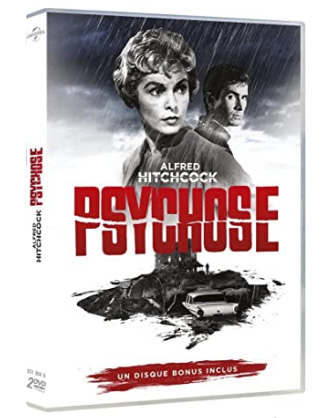
Psycho
Synopsis
Marion Crane is a stressed Phoenix secretary who impulsively embezzles forty thousand dollars from her employer real estate firm to start a new life with her boyfriend. Driving through a torrential rainstorm across the California countryside, she loses her way and pulls off the highway to seek shelter at the secluded, run-down Bates Motel, managed by a polite, socially awkward young man named Norman Bates who lives with his domineering mother in an eerie Victorian mansion overlooking the property. After enjoying a quiet sandwich conversation with Norman, Marion checks into cabin number one and steps into the bathroom shower. In one of the most famous and shocking scenes in film history, a shadowy figure tears open the shower curtain and slashes Marion to death. As private investigators and Marions sister search for her disappearance, the horrifying truth behind Norman Bates and his mother is unmasked.
The Making of the Film
Director and producer Alfred Hitchcock purchased the screen rights to Robert Bloch bestselling 1959 thriller novel anonymously for a nominal sum. Hitchcock financed the low-budget horror production independently through Paramount television crew members to prove that a shocking thriller could be made outside studio censorship boards. The production revolutionized the horror genre forever.
Critical Reception
Critics initially greeted Psycho with mixed reviews and intense controversy upon its release due to its unprecedented depictions of violence, sexuality, and plumbing on screen, but time quickly transformed it into an undisputed masterpiece of cinema. Reviewers lauded Alfred Hitchcock visionary direction, Bernard Herrmann screaming string score, and Anthony Perkins chilling lead performance. It is universally celebrated as the birth of the modern horror film.
Public reception was explosive and unprecedented, turning the low-budget thriller into a massive global box-office blockbuster. Hitchcock famously enforced a strict no-late-admissions policy in theaters that became legendary. Its cultural footprint is monumental.
The film earned four Academy Award nominations, including Best Director for Alfred Hitchcock, Best Supporting Actress for Janet Leigh, and Best Cinematography. Its critical legacy stands as an untouchable milestone in cinema history.
Behind-the-Scenes Stories
Director Alfred Hitchcock drew inspiration from Ed Gein real-life Wisconsin serial killer crimes, pulp thriller novels, and German expressionism. He chose a modest, monochromatic soundstage in Universal Studios to construct the Bates Motel and Victorian mansion. His direction pushed Janet Leigh through seven grueling days of shooting inside the shower set with fifty distinct camera angles and rapid edits.
Production faced heavy censorship battles with the MPAA over nudity, violence, and the infamous flushing toilet scene, but Hitchcock cleverly outsmarted censors by yielding on minor points to keep the shower murder untouched. Anthony Perkins brought twitchy, sympathetic menace to Norman Bates. Bernard Herrmann composed the iconic screeching violin score that Hitchcock initially doubted until hearing it applied to the shower scene.
A memorable sequence features Marion Crane taking a shower in cabin number one while a shadowy figure enters the bathroom, rips back the shower curtain, and stabs her repeatedly to a screeching violin assault. The scene is universally ranked as the most famous sequence in horror film history. The editing terrified audiences worldwide.
The casting process went smoothly as Janet Leigh was eager to work with Hitchcock, bringing immediate star sympathy to Marion Crane before her shocking early exit. Anthony Perkins was cast as Norman Bates, creating an immortal cinematic icon of psychological horror.
Themes Explored
The film explores repressed psychosis, maternal domination, voyeurism, split personality, and the hidden darkness beneath mundane American life. It highlights how madness lurks behind polite facades. Guilt haunts human consciousness.
Explication de la Fin
The film concluding sequence features a psychiatrist explaining Norman Bates psychological condition in clinical terms, revealing that Norman suffered from a severe split personality disorder after murdering his mother and her lover out of jealousy ten years prior. To cope with unbearable guilt, Norman preserved his mother corpse, dressed in her clothes, and assumed her persona entirely whenever homicidal jealousy or sexual attraction toward female guests arose. The final chilling shot shows Normans face superimposed with his mother skull while her inner voice declares she would not even hurt a fly, proving that the mother personality has completely overtaken Norman mind, leaving him permanently trapped inside his own locked dungeon of madness.
Meaning of the Title
The title refers directly to the psychological state of a psychopath, specifically targeting Norman Bates severe mental illness and split personality disorder. It highlights the psychological horror driving the narrative.
Original Soundtrack
The original motion picture soundtrack features the legendary, terrifying screeching violin score composed exclusively with string instruments by Bernard Herrmann, which became the most famous horror musical motif in cinema history.
NULL
Similar Films
Other similar films include The Silence of the Lambs, Don't Look Now, and Repulsion.