

 Français
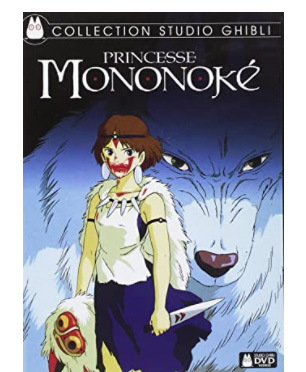
Princess Mononoke
Synopsis
Prince Ashitaka is cursed after killing a demon boar and sets out westward to find a cure. He ends up in the middle of a war between the forest gods and the people of Irontown, led by the formidable Lady Eboshi. There he meets San, a girl raised by wolves who fights to protect the forest. As both sides push toward destruction, Ashitaka tries to find a path to peace.
The Making of the Film
Hayao Miyazaki first sketched the idea for Princess Mononoke in the early 1980s, long before the film was made. The story draws on Japanese folklore, the ancient forests of Yakushima and Shirakami-Sanchi, and Miyazaki's lifelong preoccupation with the relationship between humans and nature. After the success of his earlier films at Studio Ghibli, he finally brought the project to life in the mid-1990s as an epic and more mature work than anything he had made before. The film is set in the Muromachi period, a time of social upheaval when the first iron-working communities began to threaten the wild. Miyazaki wanted to avoid a simple battle between good and evil, painting every character as someone with a valid reason to fight.
Reviews and Reception
Summary of Professional Reviews
The film was widely praised for its sweeping animation, mythic ambition and moral complexity. Critics highlighted its gorgeous hand-drawn backgrounds and Joe Hisaishi's soaring score. Some noted that its violence and heavy themes made it darker than typical animated films, which only strengthened its reputation as a landmark of the medium.
Audience Reception
In Japan, it became a phenomenon and broke box-office records for a domestic film at the time of its release. Abroad, it helped introduce a new generation of viewers to Studio Ghibli, particularly after its English-language release in the late 1990s. It remains a fan favorite for its depth and visual beauty.
Awards Won
The film won the Japan Academy Prize for Picture of the Year, an unusual honor for an animated film. It also received numerous other awards and honors in Japan, cementing its status as a national treasure.
Filming Anecdotes
Director's Inspirations
Miyazaki drew on Japanese folk tales and his admiration for the ancient forests of his country. He wanted to portray nature as powerful, mysterious and indifferent to human wishes, rather than as a gentle backdrop.
Production Difficulties
The production was famously exhausting. Miyazaki personally checked and redrew an enormous number of frames, and the animation team used a combination of traditional methods and some early digital techniques. The film took roughly three years to complete, and Miyazaki said afterward that he was ready to retire, though he later changed his mind.
Anecdote About a Particular Scene
The forest spirit, a sacred stag that turns into a towering night-walking figure, is one of the film's most striking creations. Its eerie, luminous design and the unforgettable tiny tree spirits, the kodama, quickly became iconic images of Japanese animation.
Themes Explored
Princess Mononoke is a profound exploration of the conflict between human progress and the natural world. It refuses to demonize either side: Irontown provides jobs and shelter to outcasts, while the forest protects a fragile ecological balance. The film also deals with hatred, curses and the cycle of violence that consumes everyone involved. Ashitaka stands for the possibility of understanding and coexistence in the middle of fury. Beneath it all runs a message about respect for life in all its forms and the cost of ignoring the consequences of our actions.
Ending Explained
After the forest spirit is beheaded, a deadly wave of decay sweeps across the land until Ashitaka and San return its head. The spirit dies, but nature is reborn in a gentle burst of green, and the curse on Ashitaka is lifted. San cannot forgive humanity and chooses to remain in the forest, while Ashitaka decides to live in Irontown, promising to visit her. The ending is intentionally bittersweet, suggesting that peace between people and nature is possible but never complete.
Meaning of the Title
The Japanese word mononoke refers to a vengeful spirit or monstrous being from folklore, so the title translates roughly as "Princess of the Spirits" or "Princess of the Vengeful Spirits". It refers to San, a human girl raised by wolf gods who is seen as more beast than person. The title captures the story's central tension: a girl caught between two worlds and belonging fully to neither.
Original Soundtrack
Joe Hisaishi's score is one of the highlights of his long collaboration with Miyazaki. Its sweeping orchestral themes and haunting vocal main theme perfectly capture the epic, spiritual atmosphere of the film. Many listeners consider it among the finest works in the history of animated cinema.
Similar Films
- Nausicaä of the Valley of the Wind: another Miyazaki story of ecology and war.
- Spirited Away: a magical journey through a world of spirits.
- My Neighbor Totoro: a gentler vision of nature and wonder.
- The Boy and the Heron: a more recent Miyazaki fantasy.