

 Français
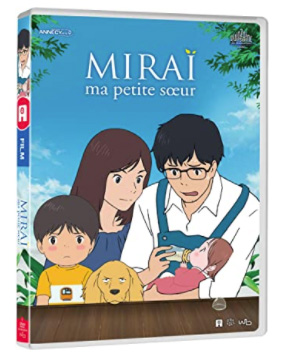
Mirai
Synopsis
Kun is a four-year-old boy whose world is turned upside down when his baby sister, Mirai, comes home. Feeling jealous and neglected, he retreats to the small garden of their modern house, where a magical tree allows him to travel through time. There, he meets members of his own family at different ages, including his future sister. Through these fantastical encounters, Kun begins to understand that he is part of a long chain of people connected by love.
The Making of the Film
Mirai is an animated feature written and directed by Mamoru Hosoda and produced by Studio Chizu. The idea came from Hosoda's observations of family life, particularly the jealousy a young child can feel when a new sibling arrives. The film takes a very intimate subject and expands it into a fantasy about family history and time. It had its world premiere at the Directors' Fortnight section of the Cannes Film Festival in 2018 and was released in Japan the same summer. The film went on to reach international audiences and earned an Academy Award nomination.
Reviews and Reception
Summary of Professional Reviews
Critics praised the film for its realistic depiction of childhood and for its warm, humane tone. The portrayal of Kun's tantrums and emotions was often described as astonishingly authentic. Some reviewers found the time-travel episodes somewhat episodic or uneven. Overall, the response was positive, with many highlighting the film's originality compared to more spectacle-driven animation.
Audience Reception
Audiences, especially parents, tended to connect strongly with the family dynamics shown on screen. The film was seen as touching and relatable, even though it is more modest than Hosoda's previous fantasy adventures. Some viewers found the main character irritating at first, which reflects how realistic he is as a small child. Over time, the film has gained a reputation as a quiet gem of modern animation.
Awards Received
Mirai was nominated for the Academy Award for Best Animated Feature, a rare honor for a Japanese film outside of Studio Ghibli. It was also nominated for a Golden Globe in the same category. The film received nominations at the Annie Awards as well. These recognitions helped bring it to a much wider international audience.
Themes Explored
The film is a celebration of family and of the invisible threads that connect generations. It examines sibling rivalry and the difficult process of learning to share love. Through time travel, it suggests that every person is the result of countless choices and encounters made by their ancestors. Growing up is shown as a series of small steps, where acceptance and empathy slowly replace jealousy. The film also explores the idea of home, with the house itself becoming almost a character. Ultimately, it is a gentle meditation on how love is passed from one generation to the next.
Ending Explained
By the end of the story, Kun has seen glimpses of his family's past and future, and he begins to understand where he fits in the larger picture. This realization allows him to accept his role as a big brother and to see his sister not as a rival but as a part of his story. The fantastical journey is ultimately a way of helping a child grow emotionally. The film closes with a sense of continuity, suggesting that family history is something we are all part of.
Meaning of the Title
"Mirai" means "future" in Japanese, and it is also the name of the baby sister. The title therefore refers both to a character and to the idea of what is yet to come. The original Japanese title, "Mirai no Mirai", plays with this double meaning, hinting at the future of Mirai herself.
Soundtrack
The music was composed by Masakatsu Takagi, who had already worked with Hosoda on previous films. His score is soft and playful, with a delicate sound that matches the intimacy of the story. It supports the shifts between everyday family life and dreamlike time travel.
Similar Films
- Wolf Children (2012): Hosoda's earlier film about motherhood and growing up.
- Summer Wars (2009): another Hosoda film centered on a large, loving family.
- Your Name (2016): a Japanese animated film about connections across time.
- The Girl Who Leapt Through Time (2006): a time-travel story by the same director.