

 Français
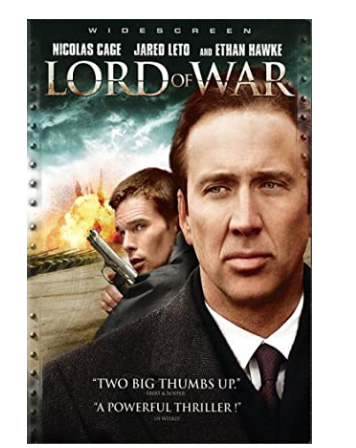
Lord of War
Synopsis
Yuri Orlov, a Ukrainian-born immigrant living in Brooklyn, discovers that he has a natural talent for selling weapons. Over the next two decades he builds a vast illegal empire, supplying armies and warlords around the globe. His charm and cynicism let him slip through every net, while his family life slowly falls apart. Hot on his trail is Interpol agent Jack Valentine, who is determined to bring him down.
The Making of the Film
Lord of War was written and directed by Andrew Niccol, who had previously made Gattaca and The Truman Show as a screenwriter. He wanted to tell a story about the global arms trade that would not feel like a lecture, so he chose a sly, darkly comic narrator who is proud of what he does. Yuri Orlov is fictional, but he is inspired by several real arms dealers, among them Viktor Bout, whose story later became widely known. Niccol did extensive research into how weapons move across borders, how loopholes work and which governments quietly look the other way. Nicolas Cage not only starred but also helped produce the film and became closely involved in shaping the character. Ethan Hawke, Jared Leto, Bridget Moynahan and Ian Holm joined the cast. The result is a satire built on real facts, designed to make the audience laugh and then feel uncomfortable about it.
Reviews and reception
Summary of professional reviews
Reviews were generally positive, though not unanimous. Many critics praised Nicolas Cage's cold and charming performance and the film's unusual first-person narration. The stylish opening sequence, which follows a bullet from the factory to its victim, drew particular admiration. Some reviewers felt the film was more clever than moving, but few doubted its ambition.
Audience reception
The film had a modest theatrical run, earning around 72 million dollars worldwide on a budget of about 42 million. Over time it found a loyal audience on home video and television. Viewers often note that it is both entertaining and disturbing, which is exactly what its creators intended. It has also been used in discussions about the real-world arms trade.
Awards and nominations
Lord of War did not win major mainstream awards. It was nevertheless praised by organizations concerned with human rights and arms control. Amnesty International and other groups pointed to it as a rare film that tackled the arms trade with a high degree of realism.
Filming anecdotes
Director's inspirations
Niccol wanted to show the arms trade from the inside, through the eyes of someone who sees it as simple business. He studied real cases of smuggling and corruption and built the film around the idea that, in many conflicts, the same weapons end up in everyone's hands. The film's cold tone is a deliberate choice to make the horror more striking.
Production difficulties
Filming took place in several countries, including South Africa and the Czech Republic, and in New York. Recreating war zones and arms bazaars required large sets and many extras. The opening bullet sequence needed careful planning and visual effects to make it look like a single seamless journey.
Anecdote about a particular scene
The opening shot, following a bullet from assembly line to the head of a child soldier, sets the tone for the whole movie. It is told from the point of view of the ammunition itself and ends with Yuri's calm voice-over introducing himself. Many viewers consider it one of the most memorable openings of the 2000s.
Themes explored
The film is a satire of the global arms trade and of the moral emptiness that allows it to flourish. It shows how profit can erase conscience, with Yuri constantly justifying his work by saying that he is only meeting demand. The film also looks at the corruption of governments that publicly condemn weapons dealers while quietly relying on them. Family and guilt play an important role, as Yuri's wife and brother pay the price for his choices. It explores the American dream in a twisted form, with an immigrant who succeeds by selling death. Finally, it asks whether any individual can be held responsible in a system designed to avoid responsibility.
Ending explained
Jack Valentine finally arrests Yuri and seems to have won, but Yuri remains calm. He explains that his powerful clients, including governments, need him, and that he will be released. A senior official confirms this, telling Jack that the world's great powers cannot afford to lose their supplier. Yuri walks free and resumes his business, now with a wiser and more cynical perspective. The ending is bleak by design: the real villain is the system that protects people like him.
Meaning of the title
The title evokes the idea of the arms dealer as a kind of ruler over wars, a figure who holds power without ever appearing on the front line. It recalls the old nickname merchant of death, applied to arms traders in the past, and suggests a darker kind of nobility. The phrase also hints at the ancient image of the god of war. The irony is that Yuri is a lord only because governments and armies allow him to be.
Similar Films
- Blood Diamond (2006): a thriller about the trade in conflict diamonds in Africa.
- The Constant Gardener (2005): a story of corporate and political corruption.
- Scarface (1983): the rise and fall of an immigrant criminal.
- War Dogs (2016): a comedy-drama based on young arms dealers.
- Goodfellas (1990): features a charming narrator guiding us through a criminal world.