

 Français
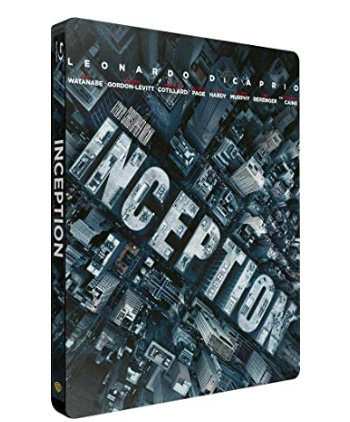
Inception
Synopsis
Dom Cobb is a highly skilled thief who specializes in extracting secrets from people by entering their dreams. His expertise makes him valuable to powerful business interests, but it also prevents him from returning to the United States and seeing his children. He is offered an extraordinary opportunity to clear his criminal record by performing the opposite of his usual task: planting an idea inside someone's subconscious. Together with a carefully assembled team, Cobb must enter increasingly complex layers of dreams while confronting memories and psychological dangers from his own past. As reality and illusion become difficult to distinguish, the mission threatens to consume everyone involved.
The Making of the Film
Christopher Nolan developed the idea for Inception over several years, initially imagining a story about people who could enter and manipulate dreams. He was fascinated by the relationship between dreams, memory and the subjective experience of time. The director first considered the concept as a smaller psychological thriller before deciding that it required the scale of a major science-fiction production. Nolan wrote an original screenplay rather than adapting an existing novel or comic book. The narrative was designed around a complex structure in which different levels of dreams operate according to different perceptions of time. Leonardo DiCaprio was selected to play Dom Cobb, bringing considerable emotional depth to the central character. The production combined practical effects, elaborate sets and computer-generated imagery to create convincing dream environments. Nolan also wanted to ensure that the film remained emotionally accessible despite its complicated narrative. The result became one of the most ambitious and influential science-fiction thrillers of the early twenty-first century.
Reviews and Reception
Professional reviews: Critics widely praised the originality of the concept, Christopher Nolan's direction and the film's technical achievements. Leonardo DiCaprio received recognition for portraying a character whose psychological struggles give emotional substance to the complex plot. The visual effects, cinematography, editing and sound design were particularly celebrated. Some reviewers found the narrative difficult to follow, but many considered this complexity one of the film's greatest strengths.
Audience reception: Inception became a major international box-office success and generated extensive discussion among moviegoers. Its layered dream structure encouraged repeated viewings and countless interpretations. Audiences were particularly fascinated by the final scene and its unresolved question about reality. The film developed a lasting cultural influence and became a reference point for ambitious science-fiction cinema.
Awards: Inception received eight Academy Award nominations and won four. Its victories included Best Cinematography, Best Sound Editing, Best Sound Mixing and Best Visual Effects. It also received nominations for Best Picture, Original Screenplay and Original Score. Hans Zimmer and Christopher Nolan received extensive recognition from critics and professional organizations.
Behind-the-Scenes Stories
Director's inspirations: Christopher Nolan was fascinated by the structure of dreams and the possibility of manipulating someone's subconscious. He wanted to transform an abstract psychological concept into an action-driven cinematic experience. The film also reflects his interest in stories involving memory, identity and unreliable perceptions of reality. The emotional foundation was built around Cobb's guilt and his desire to return to his children.
Production challenges: The production required an extraordinary combination of practical effects and computer-generated imagery. The famous rotating hallway sequence was created using a specially constructed rotating set rather than relying entirely on digital effects. The filmmakers also developed elaborate environments to represent the different levels of dreams. Coordinating action across these parallel narrative sequences required careful editing and detailed planning.
Notable scene: The final shot, in which Cobb spins his totem before reuniting with his children, is among the most discussed endings in modern cinema. The camera focuses on the spinning top as it begins to wobble, but the film cuts to black before its final movement can be confirmed. This deliberately unresolved image encourages viewers to question whether Cobb has truly returned to reality. The scene has become one of the defining examples of cinematic ambiguity.
Original casting: Leonardo DiCaprio was selected to play Dom Cobb and became central to the development of the project. Several other major performers joined the ensemble, including Joseph Gordon-Levitt, Elliot Page, Tom Hardy, Ken Watanabe and Marion Cotillard. Cillian Murphy was cast as Robert Fischer, whose subconscious becomes the target of the operation. The international cast helped establish the impression of a professional team working across different countries and environments.
Themes Explored
Inception explores the relationship between dreams, memory and reality. It asks whether human beings can ever be completely certain that their experiences are genuine. Identity is another central theme, particularly through Cobb's struggle to distinguish his memories from the projections of his subconscious. Guilt and grief shape much of the protagonist's behavior and influence the decisions he makes during the mission. The film also examines the power of ideas and how deeply they can influence individual choices. Time becomes a major narrative and philosophical element, as each dream level creates a different relationship between perception and duration. Love and family provide the emotional foundation of the story, giving Cobb a reason to undertake an almost impossible mission. The distinction between creation and manipulation is also important, since dreams can be both places of freedom and instruments of control. Ultimately, the film suggests that subjective experience may be more important to human happiness than the objective certainty of reality.
Ending Explained
The ending takes place after Cobb and his team have apparently completed their mission. Cobb returns to the United States and is finally reunited with his children, ending the separation that has defined his life. Before accepting that he has returned to reality, he spins his personal totem, a small top that helps him distinguish dreams from the real world. However, instead of waiting to see whether the top falls, Cobb walks away to embrace his children. The camera remains focused on the spinning object, which appears to wobble slightly before the screen turns black. This final image deliberately prevents viewers from obtaining a definitive answer. One interpretation is that Cobb has genuinely returned home and no longer needs to depend on the totem. Another possibility is that he remains inside a dream and has simply chosen to accept it. The emotional significance of the ending lies in Cobb's decision to stop obsessing over uncertainty and embrace the life he believes he has recovered.
Meaning of the Title
The title Inception refers to the act of planting an idea inside another person's subconscious. Unlike extraction, which involves stealing information from a dreamer, inception requires the creation of a thought that the individual will eventually believe to be entirely their own. The word also suggests the beginning of something new, whether an idea, a decision or a transformation. This meaning reflects the central operation undertaken by Cobb and his team. The title also connects to the film's exploration of how thoughts can influence identity and behavior. An apparently simple suggestion can develop into a powerful conviction when it becomes part of someone's inner world. The concept raises questions about free will, manipulation and personal responsibility. Ultimately, the title captures the film's central idea that the most powerful influence on a human being may be an idea planted deep within the mind.
Hans Zimmer composed the original score, creating one of the most recognizable soundtracks of his career. The music is famous for its powerful brass, electronic textures and gradually intensifying rhythms. Zimmer developed the score around a musical idea connected to Edith Piaf's song Non, je ne regrette rien, which appears in the film as an important signal. The slowed-down musical motif becomes an atmospheric foundation for several major sequences. The soundtrack reinforces the film's exploration of time, tension and the boundaries between different levels of reality. Its distinctive sound helped make Inception one of the most recognizable musical productions of modern science-fiction cinema.
Similar Films
The Matrix explores the relationship between perceived reality and an artificial world. Memento examines memory, identity and the difficulty of establishing objective truth. Shutter Island explores psychological uncertainty and the fragile boundary between reality and delusion. Interstellar combines complex scientific concepts with an emotional story about family and time. Paprika explores the manipulation of dreams and the relationship between the subconscious and reality. Dark City examines identity, memory and a world whose apparent reality conceals a deeper mystery. Eternal Sunshine of the Spotless Mind explores memory, love and the psychological consequences of altering personal experiences. These films share Inception's interest in consciousness, subjective reality, memory and the extraordinary possibilities of the human mind.