

 Français
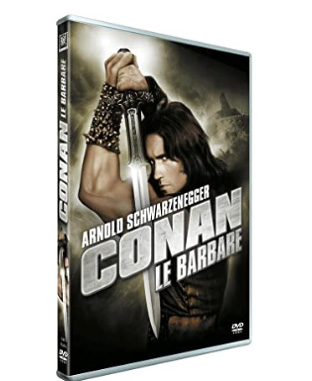
Conan the Barbarian
Synopsis
In the mythical Hyborian Age, young Conan sees his parents slaughtered and his village destroyed by the warlord Thulsa Doom. Enslaved and forced to push a giant wheel, he grows into a mighty warrior and is later trained as a gladiator. Freed, he sets out on a journey of vengeance, joined by the thief Subotai and the fierce warrior Valeria. Together, they must confront Doom, the leader of a snake cult, in his mountain stronghold.
The Making of the Film
Conan the Barbarian is based on the pulp fantasy stories written by Robert E. Howard in the 1930s, which established the hero as a symbol of raw strength and survival. The character had been a staple of comic books and paperbacks for decades, but a film adaptation had to wait until producer Dino De Laurentiis acquired the rights in the late 1970s. A young Oliver Stone wrote an early, very ambitious screenplay, which was later reworked by director John Milius. Milius, a fan of Howard's writing, wanted to make an epic that mixed mythology, philosophy and violence. He was inspired by the films of Akira Kurosawa and by the writing of Friedrich Nietzsche, whose line about what does not kill us making us stronger opens the film. Arnold Schwarzenegger, who had been a bodybuilding champion and had appeared in a few small roles, was chosen to play Conan. The film was shot in Spain with a large crew and a huge set of weapons and costumes. It was conceived as a barbaric opera, full of ritual and spectacle.
Reviews and reception
Professional critics' summary
Critics were divided, with some admiring the film's visual power and others criticising its violence and thin story. Many reviewers noted that Schwarzenegger had an extraordinary presence, even though his line delivery was limited. The cinematography and the sets were praised for their epic quality. Others found the film's pacing slow and its philosophy pretentious.
Audience reception
The film was a success at the box office, earning more than 100 million dollars worldwide on a moderate budget. It made Arnold Schwarzenegger a star and led to a sequel, Conan the Destroyer, in 1984. Over the years, it has become a cult classic, praised for its raw energy and its distinctive vision. Many fans regard it as one of the best fantasy films of the 1980s.
Awards
Sandahl Bergman, who played Valeria, won the Golden Globe for New Star of the Year in a Motion Picture. The film also received nominations at genre ceremonies, such as the Saturn Awards. Basil Poledouris's score has since earned special recognition among film music fans. The film's long-term reputation has been its greatest reward.
Filming anecdotes
Director's inspirations
John Milius was a passionate fan of Howard's stories and of Nordic and Asian epics. He took inspiration from Kurosawa's samurai films, with their slow build-ups and sudden explosions of violence. The idea of the Wheel of Pain, to which young Conan is chained, came from Milius's own vision of destiny and suffering. He also wanted to honour the pulp tradition by embracing its larger-than-life images.
Production difficulties
The film was shot in Spain, in difficult conditions and with a large number of extras and animals. Schwarzenegger performed many of his own stunts, and the cast spent months training with swords and horses. Several injuries occurred on set, and the production had to deal with a very tight schedule. The battle scenes required a considerable amount of choreography and safety precautions.
Anecdote about a particular scene
One of the best-known moments is the scene in which Conan is asked what is best in life, and replies with a brutal speech about crushing his enemies. The scene has become one of the most quoted in action cinema. Another memorable sequence is the climactic fight in the temple of Thulsa Doom, with its hypnotic ceremonies and serpents. The film also features a funeral scene for Valeria, which stands out for its beauty and emotion.
Originally planned casting
Arnold Schwarzenegger was cast as Conan after years of working to develop his acting skills. James Earl Jones, famous as the voice of Darth Vader, played the villain Thulsa Doom, bringing a deep and chilling voice. Sandahl Bergman, a dancer making her film debut, played Valeria, and Gerry Lopez, a legendary surfer, played Subotai. Max von Sydow appeared as King Osric.
Themes explored
The film is about vengeance and the search for identity in a brutal world. Conan is driven by the loss of his family, and his strength comes from suffering. It also explores the nature of power, as Thulsa Doom uses faith and manipulation to control his followers. Another theme is freedom, which is shown through Conan's long journey from slavery to kingship. The story reflects a vision of life as a constant struggle, in which only the strong survive. Friendship and loyalty appear in Conan's bond with Subotai and Valeria. The film touches on destiny, as the hero's path seems guided by forces larger than himself. Ultimately, it celebrates courage in the face of cruelty.
Ending explained
Conan reaches Thulsa Doom's mountain temple, where he confronts the leader of the cult. With the help of Subotai and Valeria, he destroys the stronghold and kills Doom by cutting off his head. The cult collapses as its followers realise that their leader was a false god. Conan has avenged his parents and his people, and his long quest comes to an end. The film closes with an epilogue in which an older Conan sits on a throne as king. This final scene suggests that he has risen from slavery to rule. It closes the story with a mythic note of triumph.
Meaning of the title
The title Conan the Barbarian identifies the hero by his name and by his origins. The word barbarian refers to a man from outside civilisation, someone who lives by his strength and instincts. In Robert E. Howard's stories, it is a mark of pride, since the barbarian is free from corruption. The title also links the film to the pulp tradition, in which heroes have simple, memorable names. For viewers, it announces a story of swords, sorcery and savage adventure. It also suggests a contrast between the barbarian and the decadent civilisations of the world he explores. It is a bold and direct title that has become iconic.
Original Soundtrack
Basil Poledouris composed the score, which is widely regarded as one of the great film scores of the 1980s. His music combines choirs, heavy percussion and soaring brass to give the film an epic and almost operatic character. Themes such as the Anvil of Crom and the Riddle of Steel are instantly recognisable. The score helps to turn Conan into a mythic story and has been praised by composers and fans for decades.
Similar Films
Conan the Destroyer is the direct sequel to this film. Red Sonja and The Beastmaster are other swords-and-sorcery films from the same period. The Lord of the Rings trilogy offers a more refined take on epic fantasy. Excalibur and Willow are also notable fantasy films of the era.