

 Français
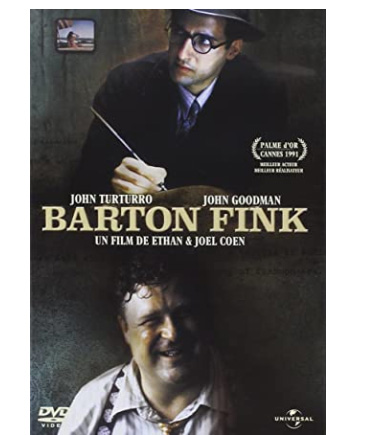
Barton Fink
Synopsis
Set in 1941, the film follows Barton Fink, an idealistic, socially conscious New York playwright who achieves sudden Broadway success and is promptly lured to Hollywood by Capitol Pictures to write a formulaic B-movie wrestling script. Lodged in the decaying, sweltering, bug-infested Hotel Earle, Barton suffers from severe writer's block, staring blankly at a wallpaper that mysteriously peels from the humidity. His only solace comes from his friendly, gregarious insurance-salesman neighbor, Charlie Meadows. As days pass, Barton descends into a surreal, feverish nightmare of corporate exploitation, decapitation, and bizarre psychological terror.
The Making of the Film
Writer-directors Joel and Ethan Coen wrote the screenplay in just three weeks while suffering from severe writer's block themselves while attempting to write another film (Miller's Crossing). Frustrated and confined to a hotel room, they channeled their creative anxiety into a surreal 1940s Hollywood satire. The production aimed to blend social commentary on labor exploitation with nightmarish psychological horror. Cineastes immediately noted strong homages to Roman Polanski and German Expressionism.
Critical Reception and Reviews
Professional Critic Reviews
Critics offered overwhelming critical acclaim, praising the film's astonishing sweep at the Cannes Film Festival, John Turturro's tour-de-force lead performance, and Roger Deakins' atmospheric cinematography. Reviewers commended the Coen brothers' fearless genre-bending blend of Hollywood satire, dark comedy, and psychological horror. The film achieved a historic sweep at Cannes, winning the Palme d'Or and Best Director. It was hailed as a modern masterpiece of cinematic surrealism.
Public Reception
Audiences responded with fascinated intrigue to the film's bizarre psychological descent, though its arthouse surrealism kept it relatively niche at the box office. Cinephiles and film scholars embraced the dense symbolism, literary allusions, and haunting hotel atmosphere. Word-of-mouth secured its cult classic status.
Awards and Honors
At the 1991 Cannes Film Festival, 'Barton Fink' achieved a rare sweep, winning the Palme d'Or, Best Director (Joel Coen), and Best Actor (John Turturro). It earned multiple Academy Award nominations for Best Supporting Actor (Michael Lerner), Best Art Direction, and Best Costume Design.
Filming Anecdotes
Director's Inspirations
Joel and Ethan Coen drew inspiration from classic 1940s Hollywood noir, German expressionist cinema, and the surreal psychological horror of Roman Polanski ('Repulsion', 'The Tenant'). They wanted the decaying Hotel Earle to feel like a physical manifestation of hell and Barton's deteriorating psyche. The peeling wallpaper and buzzing mosquitoes symbolized his mounting madness.
Production Difficulties
Simulating the oppressive, humid heat of the decaying hotel required the art department to build special wallpaper that visibly bubbled and peeled on cue using steam and moisture. John Turturro endured grueling emotional and physical exhaustion playing Barton's frantic descent into writer's block. Managing complex sound design elements (like the relentless buzzing mosquito and dripping plumbing) required meticulous audio engineering.
Particular Scene Anecdote
The terrifying, surreal hotel fire climax where Charlie Meadows walks down a blazing corridor shouting 'Look upon my works, ye mighty, and despair!' was executed using practical fire effects and stunt performers. John Turturro brought intense neurotic energy to his typewriter scenes. Michael Lerner delivered an unforgettable, explosive performance as the tyrannical studio boss Jack Lipnick.
Initial Casting Choices
John Turturro was the Coen brothers' absolute first choice to play Barton Fink, bringing unmatched theatrical intensity and neurosis. John Goodman was cast as Charlie Meadows, bringing folksy charm that slowly curdles into terrifying menace. Michael Lerner, Steve Buscemi, and Judy Davis rounded out the stellar supporting cast.
Themes Explored
The film explores the painful gulf between high art and commercial entertainment, intellectual pretension versus working-class reality, and corporate exploitation in Hollywood. It examines writer's block, isolation, guilt, and descent into madness. Another core theme is the illusion of American success. Ultimately, it is a surreal psychological nightmare.
The surreal climax reveals that Charlie Meadows is actually a deranged serial killer named Karl 'Madman' Mundt who has been hiding out in the hotel, leaving a bloody package containing a severed head in Barton's room before vanishing. Barton is interrogated by detectives, abandoned by the studio who refuse to produce his script, and left stranded in Los Angeles with his manuscript. In the final haunting scene, Barton walks onto a sunny beach holding the mysterious box, staring out at the ocean as a seabird plunges into the water mirroring a painting in his hotel room. It signifies complete spiritual and creative alienation in a nightmare world.
Meaning of the Title
The title 'Barton Fink' places the full identity of the pretentious, self-absorbed protagonist at the center of the narrative, highlighting a character study of artistic narcissism meeting systemic destruction. It personalizes the Hollywood satire. The simple name sets the dark arthouse tone.
Original Soundtrack
Carter Burwell composed a haunting, atmospheric musical score featuring eerie string arrangements and theatrical cues that heighten the surreal psychological horror of the hotel.
["The Tenant", "Barton Fink", "Mulholland Drive"]