

 Français
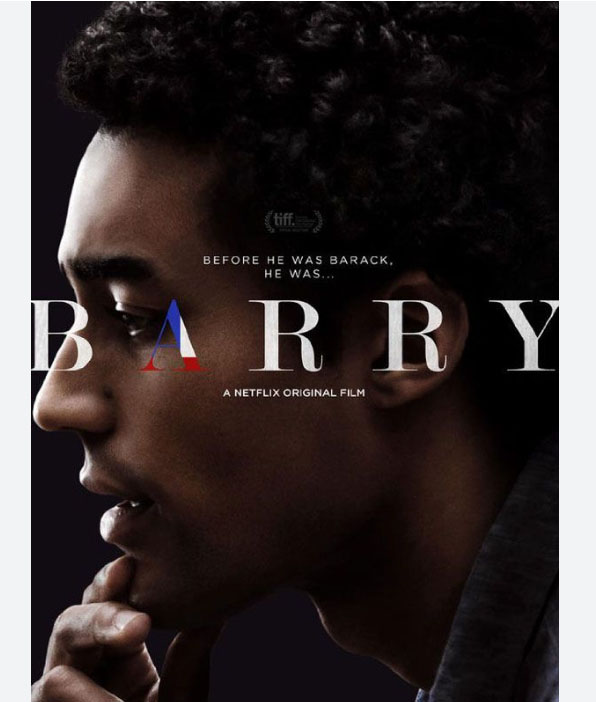
Barry
Synopsis
In 1981, a young man who goes by the name Barry arrives at Columbia University in New York, caught between two worlds and unsure of who he is. Born to a white mother and an African father, he struggles with questions of race, belonging and family history. Through new friendships, a romance and a few painful confrontations, he slowly begins to define the man he wants to become. The film follows the formative years of a future President of the United States, long before anyone could have predicted his path.
The Making of the Film
Barry is a Netflix biographical drama directed by Vikram Gandhi, a filmmaker known for his documentary work. The screenplay was written by Adam Mansbach, who set out to imagine the student years of Barack Obama, a period that the future president himself explored in his memoir "Dreams from My Father". Rather than telling the story of the politician, the film focuses on a young man searching for his place in the world. Several characters are fictionalized or composites, which allowed the writers to condense real experiences into a tight narrative. The role of the young Obama was entrusted to Devon Terrell, an Australian actor who was relatively unknown at the time. The film premiered at the Toronto International Film Festival in 2016 before arriving on Netflix in December of the same year.
Reviews and Reception
Summary of Professional Reviews
Critics gave the film a mixed to positive reception. Most praised Devon Terrell for a convincing and nuanced performance that avoids simple imitation. Some reviewers felt the screenplay was a little conventional, following the familiar beats of a coming-of-age story. Others appreciated its quiet approach, which prefers intimate scenes of doubt and conversation to grand historical moments.
Audience Reception
Audiences were intrigued by the idea of seeing the man before the myth, and the film attracted curiosity well beyond its release window. Viewers who wanted a political thriller were sometimes disappointed, while those looking for a personal portrait tended to be more receptive. The film was often discussed alongside other Obama-related productions released around the same time.
Themes Explored
The film is above all a story about identity. It explores what it means to belong to two worlds at once and to feel like a stranger in both. Questions of race, privilege and perception run through every relationship the young man builds in New York. The absence of a father, and the complicated legacy he left behind, adds an emotional layer to the story. The film also deals with ambition, as the young man starts to sense that his life might be meant for something larger. Through small scenes of friendship, love and conflict, it suggests that identity is not something you are given but something you build.
Ending Explained
The film does not end with a triumphant political milestone. Instead, it closes on a moment of personal clarity, where the young man seems to have made peace with parts of his past. This choice is deliberate: the story is not about what he becomes, but about how he begins to understand himself. Viewers who know the real history will recognize the first steps toward the path that follows, while the film itself leaves that future open.
Meaning of the Title
"Barry" is the nickname the young Barack Obama used during his youth. The title points to a time before he fully embraced his given name, when he was still negotiating who he wanted to be. Using the nickname rather than the full name signals that the film is about the private young man rather than the public figure.
Similar Films
- Southside with You (2016): a gentle portrait of the early romance between Barack and Michelle Obama.
- Selma (2014): a historical drama about the civil rights movement.
- Loving (2016): a quiet and human look at race and family in America.
- Moonlight (2016): a coming-of-age story built around identity and belonging.