

 Français
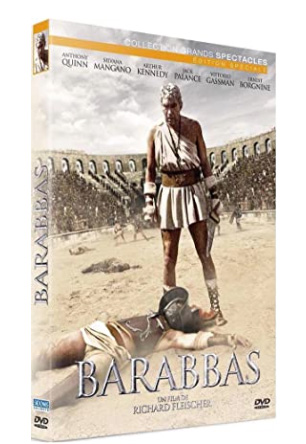
Barabbas
Synopsis
Set in ancient Jerusalem during the reign of Pontius Pilate, the film tells the epic biblical and post-resurrection story of Barabbas, the notorious criminal whose life was spared by the Jewish crowds who chose to free him instead of Jesus of Nazareth. Haunted by the execution of Jesus in his place, Barabbas struggles with profound spiritual confusion, guilt, and existential dread as he returns to a life of banditry. Following a botched robbery, he is captured and sentenced to a brutal life of hard labor in the Sicilian sulfur mines, where he survives a catastrophic mine collapse before being sent to Rome to train as a gladiator in the Colosseum. Through unimaginable suffering and encounters with early Christians, his tortured soul seeks ultimate redemption.
The Making of the Film
Producer Dino De Laurentiis and director Richard Fleischer developed the grand religious epic based on Pär Lagerkvist's Nobel Prize-winning philosophical novel. De Laurentiis financed the massive international production, aiming to create a psychological and theological companion piece to traditional Hollywood biblical films. The screenplay was crafted to focus on existential guilt and spiritual awakening rather than standard hagiography. The production utilized authentic Italian locations and the Colosseum in Rome for breathtaking historical scale.
Critical Reception and Reviews
Professional Critic Reviews
Critics offered widespread critical acclaim, praising Anthony Quinn's towering, muscular lead performance, Aldo Ray's villainy, and the brutal, gritty realism of the Gladiator arena sequences. Reviewers commended the film for avoiding cheesy religious melodrama, opting instead for a grim, philosophical exploration of faith, guilt, and redemption. The breathtaking cinematography by Aldo Tonti received high praise. It was celebrated as one of the finest historical epics of its era.
Public Reception
Audiences responded with awe and solemn appreciation, drawn by the spectacular historical scale, fierce gladiatorial combat, and Anthony Quinn's commanding physical presence. Viewers found the theological questions surrounding Barabbas's survival deeply compelling. Box-office returns performed exceptionally well globally.
Awards_and_Honors
While the film missed major Academy Award wins, it received numerous international film critic awards and accolades for Anthony Quinn's unforgettable lead performance and Aldo Tonti's cinematography. It remains an enduring classic of biblical cinema.
Filming Anecdotes
Director's Inspirations
Richard Fleischer drew inspiration from classic historical epics and dark classical art, wanting the ancient world to feel dusty, brutal, and unforgiving. He chose to film the crucifixion sequence during an actual solar eclipse in Italy to capture authentic, unmanipulated darkness on screen. The visual palette favored harsh Mediterranean sunlight and dark sulfur mine shadows.
Production Difficulties
Shooting the harrowing sulfur mine labor sequences inside deep, genuine caverns presented extreme heat, sulfur gas odors, and physical exhaustion for the cast and crew. Anthony Quinn performed many of his own grueling physical stunts in the gladiator arena. Managing massive international background crowd extras in Rome required rigorous logistical coordination.
Particular Scene Anecdote
The legendary crucifixion sequence was filmed during a rare total solar eclipse in Italy, giving the cinematic death of Jesus an eerie, authentic atmospheric darkness that stunned the entire crew. Anthony Quinn brought staggering physical intensity to his gladiatorial combat scenes. Jack Palance delivered a memorably sadistic performance as the veteran gladiator Torvald.
Initial Casting Choices
Anthony Quinn was cast as Barabbas, bringing raw animalistic power, vulnerability, and profound dramatic depth to the titular criminal. Jack Palance, Silvana Mangano, and Ernest Borgnine rounded out the stellar international supporting cast. Auditions focused on actors capable of projecting ancient historical grit.
Themes Explored
The film explores guilt, redemption, existential doubt, faith, and the psychological burden of a second chance at life. It examines the dawn of Christianity versus Roman imperial brutality. Another core theme is suffering and spiritual awakening. Ultimately, it is a profound theological epic about finding grace in darkness.
The narrative concludes in Rome during the Great Fire of Nero, where Barabbas, now an old and weary gladiator who has refused to kill his Christian brethren in the arena, dies on a wooden cross after embracing his long-awaited faith in God. As he gazes up into the night sky, his decades of torment and guilt finally dissolve into peaceful surrender. The final poignant shot captures his crucifixion echoing the fate of Jesus years prior. It signifies ultimate spiritual redemption and peace for a tortured soul.
Meaning of the Title
The title 'Barabbas' refers directly to the biblical titular criminal whose life was traded for Jesus during the Passover trial, setting the stage for a unique post-resurrection spiritual journey. It highlights the individual focus on a forgotten historical footnote. The single-word title establishes the epic biblical character study tone.
["Ben-Hur", "The Robe", "Spartacus"]