

 Français
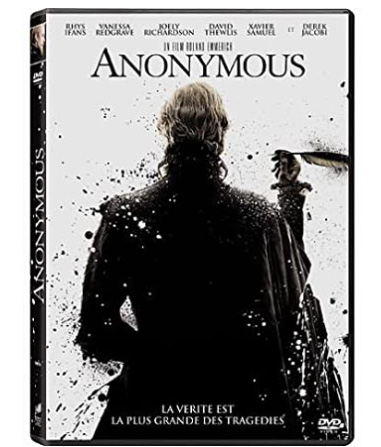
Anonymous
Synopsis
In Elizabethan England, the nobleman Edward de Vere, Earl of Oxford, is a gifted writer who is forbidden by his social rank from publishing plays. He secretly commissions the struggling actor William Shakespeare to put his name on the works. As the plays gain fame, political intrigue and a succession crisis swirl around Queen Elizabeth I. The film imagines that the greatest works in English literature were written by someone else.
The Making of the Film
Anonymous is built on the Oxfordian theory, a controversial claim that the plays attributed to William Shakespeare were really written by Edward de Vere, the 17th Earl of Oxford. Screenwriter John Orloff, who had been fascinated by the authorship question for years, wrote the script long before it was filmed. Director Roland Emmerich, best known for disaster blockbusters such as Independence Day and The Day After Tomorrow, wanted to make a more personal project. Rhys Ifans was cast as Oxford, with Vanessa Redgrave and her daughter Joely Richardson playing the older and younger Queen Elizabeth. Rafe Spall played Shakespeare as a buffoonish actor, and Derek Jacobi introduced the story as a prologue. The film was shot in Germany at Babelsberg Studios, with computer-generated recreations of Tudor London. Historians have strongly criticized the theory behind the film, and the filmmakers presented it as a work of fiction.
Reviews and reception
Summary of professional reviews
Critics were divided. Many praised the film's visual beauty, its costumes and the performances of Rhys Ifans and Vanessa Redgrave. Others criticized the confusing structure and the shaky historical foundations. Scholars of Shakespeare were particularly harsh about the premise.
Audience reception
The film did not perform well at the box office, earning only about 15 million dollars worldwide on a budget of roughly 30 million. Audiences were not drawn to the historical drama, and the controversy over its claims did not help. It has since found a small following among fans of costume dramas and conspiracy stories. It is mostly remembered as a curiosity.
Awards and nominations
Anonymous was nominated for the Academy Award for Best Costume Design. It also received nominations for its art direction and production design at other ceremonies. It did not win major prizes, but its look was widely praised.
Filming anecdotes
Director's inspirations
Emmerich said that he was attracted to the mystery of Shakespeare's identity and to the idea of political intrigue behind great art. He wanted to show the court of Elizabeth I as a dangerous place full of plots and betrayals. He also used his experience with special effects to recreate the city of London.
Production difficulties
The production built a digital version of Elizabethan London, which required extensive visual effects work. It also had to deal with criticism from literary scholars, who objected to the film's premise. Emmerich responded by emphasizing that it was a work of imagination.
Anecdote about a particular scene
One of the film's most striking scenes is the first performance of a play at the Globe Theatre, which shows the excitement of the audience. The prologue, spoken by Derek Jacobi on a modern stage, sets up the film's central question. Many viewers also remember the scenes of Queen Elizabeth in different stages of her life.
Themes explored
The film is about authorship, truth and the power of storytelling. It questions who really creates culture and how history is written by those in power. Political intrigue, ambition and the struggle for succession are central. The conflict between art and social class is another important theme, since Oxford cannot publish under his own name. Love and betrayal run through the story. It also invites viewers to consider the role of secrets in shaping legacies.
Ending explained
Edward de Vere dies without being credited as the author of his plays. His friend Ben Jonson preserves the manuscripts, ensuring that they survive. The works are eventually attributed to Shakespeare, as history knows. The ending suggests that great art may outlive the identity of its creator. It leaves the audience with the idea that the truth may have been lost.
Meaning of the title
The title refers to the idea that the true author of the plays remained anonymous. It also reflects the way writers in the Elizabethan era often published without their names. In the film, anonymity is both a protection and a tragedy. The title poses the question of who deserves credit for creative genius.
Original Soundtrack
The score was composed by Thomas Wanker and Harald Kloser, who created a sweeping and dramatic sound that fits the historical setting. Their music underlines the film's mix of intrigue and passion. It helps to maintain a sense of grandeur in the court scenes.
Similar Films
- Shakespeare in Love (1998): a romantic comedy about the playwright's life.
- Elizabeth (1998): a drama about the early reign of Elizabeth I.
- The Other Boleyn Girl (2008): intrigue in the Tudor court.
- Amadeus (1984): a drama about genius and rivalry.
- Becoming Jane (2007): a fictional account of a writer's life.