

 Français
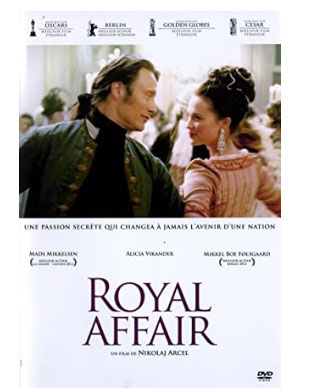
A Royal Affair
Synopsis
Set in 18th-century Denmark, Princess Caroline Mathilda of Great Britain is married off at age fifteen to King Christian VII of Denmark, a mentally unstable and erratic monarch. Isolated in a rigid, conservative royal court governed by corrupt ministers, Caroline finds herself desperately lonely until German physician Johann Friedrich Struensee is hired as the king's personal doctor. Struensee, an enlightened intellectual influenced by Enlightenment philosophers, gradually gains influence over the unstable king, successfully convincing him to implement sweeping progressive reforms across Denmark. As Struensee and Queen Caroline work together to modernize the nation, a passionate, clandestine romance blossoms between them, ultimately sparking a dangerous aristocratic backlash.
The Making of the Film
Adapted from Bodil Steensen-Leth's acclaimed 2000 historical novel The Royal Physician's Visit, the Danish historical drama was directed by Nikolaj Arcel. Arcel sought to bring an epic, passionate cinematic scale to one of the most scandalous and influential political love stories in Scandinavian history. Screenwriter Rasmus Heisterberg collaborated on adapting the dense political history. Mads Mikkelsen and Alicia Vikander were cast as the lead historical figures, bringing international prestige to the production.
Critical Reception
Critical reception for the film was universal critical acclaim, with reviewers praising Alicia Vikander and Mads Mikkelsen's stellar lead performances, lavish period costume design, and gripping political tension. Critics lauded Arcel for transforming dense European history into a thrilling, passionate romantic drama. The film won two Silver Bears at the Berlin International Film Festival and received an Academy Award nomination for Best Foreign Language Film. It is celebrated as a modern historical masterpiece.
Behind-the-Scenes Stories
Alicia Vikander learned Danish phonetically prior to filming, delivering her royal dialogue with remarkable linguistic precision. Mads Mikkelsen immersed himself in 18th-century medical history and Enlightenment philosophy to portray Dr. Struensee accurately. The production utilized authentic royal palaces and historic castles across Denmark and the Czech Republic. Costume designers meticulously crafted hundreds of hand-stitched silk court gowns.
Themes Explored
The film explores Enlightenment political reform, forbidden royal romance, censorship, aristocracy corruption, and revolution from within. It highlights mental illness in monarchy, sacrifice, and intellectual progress. Royal court intrigue drives the historical plot. It also touches upon justice.
Ending Explained
Following a conservative aristocratic coup d'état orchestrated by corrupt ministers, Struensee is arrested, tortured, and executed for treason, while Queen Caroline is permanently exiled from Denmark, never to see her children again. Before her death in exile years later, Caroline rejoices knowing her young son—now king—has inherited Enlightenment ideals and will maintain their progressive reforms. The tragic political sacrifice forever alters Danish history. The conclusion provides a devastating, epic historical finale.
Meaning of the Title
The title refers directly to the scandalous, politically explosive romance between Queen Caroline and Dr. Johann Friedrich Struensee that shook the Danish monarchy: "A Royal Affair." It symbolizes forbidden passion and revolution. The phrase sets a sweeping historical drama tone.
Gabriel Yared and Cyrille Aufort composed a magnificent, sweeping orchestral period score featuring romantic piano and string arrangements that elevated the royal tragedy.
The Favourite, Marie Antoinette, The Duchess, Elizabeth