

 Français
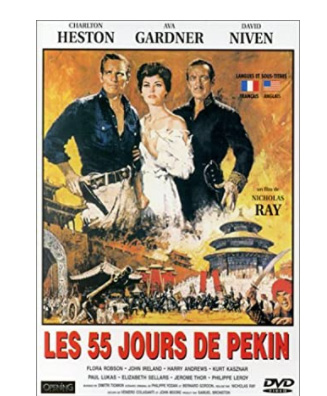
55 Days at Peking
Synopsis
Set during the turbulent summer of 1900 in China, the historic Boxer Rebellion erupts as xenophobic nationalist militias surround the foreign legation quarter in Peking. Trapped inside the besieged compound are diplomats, soldiers, and civilians from various Western powers, facing dwindling supplies, relentless attacks, and imminent massacre. Major Matt Lewis, an American Marine officer, falls in love with a Russian baroness while organizing the desperate defense of the compound alongside British and international forces. This epic historical war drama captures imperial tension and courage under siege.
The Making of the Film
Produced by legendary independent producer Samuel Bronston, the film was designed as a massive, roadshow historical epic following the international success of El Cid. Director Nicholas Ray initially spearheaded the production, bringing sweeping visual grandeur and complex political nuance to the historical tragedy. However, due to severe health issues and creative friction on set during the grueling Spanish shoot, Ray was replaced midway by codirector Andrew Marton. The screenplay drew inspiration from historical accounts of the siege of the Peking legation quarter.
Critical Reception
Upon its theatrical release, the film received mixed reviews from critics who praised its stunning production design, massive scale, and action set pieces while criticizing its conventional romantic subplots and historical simplification. Audiences enjoyed the grand cinematic spectacle, turning it into a modest box-office performer during the roadshow era. Reviewers particularly commended Charlton Heston and Ava Gardner for their charismatic lead performances amidst the historical chaos. It received two Academy Award nominations for Best Original Score and Best Original Song.
Behind-the-Scenes Stories
Producer Samuel Bronston constructed a colossal, incredibly detailed replica of the Peking legation quarter on a massive outdoor lot outside Madrid, Spain, employing thousands of local extras. Director Nicholas Ray suffered a severe heart attack during the grueling production, forcing him to direct scenes from a hospital bed and eventually stepping down. Charlton Heston performed many of his own action stunts during the fiery siege sequences, working closely with veteran stunt coordinators. The production faced massive logistical hurdles managing hundreds of international actors, languages, and pyrotechnics.
Themes Explored
The film explores imperialism, geopolitical conflict, cultural clashes, and the violent eruption of anti-foreign nationalism in turn-of-the-century China. It examines cross-cultural romance and human solidarity forged under mortal siege conditions. Furthermore, it highlights military duty, sacrifice, and the futility of colonial arrogance.
Ending Explained
After nearly two months of horrific bombardment and dwindling ammunition, the international relief coalition finally breaks through the city gates, lifting the devastating siege and saving the surviving diplomats. Major Matt Lewis survives the brutal final assault, though the victory is bittersweet, marked by massive casualties and the tragic death of the baroness. In the final sequence, the surviving foreign troops march away from the scarred city under a heavy cloud of political uncertainty. The conclusion emphasizes historical transition and sorrow.
Meaning of the Title
The English title 55 Days at Peking references the exact historic duration of the siege of the foreign legations by the Boxer militia in the summer of 1900. It establishes a precise temporal framework symbolizing endurance and crisis. The title sets an epic, historical adventure tone.
Dimitri Tiomkin's grand, sweeping musical score earned an Academy Award nomination, blending epic orchestral arrangements with traditional Chinese musical motifs to evoke historical scale.
Lawrence of Arabia, The Alamo, Zulu, Khartoum