

 Français
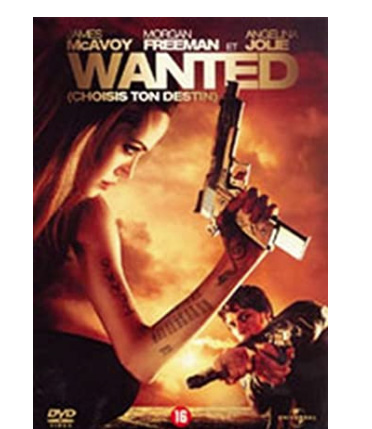
Wanted
Synopsis
Wesley Gibson is a miserable, anxiety-ridden office worker stuck in a dead-end job with a cheating girlfriend and a nagging boss. His monotonous life is abruptly shattered when a lethal assassin named Fox recruits him into a secret society of ancient assassins called the Fraternity. Fox reveals that Wesley's estranged father was an elite member of the Fraternity recently murdered by a rogue assassin named Cross. Trained by veteran mentor Sloan, Wesley discovers he possesses superhuman reflexes that allow him to curve bullets through the air. Stepping into his destiny, Wesley transforms from a weakling into an unstoppable killing machine.
The Making of the Film
Adapted from Mark Millar and J.G. Jones's controversial 2004 comic book miniseries, the film adaptation was directed by Timur Bekmambetov in his Hollywood directorial debut. Bekmambetov wanted to bring his signature visual flair, gravity-defying action, and stylized CGI bullet-curving mechanics to the big screen. The screenplay significantly altered the comic's dark tone to focus on corporate office satire and superhero-style action. James McAvoy was cast to anchor the underdog transformation.
Critical Reception
Critical reception for the film was generally positive, with reviewers praising its breathtaking visual effects, relentless action pacing, and James McAvoy's charismatic lead performance. Critics lauded Bekmambetov's hyper-stylized direction and inventive action set pieces, such as the train derailment sequence. Audiences embraced the popcorn blockbuster spectacle, turning it into a massive box office hit worldwide. It is remembered as a defining action movie of the late 2000s.
Filming Anecdotes
James McAvoy performed numerous physical stunts, including intense running and martial arts combat, though he suffered minor bruises during the keyboard smashing fight scene. Angelina Jolie brought iconic screen presence to her role as Fox, executing complex gun-fu maneuvers with effortless grace. The famous curved bullet physics required intricate CGI development and pre-visualization camera work. Director Timur Bekmambetov utilized rapid editing and extreme slow-motion to accentuate the visual impact of bullet trajectories.
Themes Explored
The film explores destiny, self-actualization, breaking free from corporate mediocrity, and taking control of one's life. It highlights revenge, familial legacy, and moral ambiguity within secret societies. Absolute control versus free will is a central philosophical debate revealed in the climax. It also touches upon workplace rebellion.
Ending Explained
It is revealed that the Fraternity's leader, Sloan, has been manipulating the loom of fate to assassinate targets for personal profit rather than preserving destiny. In the final thrilling sequence, Wesley executes a legendary "curve bullet" shot that simultaneously eliminates Sloan and all remaining corrupt assassins in the room. Wesley walks away financially secure, confident, and fully transformed into the ultimate master assassin. The conclusion delivers a triumphant, fourth-wall-breaking finale.
Meaning of the Title
The title refers directly to the criminal wanted posters and the protagonist's transition from being an unwanted nobody to a wanted master assassin. It highlights the high-stakes fugitive and action-packed nature of the plot. The single-word title sets an edgy, rebellious tone.
Danny Elfman composed an adrenaline-pumping, electric guitar and orchestral score that amplified the frantic action energy.
The Matrix, John Wick, Kingsman: The Secret Service, Equilibrium