

 Français
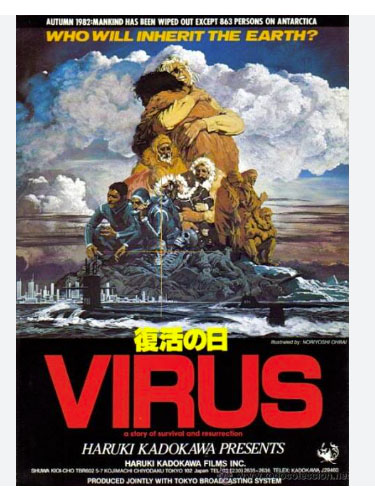
Virus
Synopsis
Following a catastrophic military laboratory accident in the Swiss Alps, a lethal biological weapon engineered by the United States known as the "MM88 virus" is accidentally unleashed upon the world, wiping out nearly the entire human population of planet Earth almost overnight. Because the virus remains entirely dormant in sub-zero temperatures, the icy wasteland of Antarctica becomes the sole sanctuary for a small international group of military personnel and scientists stationed at McMurdo Sound who survived the initial pandemic. However, their fragile survival is soon threatened by an automated military defense system programmed to retaliate against foreign powers even after human creators have perished, triggering an impending nuclear missile launch that will destroy the Antarctic bunker. To save the last remnants of humanity, the international survivors must embark on a perilous, freezing journey across the polar continent.
The Making of the Film
Directed by legendary Japanese auteur Kinji Fukasaku, this big-budget science fiction disaster epic (Fukkatsu no Hi) was produced by Kadokawa Haruki Corporation as the most expensive Japanese film ever made at the time of its release. Filmmakers adapted Komatsu Sakyo's acclaimed sci-fi novel to explore apocalyptic nuclear annihilation and global pandemic fears during the height of the Cold War. The production secured unprecedented cooperation from the Japanese Maritime Self-Defense Force and real naval vessels. Principal photography took place across authentic, freezing Antarctic locations in McMurdo Sound, alongside massive studio soundstages in Japan, utilizing state-of-the-art miniature special effects. The film featured a massive international star cast.
Critical Reception
Critics gave the film mixed reviews upon release, praising its ambitious global scale, stunning Antarctic cinematography, and terrifying apocalyptic premise while critiquing its sprawling runtime and uneven dramatic pacing. Reviewers highlighted the chilling realism of a global pandemic combined with automated nuclear dead-man switches. Commentators noted that Fukasaku brought his trademark uncompromising intensity to a massive sci-fi canvas. Over decades, the film has achieved cult classic status for its chillingly prescient themes.
Audiences in Japan turned the epic disaster film into a major box office event, though international theatrical distribution faced heavy studio editing and shorter cuts. Sci-fi fans and disaster film enthusiasts praised the breathtaking physical scale, real icebreaker ships, and grim philosophical exploration of human self-destruction. Viewers appreciated the stark warning against nuclear proliferation. Social media and retrospective reviews frequently celebrate its bold apocalyptic vision.
While traditional major awards in 1980 largely bypassed sci-fi epics, the film earned technical recognition within Japanese film industry awards for special effects and cinematography. Critics' circles commended Fukasaku's fearless directorial scope. Industry analysts noted its monumental production budget as a bold milestone in Japanese cinema history. It remains a legendary, chilling monument in apocalyptic science fiction cinema.
Behind-the-Scenes Stories
Director Kinji Fukasaku insisted on flying a full Japanese film crew and international actors directly to the freezing continent of Antarctica to shoot authentic exterior survival sequences, making it the first Japanese feature film shot on location in the South Pole. The cast endured harsh polar winds and sub-zero temperatures to ensure the physical exhaustion and frostbite looked entirely genuine on camera. The production utilized real nuclear icebreaker ships for naval sequences.
Production faced extreme logistical hurdles coordinating complex international travel, heavy camera gear insulation against freezing air, and massive miniature scale-model destruction on Tokyo soundstages. Special effects artists built elaborate automated missile silos and crumbling cities. Wardrobe designers outfitted actors in genuine polar expedition parkas. Sound designers layered howling wind audio with haunting electronic synth arrangements.
During the filming of an outdoor polar traverse sequence, a sudden whiteout blizzard temporarily blinded the camera operators, leading to a mandatory safety retreat inside heated base camps that was handled with disciplined efficiency by the military advisors. The prop department manufactured authentic scientific monitoring equipment and military survival gear. Cameras utilized specialized cold-weather film magazines.
Casting a massive international ensemble brought global prestige, featuring Japanese star Tsunehiko Watase alongside Hollywood veterans Glenn Ford, George Kennedy, Olivia Hussey, Chuck Connors, and Robert Vaughn. Each actor brought gravitas to their respective national scientific roles.
Themes Explored
Nuclear annihilation, Cold War paranoia, and the destructive folly of military-industrial complexes form the central apocalyptic warning of the narrative. Global pandemic, biological warfare, and human fragility in the face of nature and science are explored with grim realism. International cooperation versus nationalist stubbornness even after civilization collapses highlights human self-destructiveness. Additionally, hope for human rebirth in the face of total extinction drives the survivors.
Ending Explained
Following the activation of the automated nuclear defense system's dead-man switch, the Antarctic survivors realize they cannot stop the missile launch targeting the southern hemisphere, forcing them to scatter or perish. Major Shuzo Kitajima manages to survive the catastrophic automated nuclear strikes by sheltering deep within a specialized geological fissure, while fellow survivor Yuriko also manages to endure in a separate polar pocket. Years later, as the radioactive winter slowly begins to clear across a desolate planet Earth, Shuzo walks across the silent shores of South America, eventually reuniting with Yuriko, realizing they are the ultimate Adam and Eve tasked with repopulating a clean, reborn world free from nuclear war. The poignant final shots show the two survivors gazing at the horizon. The satisfying conclusion resolves global extinction with a tender spark of human rebirth.
Meaning of the Title
Refers directly to the deadly man-made biological pathogen ("MM88 virus") that annihilates global human civilization at the start of the story.
Original Soundtrack
A haunting, melancholic orchestral and electronic synth score composed by Teo Macero and Kentaro Haneda, featuring soaring choral themes and desolate polar ambient soundscapes.
Similar Films
On the Beach, The Andromeda Strain, Dr. Strangelove, Contagion, The Day After.