

 Français
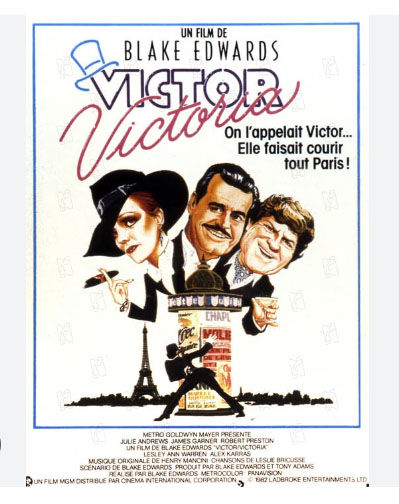
Victor/Victoria
Synopsis
In 1934 Paris during the depths of the Great Depression, Victoria Grant is a talented but starving British soprano struggling to find work in cabarets. After yet another failed audition, she meets a flamboyant, aging gay nightclub performer named Toddy, who hatches a brilliant, desperate scheme: Victoria should disguise herself as a man who performs as a female impersonator. Adopting the stage persona of "Count Victor Grezhinski," Victoria becomes an overnight sensation across Parisian nightclubs, dazzling high-society crowds and gangsters alike. However, complications arise when King Marchan, a tough, wealthy American Chicago mobster visiting Paris, falls in love with "Victor," throwing his own rigid heterosexual identity into deep confusion as he pursues a romance with a person he believes is a man. As gossip spreads and gangsters close in, maintaining the elaborate double-identity becomes a hilarious, high-stakes tightrope walk.
The Making of the Film
Written and directed by legendary comedy auteur Blake Edwards, this musical comedy was adapted from a 1933 German film of the same name (Viktor und Viktoria). Edwards wanted to create a sophisticated, glittering farce that playfully subverted traditional gender roles, sexual identity, and 1930s morality codes. He tailored the lead role specifically for his wife, Julie Andrews, to showcase her legendary vocal range and immaculate comedic timing. Principal photography took place across lavishly constructed soundstages in England, recreating a glamorous, romanticized 1930s Paris. Henry Mancini composed the iconic musical numbers with lyrics by Leslie Bricusse.
Critical Reception
Critics gave the film glowing, enthusiastic reviews upon release, praising its sparkling wit, brilliant musical numbers, immaculate period art direction, and Julie Andrews' tour-de-force lead performance. Reviewers highlighted how Blake Edwards handled themes of gender fluidity and sexual ambiguity with immense charm, elegance, and progressive humor. The laugh-out-loud supporting performances of Robert Preston and James Garner received universal critical acclaim. Many commentators noted it as one of the finest musical comedies ever made.
Audiences embraced the glamorous musical farce enthusiastically at box offices worldwide, turning it into a major commercial and cultural hit. Fans of musical theater and classic comedy enjoyed the sparkling dialogue, elaborate cabaret numbers, and delightful confusion surrounding King Marchan's romantic dilemma. Viewers praised the progressive, open-minded celebration of love and identity. Social media and film retrospectives frequently celebrate its timeless comedic brilliance.
At the Academy Awards, the film earned seven major nominations, including Best Actress for Julie Andrews, Best Supporting Actor for Robert Preston, and Best Supporting Actor for Lesley Ann Warren, ultimately winning the Oscar for Best Original Song Score. It also won Golden Globe Awards for Andrews. Critics' circles worldwide named it a masterclass in cinematic farce. Industry analysts praised its enduring cultural legacy. It remains a legendary landmark in musical comedy history.
Behind-the-Scenes Stories
Director Blake Edwards spent years trying to get the musical comedy financed, as studio executives in the late 1970s were nervous about the film's progressive exploration of fluid gender roles and homosexuality. Julie Andrews threw herself into intense vocal training and physical posture coaching to convincingly portray a woman pretending to be a gay man performing as a woman. Robert Preston brought infectious theatrical joy to every scene as the mentor Toddy.
Production faced unique logistical hurdles coordinating massive, highly choreographed cabaret musical numbers on elaborate London soundstages with dozens of professional dancers and musicians. The art department constructed stunning Parisian art-deco nightclub interiors. Costume designers fabricated hundreds of glamorous 1930s evening gowns and sharp men's tailored tuxedos. Sound designers recorded Julie Andrews' singing voice live on set during several key performance sequences.
During the filming of a hilarious hotel bedroom farce scene involving mistaken identities and sliding doors, James Garner accidentally tripped over a prop rug, leading to an unscripted laugh that Blake Edwards kept in the final film because it felt so natural. The prop department manufactured vintage champagne flutes and cabaret microphones. Cameras utilized soft, glowing lenses to evoke 1930s romance.
Casting Julie Andrews in the dual gender-bending role was a masterstroke, showcasing her unmatched comedic elegance and vocal brilliance. Robert Preston delivered a legendary, heartwarming performance as Toddy. James Garner brought rugged, confused American charm to King Marchan, while Lesley Ann Warren stole scenes as his brassy moll.
Themes Explored
Gender fluidity, performative identity, and the artificiality of societal rigidness form the central satirical backbone of the musical. Homophobia, social hypocrisy, and 1930s moral codes are gently skewered through Parisian high-society gossip. True love transcending conventional labels and physical appearances is celebrated in King Marchan's romantic awakening. Additionally, artistic reinvention during economic hardship drives the protagonists' survival.
Ending Explained
Following a series of hilarious public deceptions, gangster threats, and near-exposures, Victoria and Toddy stage an elaborate final public performance where "Victor" dramatically announces his retirement, removing his wig and revealing her true female identity to all of Parisian high society. King Marchan publicly embraces Victoria, having moved entirely past his initial homophobic anxieties to realize he loves her unconditionally regardless of labels. The gangsters are thwarted, Toddy and his partner find artistic triumph, and the romantic couples unite in joyful celebration. The heartwarming final shots show the glittering Parisian cabaret audience applauding wildly. The satisfying conclusion resolves all gender confusions with joyous applause.
Meaning of the Title
Refers directly to the protagonist's dual stage identity—"Victor" (her male persona) and "Victoria" (her real female identity).
Original Soundtrack
A dazzling, Oscar-winning musical score and song suite composed by Henry Mancini with lyrics by Leslie Bricusse, featuring showstopping numbers like "Le Jazz Hot."
Similar Films
Some Like It Hot, Tootsie, Cabaret, The Birdcage, What's Up, Doc?.