

 Français
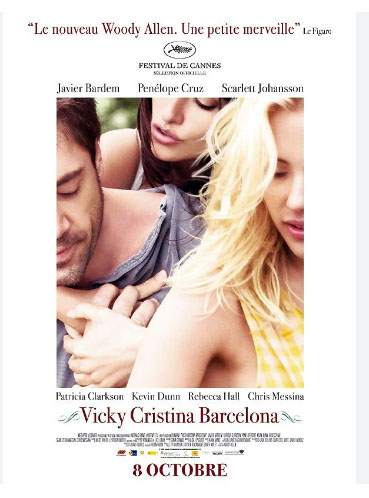
Vicky Cristina Barcelona
Synopsis
Two American college friends, the pragmatic Vicky and the romantic Cristina, spend a sun-drenched summer vacation in Barcelona staying with distant relatives. Vicky is traditional, engaged to be married, and focused on sensible life choices, whereas Cristina is impulsive, artistic, and searching for passion. During an art gallery visit, they are both captivated by Juan Antonio, a charismatic and bohemian Spanish painter who boldly invites them to join him for a weekend getaway in Oviedo. Once there, their lives become intensely entangled when Juan Antonio's volatile, brilliantly unstable ex-wife Maria Elena unexpectedly moves back into his life, creating an eccentric, passionate polyamorous quadrangle. As the Spanish summer unfolds, each woman confronts deep truths about love, art, and personal desire.
The Making of the Film
Written and directed by Woody Allen, this romantic comedy-drama was produced to celebrate the vibrant culture, architecture, and romantic atmosphere of Spain following a production financing partnership with Spanish producers. Allen wanted to explore the complexities of modern love and bohemian relationships through the contrasting perspectives of two American tourists encountering an untamed European artist. Principal photography took place entirely on location across Barcelona, Oviedo, and surrounding Catalan regions, utilizing stunning Antoni Gaudí architecture as a visual canvas. The production assembled an elite international cast of powerhouse actors.
Critical Reception
Critics gave the film overwhelmingly positive reviews, praising its sparkling dialogue, gorgeous sun-drenched cinematography, and Penelope Cruz's electrifying, Oscar-winning supporting performance. Reviewers highlighted how Allen captured the intoxicating artistic spirit of Barcelona while weaving a sophisticated, witty romantic quadrangle. The humorous voiceover narration and stellar chemistry among Scarlett Johansson, Rebecca Hall, and Javier Bardem received widespread critical acclaim. Many commentators noted it as one of Allen's finest 21st-century films.
Audiences embraced the romantic drama enthusiastically at box offices worldwide, turning it into one of Woody Allen's most commercially successful modern releases. Fans of romantic cinema enjoyed the lush European scenery, bohemian philosophy, and passionate dramatic outbursts. Viewers praised the nuanced exploration of different types of romantic longing. Social media and film retrospectives frequently celebrate Penelope Cruz's fiery screen presence.
At the Academy Awards, Penelope Cruz won the Oscar for Best Supporting Actress, while the film earned numerous Golden Globe nominations, winning the Golden Globe for Best Motion Picture – Musical or Comedy. Critics' circles worldwide named it a major highlight of the cinematic year. Industry analysts praised its profitable independent international financing model. It remains a celebrated modern classic in romantic comedy-drama history.
Behind-the-Scenes Stories
Director Woody Allen famously approached tourism boards and local production companies with a simple premise: he wanted to make a cinematic love letter to Barcelona, resulting in swift financial backing and complete creative freedom. Javier Bardem spoke fluent Spanish and English on set, helping bridge communication between the American actresses and local Spanish crew members. The director encouraged naturalistic, flowing conversational performances.
Production faced unique logistical hurdles coordinating shooting permits around crowded tourist landmarks in Barcelona, requiring early morning call times to capture empty streets near Gaudí architecture. The art department decorated Juan Antonio's bohemian country villa with authentic Spanish artwork and rustic pottery. Costume designers dressed Scarlett Johansson and Rebecca Hall in breezy summer tourist attire contrasting with Penelope Cruz's fiery artistic bohemian wardrobe. Cinematographer Javier Aguirresarobe utilized warm golden-hour lighting filters.
During the filming of a passionate shouting match between Javier Bardem and Penelope Cruz in Spanish, the intensity was so authentic that the American crew members stood in stunned silence between takes, wondering if the actors were actually fighting. The prop department manufactured authentic paintings and wine bottles. Cameras utilized fluid tracking shots.
Casting Javier Bardem as the irresistible painter brought effortless Latin charm and intellectual seduction to the film. Scarlett Johansson and Rebecca Hall provided a brilliant psychological contrast as Cristina and Vicky. Penelope Cruz delivered a legendary, fiery masterclass in comedic and dramatic volatility as Maria Elena.
Themes Explored
Unconventional relationships, polyamory, and the eternal quest for romantic fulfillment form the central philosophical core of the narrative. Pragmatism versus romantic idealism is embodied by Vicky and Cristina's contrasting worldviews. Art, passion, and emotional volatility are explored through Juan Antonio and Maria Elena's turbulent artistic marriage. Additionally, the magical, transformative atmosphere of Barcelona shapes every character's inner awakening.
Ending Explained
Following a chaotic, emotionally explosive summer that leaves deep psychological marks on everyone involved, Vicky breaks off her traditional engagement and returns home to America, disillusioned yet forever changed by her Spanish awakening, while Cristina realizes she still does not know what she wants out of life and packs her bags to travel elsewhere. Maria Elena and Juan Antonio's passionate reconciliation ultimately dissolves once again into independent artistic solitude. The film concludes with Vicky back in her predictable American life, haunted by the lingering memory of bohemian passion she left behind in Catalonia. The poignant final voiceover reflects on the permanent mysteries of the human heart. The satisfying conclusion leaves all romantic questions deliberately unresolved.
Meaning of the Title
Refers directly to the names of the two American female protagonists and the vibrant Spanish city where their romantic awakening takes place.
Original Soundtrack
A lively, evocative acoustic guitar score featuring traditional Spanish flamenco music, notably highlighted by the recurring theme "Granada" performed by Giulia Valenti.
Similar Films
Midnight in Paris, Match Point, Before Sunrise, Roman Holiday, Vicky Cristina Barcelona style romances.