

 Français
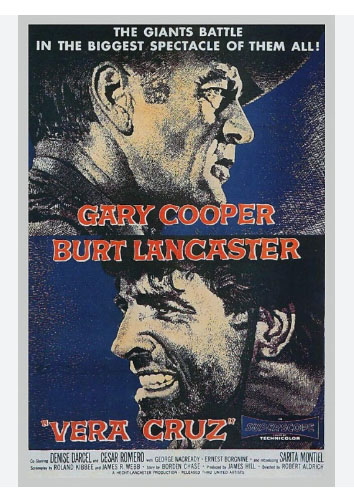
Vera Cruz
Synopsis
During the turbulent era of the Franco-Mexican War in the 1860s, two opportunistic American adventurers—former Confederate soldier Ben Trane and charismatic gunslinger Joe Erin—travel to Mexico seeking fortune and glory. They are hired by the doomed Emperor Maximilian's forces to escort a wealthy French countess and a secret carriage containing three million dollars in gold safely to the port city of Veracruz. However, as greed and shifting loyalties take hold, both men find themselves torn between supporting the corrupt imperial army or aiding the Mexican revolutionary freedom fighters led by Benito Juárez. With betrayal lurking at every turn, the two mercenaries must decide where their true loyalties lie before reaching the gold.
The Making of the Film
Directed by legendary action auteur Robert Aldrich, this gritty, cynical western was produced by Hecht-Lancaster Productions and released by United Artists to redefine traditional Hollywood western tropes. Screenwriters Roland Kibbee and James R. Webb crafted a morally ambiguous script where heroes and villains blur into ruthless anti-heroes driven purely by greed. The filmmakers wanted to inject European-style cynicism and fast-paced action into the American western genre. Principal photography took place across rugged, sun-drenched locations in Mexico, utilizing authentic historic backdrops and massive crowd scenes. Burt Lancaster and Gary Cooper brought incredible star power and physical contrast to the dual lead roles.
Critical Reception
Critical Reception
Critics gave the film positive reviews upon release, praising its gritty action choreography, witty cynical dialogue, and the electric screen chemistry between Burt Lancaster and Gary Cooper. Reviewers highlighted how Aldrich subverted traditional western morality, presenting protagonists who were unashamedly motivated by money rather than noble ideals. The dynamic fight sequences and authentic Mexican landscapes received widespread acclaim from film critics. Many commentators noted its pioneering influence on the upcoming Spaghetti Western genre.
Audiences embraced the action-packed western enthusiastically at the box office, turning it into a major commercial hit worldwide. Fans of adventure cinema enjoyed the high-stakes double-crosses, charismatic villains, and thrilling horseback shootouts. Viewers praised Gary Cooper's stoic charm alongside Burt Lancaster's flamboyant, grinning scoundrel. Social media and retrospective film reviews continue to celebrate its cynical humor.
While traditional award ceremonies in the 1950s largely overlooked action westerns, the film earned enduring praise from film historians and directors like Sergio Leone, who cited it as a major inspiration for his own spaghetti western masterpieces. Critics' circles commended Aldrich's brisk directorial pacing and moral ambiguity. Industry analysts highlighted its profitable independent production model. It remains a classic cornerstone in revisionist western cinema history.
Behind-the-Scenes Stories
Director Robert Aldrich was determined to shatter clean-cut Hollywood cowboy clichés by making his protagonists genuinely roguish, untrustworthy, and driven by hard cash. Burt Lancaster, who was also a producer on the film, handpicked Gary Cooper to star alongside him, creating a fascinating stylistic clash between Cooper's traditional laconic hero and Lancaster's energetic, toothy rogue. The director encouraged his cast to lean into playful, morally flexible banter.
Production faced intense logistical hurdles shooting in remote, blistering Mexican desert locations where heat exhaustion and equipment transport issues tested the crew daily. Stunt coordinators engineered dangerous horseback falls and elaborate castle siege shootouts using real antique firearms. Wardrobe designers custom-tailored dusty cavalry uniforms and Mexican revolutionary peasant garb. Local Mexican extras were hired by the thousands to populate battle scenes.
During the filming of a tense knife-throwing duel between Burt Lancaster and Ernest Borgnine, Lancaster executed the prop throws with such casual precision that Borgnine's genuine nervous sweat added incredible realism to the scene. The prop department manufactured replica gold bullion crates filled with heavy lead blocks. Cameras utilized wide-angle lenses to capture vast desert horizons.
Casting Gary Cooper brought legendary western authority and quiet dignity to Ben Trane, while Burt Lancaster delivered an electrifying, charismatic performance as the untrustworthy Joe Erin. Denise Darcel played the sultry French countess, and a young Charles Bronson appeared in an early breakout supporting role as a deadly henchman.
Themes Explored
Themes Explored
Greed, moral corruption, and the corrupting power of money form the core philosophical driver for both anti-hero protagonists. Loyalty versus betrayal in high-stakes criminal partnerships is tested constantly as trust evaporates. Political revolution and foreign intervention in Mexican sovereignty provide a rich historical backdrop to the action. Additionally, honor among thieves versus absolute self-preservation defines the explosive finale.
Ending Explained
Following a massive, explosive battle at the port city of Veracruz between imperial forces, revolutionaries, and the greedy mercenaries, Joe Erin attempts to double-cross Ben Trane to steal the entire gold shipment for himself. In the ensuing tragic showdown on the cobblestone streets, Ben is forced to draw his gun and fatally shoot his former friend Joe, ending their turbulent partnership. With the imperial forces defeated and freedom fighters victorious, Ben chooses to leave the gold behind to help fund the Mexican revolution, riding away a wiser and more honorable man. The poignant final shots show Ben departing into the sunset with a newfound sense of moral redemption. The satisfying conclusion resolves all shifting loyalties with classic western grit.
Meaning of the Title
Meaning of the Title
Refers directly to the historic Mexican port city of Veracruz where the climax of the gold-escort mission and final betrayals take place.
Original Soundtrack
Original Soundtrack
A rousing, brass-heavy orchestral western score composed by Hugo Friedhofer, blending traditional Mexican folk motifs with sweeping cinematic adventure themes.
Similar Films
Similar Films
The Magnificent Seven, The Wild Bunch, The Professionals, A Fistful of Dollars, 3:10 to Yuma.