

 Français
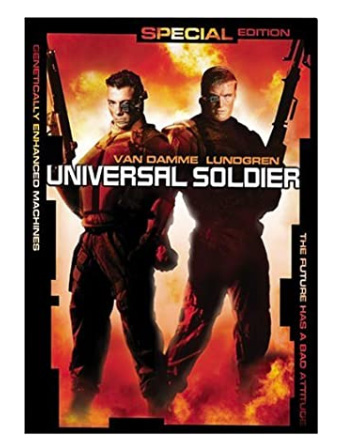
Universal Soldier
Synopsis
During the Vietnam War, soldiers Luc Deveraux and Andrew Scott kill each other in a brutal firefight but are secretly recovered by a top-secret military research project. They are resurrected decades later as elite, emotionless cybernetic super-soldiers known as "UniSols," programmed to eliminate terrorists without hesitation or fear. When Luc experiences a sudden glitch and flashes of human memory return, he abandons his mission and goes on the run with a terrified TV reporter. Meanwhile, the unhinged Scott suffers a psychotic relapse, reviving his homicidal programming and hunting Luc down across the American desert.
The Making of the Film
Directed by Roland Emmerich, the sci-fi action film was conceived as a high-concept action vehicle blending cyborg science-fiction with gritty 1990s military combat. Emmerich sought to create an explosive action blockbuster featuring state-of-the-art special effects and martial arts combat icons Jean-Claude Van Damme and Dolph Lundgren. The screenplay went through multiple rewrites to balance high-octane explosions with a cat-and-mouse dynamic between two opposing super-soldiers. The production utilized vast desert locations in Arizona to simulate remote military operations.
Critical Reception
Critical reception for the film was generally mixed, with reviewers praising its relentless action sequences, impressive physical stunts, and the intense rivalry between Van Damme and Lundgren. However, some critics faulted the script for its derivative plot elements borrowed heavily from Terminator and RoboCop. Audiences embraced the muscular action spectacle, turning it into a major box office success worldwide. It remains celebrated as a classic 1990s sci-fi action staple.
Filming Anecdotes
Jean-Claude Van Damme and Dolph Lundgren reportedly maintained intense competitive tension on set, which naturally fueled their fierce on-screen fight scenes. The infamous bathroom combat sequence required rigorous physical choreography and stunt safety precautions. The production faced extreme desert heat conditions while filming action scenes in the Arizona wastelands. Van Damme insisted on performing the majority of his own martial arts kicks and stunts.
Themes Explored
The film explores humanity versus cybernetic programming, free will, and the psychological trauma of military conflict. It highlights memory recovery, redemption, and the resurgence of human emotion over cold military conditioning. Government conspiracy and secret military experimentation drive the plot. It also touches upon fierce rivalry and survival.
Ending Explained
Luc engages in a brutal, bone-crunching final showdown with the psychotic Andrew Scott inside a processing facility. Using sheer human instinct and ingenuity, Luc overpowers Scott and destroys his cybernetic system once and for all. He reunites with the reporter, having reclaimed his humanity, memories, and identity. The conclusion provides a triumphant, explosive resolution to the cybernetic manhunt.
Meaning of the Title
The title is a portmanteau of "Universal" and "Soldier," representing the ultimate, mass-produced cybernetic military weapon created by the government. It highlights the soulless, standardized nature of the cyborg combatants. The name sets a futuristic, high-tech action tone.
Christopher Franke composed an industrial electronic synthesizer score that defined the sci-fi action sound of the early 1990s.
Terminator 2: Judgment Day, RoboCop, Predator, Hard Target