

 Français
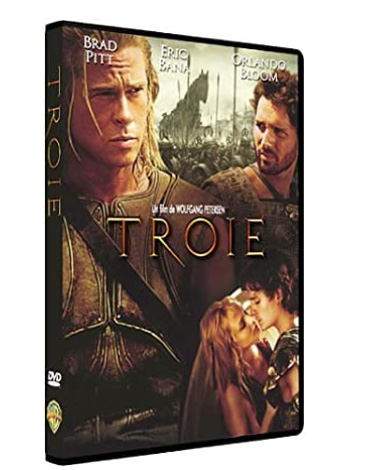
Troy
Synopsis
When Paris, a prince of Troy, runs away with Helen, the queen of Sparta, the Greek kings unite under Agamemnon to bring her back. The war pits the unbeatable warrior Achilles against Hector, the noble defender of Troy. As the siege drags on, love, pride and ambition lead to tragedy. The conflict ends with a clever trick that will change history.
The Making of the Film
Troy is a big-screen adaptation of Homer's epic poem The Iliad and the legendary story of the Trojan War. Director Wolfgang Petersen, who had made Das Boot and The Perfect Storm, wanted to bring the ancient story to life with a modern, human approach. Screenwriter David Benioff wrote the screenplay, removing the gods from the story to focus on the mortals. Brad Pitt was cast as Achilles, Eric Bana as Hector, Orlando Bloom as Paris and Diane Kruger as Helen. Peter O'Toole, Brian Cox and Sean Bean added to the star-studded cast. The production was one of the most expensive of its time, with a budget of around 175 million dollars. The film was released in 2004 and quickly drew comparisons to other historical epics such as Gladiator.
Reviews and reception
Summary of professional reviews
Critics were divided. Many praised the grand battle scenes, the production design and the performances of Pitt and Bana, while others criticized the changes from Homer's story and the sometimes stiff dialogue. The film was considered an impressive but imperfect epic.
Audience reception
Troy was a success, earning about 497 million dollars worldwide, with most of the money coming from outside the United States. Audiences enjoyed the spectacle and the star power. It remains a popular choice on television. Some viewers feel that it deserves more credit than it initially received.
Awards and nominations
The film received an Academy Award nomination for Best Costume Design. It was also nominated for several other awards, including some for its visual effects and its actors. It did not win major prizes, but it was recognized for its craftsmanship.
Filming anecdotes
Director's inspirations
Petersen wanted to portray the war as a human conflict full of ambition and pride rather than a clash of gods. He was inspired by the large-scale epics of classic Hollywood. The idea was to make Achilles a complex hero, brilliant in battle but troubled by his fate.
Production difficulties
The film was shot in Malta and Mexico, where huge sets were built to recreate the city of Troy and the Greek camp. Brad Pitt injured his Achilles tendon during training, which delayed filming for several weeks. Coordinating thousands of extras and complex fight scenes was a major challenge.
Anecdote about a particular scene
The duel between Achilles and Hector in front of the walls of Troy is the film's centerpiece. It required long rehearsals and careful choreography to make the fight look both beautiful and brutal. The scene shows the nobility of Hector and the ruthlessness of Achilles.
Themes explored
The film explores the cost of war and the vanity of glory. Achilles seeks immortal fame but must confront the loneliness of the warrior. The story deals with honor and duty, represented by Hector's loyalty to his city and family. Love is another driving force, with Paris and Helen's passion igniting the conflict. Pride and ambition lead to tragedy, especially in the character of Agamemnon. The film also reflects on fate and the idea that men are remembered for their deeds.
Ending explained
After Hector is killed by Achilles, King Priam begs for his son's body, and Achilles shows a moment of compassion. Later, the Greeks pretend to retreat, leaving behind a giant wooden horse. The Trojans bring it into the city, and the Greek soldiers hidden inside open the gates at night. Troy is burned, and Achilles is killed by an arrow in the heel shot by Paris. The film ends with the funeral of the hero and the escape of a few Trojans, led by Aeneas, who will found a new future.
Meaning of the title
Troy is the name of the ancient city that was besieged in the legendary war. The word has come to symbolize the clash between two civilizations. The title also suggests the idea of a city that falls through trickery and pride. It anchors the film in the myth that has fascinated readers for almost three thousand years.
Original Soundtrack
James Horner composed the score at a late stage, replacing an earlier score by Gabriel Yared. His music combines sweeping orchestral themes with ethnic vocals and gives the film a sense of ancient grandeur. The song Remember, performed by Josh Groban, accompanies the end credits.
Similar Films
- Gladiator (2000): a Roman general seeks revenge.
- 300 (2006): a stylized version of the Spartan stand at Thermopylae.
- Alexander (2004): a biographical epic about Alexander the Great.
- Kingdom of Heaven (2005): a medieval epic about the Crusades.
- Clash of the Titans (2010): a mythological adventure.