

 Français
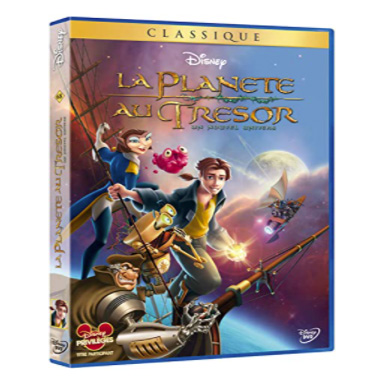
Treasure Planet
Synopsis
A rebellious teenage boy living in a futuristic sci-fi universe stumbles across a holographic map leading to the legendary "loot of a thousand worlds" hidden on a distant treasure planet. Joining an interstellar solar-galleon crew to fund a better life for his mother, he embarks on a dangerous voyage across the cosmos. Aboard the ship, he forms a deep, unexpected father-son bond with the ship's cyborg cook, who is secretly plotting a mutiny. This visually stunning animated adventure reimagines Robert Louis Stevenson's classic novel in outer space.
The Making of the Film
The idea for Treasure Planet was originally pitched by directors Ron Clements and John Musker during the production of The Little Mermaid as a sci-fi adaptation of Robert Louis Stevenson's Treasure Island. Disney executives repeatedly turned down the pitch for decades until the directors finally secured greenlight approval following the massive success of Aladdin and Hercules. The creative team wanted to merge classic 17th-century maritime aesthetics with high-tech steampunk space opera elements, creating a unique visual style known as "painting with light." The production spent years developing groundbreaking hybrid animation techniques combining hand-drawn characters with complex 3D environments.
Critical Reception
Professional critics gave mixed-to-positive reviews to Treasure Planet, praising its breathtaking visual ambition, sweeping orchestral score, and emotional father-son dynamic while noting narrative pacing flaws. Reviewers commended the bold sci-fi re-imagining of a literary classic even if some felt the futuristic world-building occasionally overwhelmed the plot. The public response was unfortunately disappointing at the box office, making it one of Disney's most famous financial disappointments despite its cult following. Audiences who discovered the film later on home video grew to deeply cherish its emotional depth and unique aesthetic. The film received an Academy Award nomination for Best Animated Feature.
Filming Anecdotes
Directors Ron Clements and John Musker drew inspiration from classic maritime adventure novels, traditional pirate lore, and epic sci-fi films like Star Wars. Production required the invention of an innovative animation system called "Deep Canvas," allowing artists to paint characters directly inside fully rotatable 3D digital environments. During the voice recording sessions, veteran actor Brian Murray and young Joseph Gordon-Levitt built an incredible, authentic emotional bond that translated into the powerful chemistry between Long John Silver and Jim Hawkins. Before production began, the script underwent years of revisions to replace traditional pirates with alien crew members.
Main Themes
The film explores deep themes of mentorship, abandonment, redemption, personal growth, and finding one's true potential despite a troubled past. It highlights how unexpected friendships can heal emotional wounds and reshape a young person's destiny. Additionally, it celebrates courage, exploration, and perseverance.
Ending Explanation
The climax resolves the interstellar mutiny when the treasure planet begins to self-destruct after the ancient booby traps are triggered by greedy pirates. Jim Hawkins risks his life using a futuristic solar-surfer board to rescue his mentor, Long John Silver, and escape the exploding planet just in time. Silver chooses to surrender his stolen treasure to save Jim's life, parting ways as a reformed father figure who leaves behind a parting token of gold. Jim returns home a celebrated hero, making his mother proud and honoring his late father's memory. The film ends on a joyful, celebratory note honoring cosmic friendship.
Title Significance
The title directly describes the ultimate destination of the film's space voyage: the legendary planet where Captain Flint hid the astronomical riches of the universe.
The film features a magnificent, soaring orchestral and rock-infused musical score and soundtrack composed by James Newton Howard, highlighted by Goo Goo Dolls frontman John Rzeznik's iconic anthem "I'm Still Here."
NULL
Atlantis: The Lost Empire, Titan A.E., Sinbad: Legend of the Seven Seas, Treasure Island