

 Français
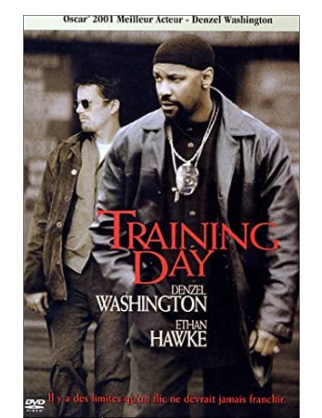
Training Day
Synopsis
Jake Hoyt is an idealistic rookie cop who gets his chance to join an elite narcotics unit of the Los Angeles Police Department. His first day on the job is under the guidance of Alonzo Harris, a charismatic and feared veteran detective. As the day goes by, Jake realizes that Alonzo's methods are far from legal and that he is being drawn into a dangerous game. With his life on the line, he must decide how far he is willing to go to survive.
The Making of the Film
Training Day was directed by Antoine Fuqua and written by David Ayer, who drew on his own knowledge of the neighborhoods and police culture of Los Angeles. The screenplay explores the moral gray zone of street policing, where the line between law enforcement and crime can blur. Denzel Washington plays Alonzo Harris, a role that sharply departs from the heroic figures he had often portrayed. Ethan Hawke plays the young officer who must navigate this corrupt world. The film was shot on location in some of the toughest neighborhoods of Los Angeles, which gives it a raw authenticity. It was released in the fall of 2001.
Reviews and Reception
Summary of Professional Reviews
Critics widely praised the film for its tension, its gritty atmosphere and above all Denzel Washington's magnetic performance. Many described the first two thirds as a gripping psychological duel between the two leads. Some reviewers felt that the final act turned into a more conventional action thriller. Nonetheless, the film was largely seen as a major success.
Audience Reception
Audiences embraced the film, which became a solid commercial hit. Alonzo Harris quickly entered popular culture as one of cinema's memorable villains, and several of his lines became widely quoted. The film also gained a strong following among viewers who appreciate crime dramas rooted in a realistic setting. It remains a reference point for the genre.
Awards Received
Denzel Washington won the Academy Award for Best Actor for his performance, a rare win for a villainous role. Ethan Hawke received an Oscar nomination for Best Supporting Actor. The film also received recognition from various critics' groups and award ceremonies. Its success marked a turning point in the careers of both its leading actors.
Filming Anecdotes
Production Challenges
Fuqua wanted to shoot in real Los Angeles neighborhoods, even in areas where outside productions rarely went. This approach added authenticity but also complicated the logistics of filming. The production reportedly worked with local residents to ensure a safe and respectful shoot. The raw backdrops make the city itself feel like a character.
Anecdote About a Particular Scene
One of the film's most famous lines, the furious declaration that begins with a comparison to King Kong, is widely reported to have been improvised by Denzel Washington. The moment captures the character's unraveling and has become one of the actor's best-known scenes. It illustrates how much of the film's intensity came from the actors' freedom on set.
Themes Explored
The film is a study of corruption and the abuse of power. It examines how a system that is supposed to protect people can be twisted by those who control it. Alonzo's philosophy that it takes a wolf to catch a wolf raises uncomfortable questions about whether the ends justify the means. Jake represents the struggle to keep one's integrity in a world that rewards compromise. The story also reflects on masculinity, loyalty and the thin line between order and chaos. Los Angeles is portrayed as a place where the street rules are stronger than the law.
Ending Explained
In the final act, Alonzo's double life collapses as the people he has betrayed come for him. Jake, who has survived the day by standing up to Alonzo, emerges as the moral victor of the story. Alonzo meets a violent end on the very streets he believed he owned. The ending delivers a sense of poetic justice, showing that a man who lives by his own rules can lose everything in a single day.
Meaning of the Title
The title refers to the day on which Jake is supposed to be trained by Alonzo. It sounds routine, almost bureaucratic, which is precisely what makes it ironic: the "training" is a brutal lesson in survival and corruption. The whole film takes place over a single twenty-four-hour period, which reinforces the title's idea of a decisive day.
Soundtrack
The film mixes a tense score by Mark Mancina with a strong selection of hip-hop tracks. The soundtrack reflects the street culture of Los Angeles and adds to the film's gritty realism. Several rappers also appear in small roles, deepening the connection between the music and the setting.
News
A television series based on the film, also called Training Day, aired on CBS in 2017 and 2018.
Similar Films
- Serpico (1973): a police officer faces corruption within the force.
- L.A. Confidential (1997): a noir about crime and corruption in Los Angeles.
- Dark Blue (2002): another thriller about a corrupt LAPD officer.
- End of Watch (2012): a gritty portrait of street police work, also written by David Ayer.