

 Français
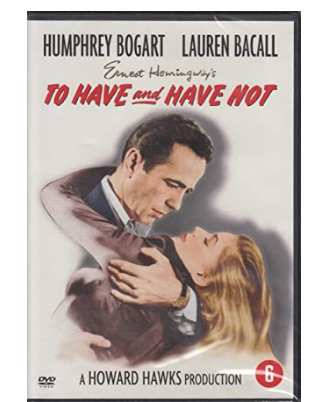
To Have and Have Not
Synopsis
In 1940, on the French island of Martinique under Vichy rule, Harry Morgan, an American fishing-boat captain, tries to stay out of politics and earn a living by chartering his boat. His neutrality is tested when the local Resistance asks him to ferry a fugitive leader and his wife, and when the police put him under pressure. Along the way he meets Marie, nicknamed Slim, a young drifter with a talent for sharp banter and a sultry stare. As feelings grow between them, Harry must decide whether he is willing to risk everything for a cause that is not his own.
The Making of the Film
The film is loosely adapted from Ernest Hemingway's 1937 novel of the same name, a tale of smuggling and desperation set in the Caribbean and Florida. According to a story the director liked to tell, Howard Hawks bet Hemingway that he could make a good movie out of what Hemingway considered one of his weakest books. The screenplay was written by Jules Furthman and William Faulkner, who reshaped the novel almost completely and kept little beyond the main character and his boat. The setting moved to Vichy-controlled Martinique, in part for political reasons, since the American government was careful about how Latin American countries were portrayed during the war. Warner Bros. was also eager to repeat the success of Casablanca, which had made a hit of a similar mixture of romance, cynicism and wartime intrigue. Hawks wanted to build the film around Humphrey Bogart's world-weary screen persona and give him a partner who could match him line for line. That partner was a 19-year-old model named Lauren Bacall, who had been noticed by Hawks's wife, Nancy, nicknamed Slim, after appearing on the cover of a fashion magazine. Her character took the nickname Slim, and the story of a tough loner learning to care for someone became the heart of the film.
Reviews and Reception
Critics welcomed the film as a stylish, witty adventure that put a fresh romantic spin on the wartime thriller. They singled out the crackling chemistry between Bogart and Bacall, the sharp dialogue and Hawks's relaxed, confident direction. Some noted that the plot echoed Casablanca, but most agreed that the film found its own voice through its sparring and humor. Walter Brennan's comic turn as the boozy Eddie also earned warm remarks.
Audiences embraced the film, and it turned Lauren Bacall into a star almost overnight. Her husky voice and unflinching gaze became the stuff of legend, and her partnership with Bogart captivated the public both on and off screen. The two married in 1945, a love story that only added to the film's mystique. Over the decades it has remained a favorite of classic Hollywood fans.
The film did not figure among the major Oscar contenders of its year, but its reputation has grown with time. The scene in which Slim teaches Harry how to whistle is counted among the best-known lines in American cinema. It is regularly cited in lists of the most memorable movie quotes.
Filming Anecdotes
Hawks was famous for working from instinct, and he often rewrote scenes on the day they were shot. Faulkner and Furthman supplied pages while filming was underway, which gave the dialogue its loose, improvised feel. Hawks encouraged Bogart and Bacall to play off each other, and the sparks between them shaped how the romance developed on screen. The director also liked to pair tough, competent men with equally tough, competent women, a signature of his films.
Because the film was made during the war, the production had to take political sensitivities into account. Moving the story from Cuba to Martinique was one of the adjustments made to keep within the guidelines of the time. Bacall was extremely nervous on her first film, and she reportedly trembled so much that she learned to keep her chin down and look up at the camera. That posture became the famous look that defined her image. Hawks also reportedly had her work on lowering her voice, which gave her the smoky tone audiences remember.
The film's most celebrated moment is Slim's whistling line, delivered as she leaves Harry's room: just put your lips together and blow. The scene is a perfect example of the playful, confident romance that Hawks favored. It works because Bacall delivers it with total composure, while Bogart is visibly charmed and caught off guard.
Themes Explored
The central theme is the tension between neutrality and commitment. Harry Morgan begins as a man who insists he is only looking out for himself, and the film follows his slow, reluctant realization that staying out of the fight is not really an option. This mirrors the position of many Americans before they entered the war, which gave the film a clear wartime resonance. Love is the second great theme, treated as a partnership between equals rather than a conquest. Slim is bold, witty and independent, and she challenges Harry's defensive cynicism at every turn. Loyalty, friendship and courage shape the secondary characters, from the loyal drunk Eddie to the members of the Resistance. Beneath the banter, the film also asks what it means to act on principle in a world where authority is corrupt and the stakes are very personal.
Ending Explained
By the end, Harry has been drawn into the struggle against the Vichy authorities, helping the Resistance and taking real risks to protect the people he has come to care about. The tension that built up through the film is released in a confrontation with the local police, after which Harry's choice is clear. He sides with the Resistance and leaves the bar with Slim, now committed both to a cause and to her. The conclusion is hopeful rather than tragic, in keeping with the light, romantic tone of the film. It suggests that a man who has spent years alone can find purpose when he finally allows himself to join something larger than himself.
Meaning of the Title
The title comes from Hemingway's novel and refers to the divide between the haves and the have-nots, those with money and security and those without. In the book, it speaks to class and poverty in the Depression era. In the film, the phrase takes on a moral meaning as well, contrasting people who have a cause to fight for with those who stand apart from it. Harry begins as a have-not in every sense, with no allegiance and almost no money. By the end, he has gained something far more valuable, which is a commitment.
Original Soundtrack
Songwriter Hoagy Carmichael appears in the film as the pianist Cricket and performs songs including How Little We Know and Hong Kong Blues. These musical interludes give the bar scenes a warm, lived-in atmosphere and have become part of the film's enduring charm. The songs are woven into the romance, which makes them feel like part of the story rather than simple decoration.
Similar Films
- Casablanca (1942), Michael Curtiz
- The Big Sleep (1946), Howard Hawks
- Dark Passage (1947), Delmer Daves
- Key Largo (1948), John Huston
- Sahara (1943), Zoltan Korda