

 Français
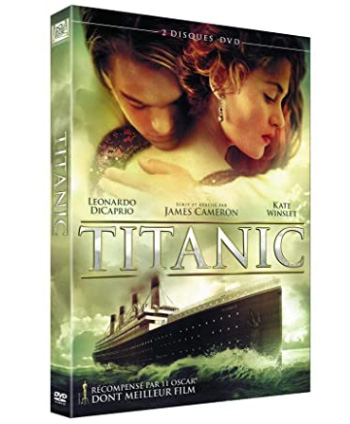
Titanic
Synopsis
In 1912, the luxurious RMS Titanic sets sail on its maiden voyage across the Atlantic. On board, a young and penniless artist named Jack falls in love with Rose, a first-class passenger engaged to a wealthy and arrogant man. Their passionate romance is cut short when the ship strikes an iceberg and begins to sink. As panic spreads, the two fight to survive in the freezing night.
The Making of the Film
James Cameron was fascinated by the wreck of the Titanic and wanted to bring its story to the screen as both a spectacle and a love story. He convinced Fox to finance the project partly by promising a dive to the real wreck, and he made multiple trips to the bottom of the Atlantic to film it. The characters of Jack and Rose are fictional, but the ship, many of the passengers and the sequence of the disaster are based on real events. Cameron did extensive research with historians to make the sinking as accurate as possible. Leonardo DiCaprio and Kate Winslet were chosen as the leads, and Winslet reportedly fought hard to win the role. A full-scale replica of the ship was built in Mexico, in a giant water tank. The budget reached around 200 million dollars, making it the most expensive film of its time.
Reviews and reception
Summary of professional reviews
Critics were largely admiring, praising the film's technical achievements, its grand scale and the emotional power of the love story. Some found the dialogue clichéd, but almost everyone agreed that the film was a spectacular piece of storytelling. The sinking sequence was singled out as a masterpiece.
Audience reception
Titanic became a global phenomenon, earning more than 2 billion dollars worldwide and becoming the highest-grossing film of all time until Avatar. Many viewers returned several times to see it in theaters. It made stars of DiCaprio and Winslet. The film's influence on popular culture, from fashion to music, was enormous.
Awards and nominations
Titanic received fourteen Academy Award nominations and won eleven, including Best Picture and Best Director, tying the record held by Ben-Hur. It also won the Golden Globe for Best Motion Picture, Drama. Its victories confirmed it as one of the most acclaimed films of the 1990s.
Filming anecdotes
Director's inspirations
Cameron wanted to create a story that would combine the romance of old Hollywood epics with modern technology. He was inspired by the real tragedy and by his love of deep-sea exploration. The goal was to make audiences feel the human cost of the disaster.
Production difficulties
The production was long and difficult, with delays and cost overruns that led to doubts about its success. The huge sets and the use of enormous water tanks required complex engineering. The cast and crew spent many hours in cold water.
Anecdote about a particular scene
The scene in which Jack draws Rose wearing only the Heart of the Ocean necklace was one of the first sequences shot, and the sketches were actually drawn by Cameron himself. The famous I'm flying scene at the bow of the ship became a defining image of the film. Many couples have recreated this pose.
Original casting plans
Several young actors were reportedly considered for the roles of Jack and Rose before DiCaprio and Winslet were chosen. Winslet is said to have pursued the part with determination, convincing Cameron that she was right for it.
Themes explored
Titanic is a story about love across class barriers, set against the rigid social hierarchy of the early 20th century. It explores freedom and the desire to escape expectations, as shown by Rose's rebellion. The disaster highlights human arrogance and the illusion of technological invincibility. Sacrifice and courage emerge in the face of death. Memory also plays a major role, as the story is told through the recollections of an elderly Rose. Above all, the film celebrates the power of love to transcend time.
Ending explained
After the ship sinks, Jack and Rose end up in the freezing water. Rose climbs onto a floating piece of wreckage, but there is no room for both of them, and Jack dies after making her promise to survive. Rose is rescued and builds a full life, never forgetting him. In the present, the elderly Rose drops the Heart of the Ocean into the sea and peacefully passes away. In a final dreamlike scene, she is reunited with Jack on the ship's grand staircase, surrounded by the passengers who died.
Meaning of the title
The title refers to the RMS Titanic, the supposedly unsinkable ocean liner that sank on its maiden voyage in April 1912. The name itself has come to symbolize human pride and tragedy. In the film, it also serves as the backdrop for the love story. The word titanic, meaning enormous, also describes the scale of the film.
Original Soundtrack
James Horner composed the score, blending Celtic-inspired melodies with sweeping orchestral themes. The film's theme song, My Heart Will Go On, performed by Celine Dion, won the Academy Award for Best Original Song and became one of the best-selling singles of all time. Horner's music also won an Oscar and helped define the emotional tone of the film.
News
Titanic has been re-released several times, including in 3D in 2012 and in a restored 4K version for its 25th anniversary in 2023. It continues to attract new audiences and remains one of the best-loved films of all time.
Similar Films
- The Notebook (2004): a sweeping romance told through memory.
- Gone with the Wind (1939): a classic epic romance during a historical upheaval.
- A Night to Remember (1958): an earlier film about the sinking of the Titanic.
- Avatar (2009): another James Cameron epic.
- Romeo + Juliet (1996): another film starring Leonardo DiCaprio about doomed lovers.