

 Français
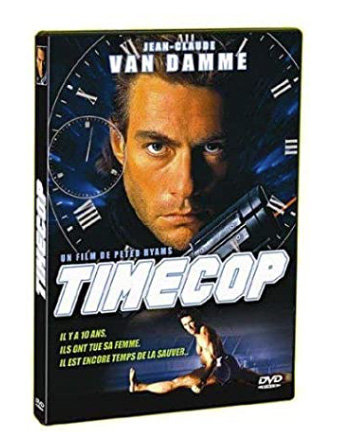
Timecop
Synopsis
In 2004, time travel has been invented and a special police force, the Time Enforcement Commission, is created to stop criminals from altering the past. Max Walker, a veteran officer, is assigned to investigate a corrupt politician, Senator McComb, who is using time travel to enrich himself. Walker is also haunted by the death of his wife, who was killed ten years earlier. As he pursues the senator through history, he must protect the timeline and face his own past.
The Making of the Film
Timecop is based on a short comic series created by Mark Verheiden and Mark Richardson for Dark Horse Comics. The idea of a police force that polices time travel offered a fresh twist on the science fiction genre and caught the attention of Hollywood. The screenplay was written by Mark Verheiden and Mark Richardson, adapted into an action thriller. Director Peter Hyams, known for films such as Outland, was hired to direct. Jean-Claude Van Damme, then at the height of his fame as an action star, was cast as Max Walker. Mia Sara played his wife, and Ron Silver played the scheming senator. The film combined martial arts with a science fiction concept.
Reviews and reception
Summary of professional reviews
Critics gave the film mixed reviews. Many enjoyed its inventive concept and its energetic action scenes, while others found the plot confusing and the dialogue weak. Van Damme's performance was considered adequate, and Ron Silver's villain stood out. Some reviewers noted that it was one of his better films.
Audience reception
The film was a solid commercial success, earning around 101 million dollars worldwide on a budget of about 27 million. It became one of Van Damme's biggest hits. Fans of action and science fiction enjoyed the time-travel premise. Over the years it has become a cult favorite among lovers of 1990s action cinema.
Awards and nominations
Timecop did not receive major awards, but it was nominated for a few genre awards, including some Saturn Award categories. Its main legacy is its role in the career of Van Damme and in the history of time-travel action films.
Filming anecdotes
Director's inspirations
Hyams wanted to mix a classic cop thriller with a time-travel story. He was inspired by film noir and by the idea of a man haunted by loss, which gives the story emotional weight. The film emphasizes visual clarity in the action scenes.
Production difficulties
The use of time travel meant that many scenes had to be shot in different historical settings, which required elaborate costumes and sets. The visual effects of the time machine and the scenes where two versions of the same person meet were particularly challenging. The action choreography with Van Damme also demanded long preparation.
Anecdote about a particular scene
In one of the film's key scenes, the older and younger versions of the villain meet and a strange physical reaction occurs, based on the rule that the same matter cannot occupy the same space. This rule is used to create a gruesome and surprising climax. Van Damme also performs his famous splits in a fight sequence.
Themes explored
Timecop explores the temptation of changing the past and the consequences that follow. It asks whether it is right to alter history for personal gain or love. The film also looks at corruption and abuse of power, represented by the senator. Grief and redemption are at the heart of Max Walker's story, as he longs to save his wife. The film plays with the paradoxes of time travel, raising questions of fate and free will. At the same time, it remains a straightforward action movie.
Ending explained
In the finale, Max travels back in time to the day his wife was killed. He stops the murder and ends up face to face with his younger self, which he cleverly avoids. The senator, trapped in the past, is destroyed by the paradox of meeting himself. When Max returns to the present, the timeline has changed, and he finds that his wife is alive. The ending gives him a happy resolution, although it raises questions about the cost of changing history.
Meaning of the title
Timecop is a blend of the words time and cop and describes the special police force in charge of enforcing the rules of time travel. The name is simple and immediately conveys the premise of the film. It also hints at the hero's role as a guardian who must protect the course of history. The short title fits the punchy tone of the movie.
News
The film inspired a short-lived television series in 1997 and a direct-to-video sequel, Timecop: The Berlin Decision, in 2003. It is still remembered as a highlight of 1990s action cinema.
Similar Films
- The Terminator (1984): a time-travel thriller with killer machines.
- Looper (2012): a modern time-travel action film.
- Back to the Future (1985): the classic time-travel adventure.
- Total Recall (1990): a sci-fi action movie with a twisted plot.
- Universal Soldier (1992): another Van Damme sci-fi action film.