

 Français
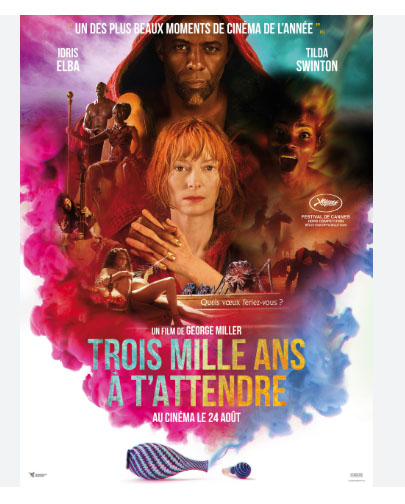
Three Thousand Years of Longing
Synopsis
Alithea Binnie is a lonely, pragmatic British academic specializing in narrative and storytelling who purchases an antique glass bottle at an Istanbul bazaar. While cleaning the trinket in her hotel room, she accidentally unleashes a magnificent, towering Djinn who offers her three traditional wishes in exchange for his freedom. Being a scholar of myth, Alithea knows all the cautionary tales of wishes going horribly wrong and initially refuses. As the Djinn recounts his extraordinary three-thousand-year history across ancient empires and tragic romances, a profound intellectual and emotional bond forms between them.
The Making of the Film
Director George Miller co-wrote and helmed this visionary fantasy epic, adapting A.S. Byatt's short story "The Djinn in the Nightingale's Eye" as a passionate passion project. The production was designed to be a sweeping, philosophical meditation on the power of storytelling, desire, and human imagination. Filmmakers utilized cutting-edge digital visual effects and opulent sound stages in Australia to recreate ancient Ottoman, Solomonic, and Victorian palaces. The project was built to be a visually lavish arthouse blockbuster.
Critical Reception
Critics offered generally favorable reviews, praising the film's dazzling visual imagination, breathtaking world-building, and the stellar onscreen chemistry between Tilda Swinton and Idris Elba. Reviewers commended George Miller for pivoting from the high-octane action of Mad Max: Fury Road into a quiet, contemplative, dialogue-heavy fantasy romance about narrative lore. Some critics noted that the framing story occasionally overshadowed the historical flashbacks, yet lauded its rare artistic ambition. It emerged as a celebrated cinematic fantasy.
Audiences appreciated the film's unique storytelling structure, mesmerizing historical set pieces, and profound philosophical themes regarding human loneliness and desire. Viewers found the sweeping historical vignettes detailing the Djinn's tragic imprisonments deeply enchanting. The intellectual sparring and emotional warmth between the scholar and the mystical being generated warm praise among cinephiles. Many hailed it as a refreshing antidote to standard franchise blockbusters.
While traditional major film academies bypassed the fantasy epic, it earned critical recognition across international fantasy film festivals for its production design, visual effects, and costume design. Tilda Swinton and Idris Elba's performances earned warm praise. The project successfully secured its legacy as a bold cinematic achievement.
Behind-the-Scenes Stories
Director George Miller spent decades developing the adaptation, fascinated by how myths and fairy tales reflect deep psychological truths about human desire and storytelling. He wanted to create an intimate conversational frame story housing massive, operatic historical flashbacks. The production team collaborated with world-class historians and artists to design authentic, vibrant ancient eras.
Shooting complex historical flashback sequences requiring massive digital set extensions and intricate costume design demanded rigorous pre-production planning. Managing international shooting logistics during pandemic-era restrictions tested the Australian crew. Maintaining a delicate balance between intimate hotel-room dialogue and grand historical spectacle required precise editing.
During the intimate hotel room sequences, Tilda Swinton and Idris Elba performed extended, dialogue-heavy scenes with mesmerizing theatrical precision, anchoring the fantastical spectacle in human emotion. Elba spent hours in prosthetic makeup to achieve his towering Djinn stature. These practical efforts brought genuine warmth to the mythic tale.
Tilda Swinton and Idris Elba starred as Alithea and the Djinn, supported by Aamito Lagum and Burcu Gölgedar. The casting process focused on finding magnetic actors with theatrical gravity. The resulting ensemble delivered fantastic dramatic chemistry.
Themes Explored
The film explores the power of storytelling, human loneliness, the nature of desire, historical wisdom, and love across time. It examines how myths help humans make sense of emotional isolation and mortality. The narrative ultimately champions genuine human connection over magic.
Ending Explained
Alithea uses her final wish to set the Djinn completely free and asks him to love her in return, allowing him to return safely to his own dimension while she resumes her academic life in London. Years later, the Djinn quietly visits her modern London apartment, demonstrating that their ethereal bond transcends physical distance and time. They share a tender, silent telepathic farewell, knowing their love was real. The ending offers a breathtaking, poetic resolution to the mythic romance.
Meaning of the Title
The title "Three Thousand Years of Longing" directly describes the immense temporal span of the Djinn's imprisonment and his enduring yearning for freedom and human connection. It highlights the epic historical scope of the narrative. The poetic title sets an enchanting fantasy tone.
Original Soundtrack
Composed by Tom Holkenborg (Junkie XL), the musical score is a lush orchestral triumph featuring sweeping Middle Eastern instrumentation, exotic percussion, and romantic string melodies. The hypnotic sound design enhances the magical historical vignettes, delighting music lovers.
Latest News
- The film continues to be celebrated by cinephiles as a rare, visionary fantasy epic that prioritizes storytelling and philosophy over traditional action.
Similar Films
Fans of fantastical and philosophical epics will enjoy The Fall (2006), Big Fish (2003), The Fountain (2006), and Life of Pi (2012), all exploring visual storytelling.