

 Français
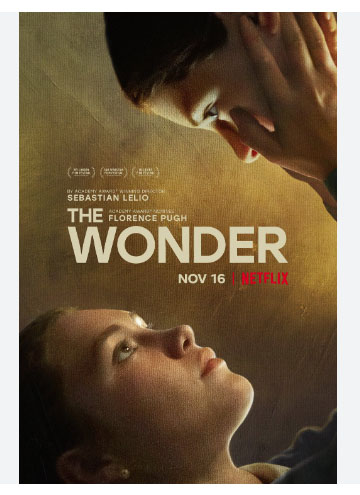
The Wonder
Synopsis
Set in the Irish Midlands in 1859, an English nurse named Lib Wright is brought to a remote rural village to observe a remarkable phenomenon: an eleven-year-old girl named Anna O'Donnell who has reportedly not eaten for four months, miraculously surviving on "manna from heaven." A committee of local town leaders and church elders hires the nurse and a nun to monitor the fasting girl to determine if she is a medical marvel or a fraud. As Lib spends weeks watching Anna, she discovers a dark, tragic family secret driving the starvation. She must race against time to save the child from fanatical religious sacrifice.
The Making of the Film
Director Sebastián Lelio adapted the psychological period drama from Emma Donoghue's acclaimed bestselling novel, bringing a haunting atmospheric vision to the historical mystery. Screenwriters Emma Donoghue, Alice Birch, and Sebastián Lelio crafted the script to examine the clash between religious fanaticism, scientific rationality, and repressed trauma in nineteenth-century Ireland. The production utilized stunning, moody Irish landscapes and constructed authentic period cottages on location. The project was built to be a deeply atmospheric psychological thriller.
Critical Reception
Critics offered generally favorable reviews, praising Florence Pugh's towering, grounded lead performance and the film's chilly, hypnotic gothic atmosphere. Reviewers commended Lelio's artistic direction, which cleverly uses a framing device to remind viewers that they are watching a constructed story, enhancing its thematic depth. Some critics noted that the deliberate, slow-burn pacing required patience, yet lauded its powerful emotional payoff. It emerged as a critical darling on Netflix.
Audiences embraced the film for its haunting psychological tension, stellar acting, and evocative period cinematography. Viewers found the mystery surrounding the fasting girl and the nurse's psychological awakening deeply compelling. The exploration of religious dogma and maternal trauma sparked thoughtful discussions among streaming fans. Many praised it as a unique and chilling historical drama.
While traditional major film academies bypassed the streaming feature, it earned recognition within British independent film awards for its cinematography, costume design, and Florence Pugh's lead performance. Pugh's acting earned widespread critical acclaim. The project successfully established its reputation as a haunting gothic mystery.
Behind-the-Scenes Stories
Director Sebastián Lelio was drawn to the novel's exploration of fasting girls and how societal hysteria weaponizes female bodies. He wanted the visual style to feel austere and cold, mirroring the harsh religious dogmas dominating the nineteenth-century village. The production team constructed the O'Donnell family cottage on an isolated Irish hill to evoke absolute isolation.
Shooting exterior period scenes in harsh Irish weather conditions required physical endurance and careful costume planning from the cast and crew. Managing sensitive themes of child abuse and religious extremism demanded rigorous emotional safety protocols. Maintaining a deliberate, haunting tone across intimate interior scenes required precise editorial control.
During the emotional confrontation scenes, Florence Pugh delivered raw, powerful monologues that anchored the psychological weight of the narrative. Young actress Kila Lord Cassidy performed with remarkable maturity, conveying complex trauma through subtle physical acting. These collaborative efforts brought emotional authenticity to the gothic tale.
Florence Pugh led the cast as Lib Wright, supported by Kila Lord Cassidy, Tom Burke, Niamh Cusack, and Ciarán Hinds. The casting process focused on finding actors who could project stark 19th-century realism. The resulting ensemble delivered fantastic dramatic chemistry.
Themes Explored
The film explores religious fanaticism, historical misogyny, trauma-induced self-punishment, the conflict between science and faith, and storytelling itself. It examines how communities can collectively blind themselves to cruelty in the name of piety. The narrative ultimately champions truth, love, and medical science over superstition.
Ending Explained
Lib discovers that Anna is being slowly starved to death by her mother as an extreme penance to save her late brother's soul from damnation. Knowing Anna is dying, Lib sets fire to the cottage as a symbolic destruction of the toxic past, rescues the child, and renames her "Nan," escaping into a new life together in Australia. A framing device at the very end explicitly breaks the fourth wall, reminding the audience that stories are constructed constructs of belief. The ending offers a powerful, cathartic liberation from dogma.
Meaning of the Title
The title "The Wonder" serves as a dark, ironic double entendre referring both to the supposed holy miracle of the fasting girl and the scientific curiosity of the medical observation. It highlights how society exploits human suffering for mythological spectacle. The concise title sets a haunting gothic tone.
Latest News
- The film continues to be celebrated by film scholars and fans of psychological period cinema for its bold framing device and Florence Pugh's performance.
Similar Films
Fans of psychological period dramas and gothic mysteries will enjoy The Witch (2015), The Nightingale (2018), Saint Maud (2019), and The Pale Blue Eye (2022), all exploring dark history.