

 Français
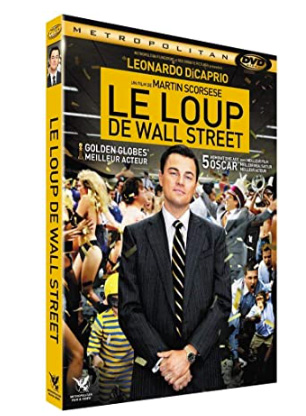
The Wolf of Wall Street
Synopsis
Jordan Belfort is a young stockbroker who discovers that aggressive sales tactics and financial manipulation can bring enormous wealth. After losing his first job during a market crash, he builds a brokerage firm that promises extraordinary profits and attracts clients through extravagant salesmanship. His success leads to a life of luxury, drugs, parties and increasingly reckless behavior. As federal investigators begin examining his business activities, Belfort struggles to maintain control over the empire he has created. The film follows his spectacular rise and the destructive consequences of greed and excess.
The film is based on the memoir of the same name by Jordan Belfort, a former stockbroker who founded the brokerage firm Stratton Oakmont. Martin Scorsese became interested in adapting the book as a portrait of financial ambition, deception and the culture of excess surrounding Wall Street. Leonardo DiCaprio, who also served as a producer, helped develop the project and took the leading role. Screenwriter Terence Winter transformed Belfort's account into a fast-paced narrative that combines black comedy, crime and biographical drama. The filmmakers wanted to show the world from Belfort's point of view, allowing the audience to experience the seduction of wealth before confronting its consequences. The film also reflects Scorsese's long-standing interest in charismatic men whose ambition gradually destroys their personal and professional lives. Its approach deliberately uses extravagant humor and rapid editing to portray a culture in which almost every moral limit has been abandoned.
The film received generally positive reviews, with critics frequently praising Scorsese's direction, the screenplay and Leonardo DiCaprio's energetic performance. Jonah Hill and Margot Robbie also received strong attention for their supporting roles. Some critics admired the film's satirical treatment of financial corruption, while others questioned whether its extravagant scenes risked glamorizing the behavior it intended to criticize. Audience reactions were enthusiastic in many markets, and the film became a major international box-office success. It generated extensive discussion about wealth, financial crime and the representation of real-life misconduct in cinema. The film received five Academy Award nominations, including Best Picture, Best Director, Best Actor for DiCaprio and Best Supporting Actor for Jonah Hill. It also received several Golden Globe and BAFTA nominations. Although it did not win an Academy Award, it remains one of Scorsese's most discussed films of the 2010s.
Leonardo DiCaprio spent time researching Jordan Belfort and the culture of the brokerage firm in order to develop the character's mannerisms and sales techniques. Belfort himself served as a consultant during parts of the production, although the film takes considerable dramatic liberties with his story. Scorsese and editor Thelma Schoonmaker created a rapid visual rhythm using voice-over narration, abrupt transitions and extended sequences of escalating excess. The production required elaborate sets and large groups of extras to recreate the offices, parties and luxury environments associated with Belfort's lifestyle. The famous Quaalude sequence was carefully choreographed to show the physical effects of the drug through exaggerated movement and comic timing. The film also uses direct address and frequent breaks in conventional storytelling to place viewers inside Belfort's persuasive and unreliable perspective. These choices help explain why the film feels both entertaining and deliberately uncomfortable.
Themes Explored
The film examines greed, corruption and the pursuit of wealth without moral limits. Jordan Belfort treats money as a measure of personal worth and uses manipulation to turn financial markets into a source of entertainment and power. The story explores the relationship between capitalism and excess, questioning how easily ambition can become exploitation. Addiction is another central theme, as Belfort becomes increasingly dependent on drugs, luxury and attention. The film also examines masculinity, status and the influence of group behavior. Its satirical tone exposes a world in which people confuse success with the ability to avoid consequences.
Ending Explained
After federal investigators close in on his business, Belfort agrees to cooperate with the authorities and wear a recording device to gather evidence against his associates. However, he warns his friend Donnie Azoff through a seemingly casual note, undermining the operation and exposing his continued inability to separate loyalty from self-interest. Belfort eventually serves a prison sentence and loses the extravagant life he once enjoyed. After his release, he reinvents himself as a motivational speaker and sales trainer. The final scene shows him teaching an audience how to sell a pen, repeating the same techniques of persuasion that made him wealthy. The ending is deliberately ambiguous: Belfort has lost his financial empire, but he has not necessarily abandoned the mentality that created it. The audience is left to consider whether his transformation is genuine or simply another performance.
Meaning of the Title
The title comes from Jordan Belfort's nickname, which reflects his reputation as an aggressive and dominant figure in the world of stockbroking. The wolf symbolizes predatory ambition, appetite and the ability to exploit weaker individuals. The expression also evokes the animal hierarchy that Belfort and his colleagues believe they occupy within the financial world. By using the nickname as the title, the film presents its protagonist as both the central attraction and the embodiment of the excesses it criticizes.
Original Soundtrack
The soundtrack brings together a wide range of songs from rock, pop, soul and other musical styles, reflecting the excess and restless energy of Belfort's world. Rather than relying on a single continuous orchestral score, the film uses existing recordings to give individual scenes their own atmosphere. The music helps establish the period and contributes to the rapid rhythm of the editing. Its eclectic selection reinforces the contrast between the glamour of the characters' lifestyle and the moral emptiness beneath it.
Viewers interested in ambitious crime stories and portraits of financial or social excess may also enjoy Goodfellas, Casino, Wall Street, Boiler Room, American Psycho and The Big Short. These films explore greed, power, deception and the consequences of living beyond moral limits.