

 Français
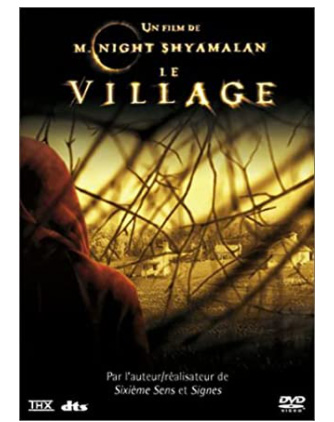
The Village
Synopsis
In the late nineteenth century, a small, isolated community in Pennsylvania lives in fear of the mysterious creatures that inhabit the surrounding woods. The villagers have an agreement with the creatures: they will not enter the forest, and the creatures will not harm them. The peace is shattered when a young man is badly wounded and the blind Ivy Walker is sent through the woods to find medicine. Her journey will force the community to confront the truth behind its fears.
The Making of the Film
The Village was written and directed by M. Night Shyamalan, following the success of "The Sixth Sense", "Unbreakable" and "Signs". The film draws on gothic and fairy-tale imagery, using the forest as a symbol of danger and the unknown. Bryce Dallas Howard, in her first leading role, plays Ivy, with Joaquin Phoenix, Adrien Brody, William Hurt and Sigourney Weaver in the cast. Much of the film was shot in Pennsylvania, which provided the rural landscapes and period atmosphere. As in Shyamalan's earlier films, the story is built around a major twist. It was released in the summer of 2004.
Reviews and Reception
Summary of Professional Reviews
Critics were divided. Many admired the film's atmosphere, cinematography and the performance of Bryce Dallas Howard, who gave the story its emotional anchor. However, a number of reviewers felt that the twist was disappointing and undermined the tension built up before it. Opinions about the film depend heavily on whether the viewer accepts the final reveal.
Audience Reception
The film was a commercial success, earning over 250 million dollars worldwide. It also divided audiences, with some loving its slow-burning mood and others feeling cheated by the ending. It is now regularly discussed as one of Shyamalan's most polarizing films. Many have re-evaluated it more positively over the years.
Awards Received
The film received an Academy Award nomination for Best Original Score, for the work of James Newton Howard. Violinist Hilary Hahn's contributions to the score were widely admired. It also earned other nominations for its visual and musical qualities. The recognition highlighted the film's strong atmosphere.
Themes Explored
The film is a meditation on fear, innocence and the desire to protect loved ones from a harsh world. It explores how a community can be shaped by shared lies and the stories it tells itself. Love is presented as a force stronger than fear, especially in the bond between Ivy and Lucius. The story also asks whether safety is worth the sacrifice of truth and freedom. Grief lies behind the elders' decision to create the village, which gives their motives a tragic dimension. Ultimately, it is a fable about the cost of isolation.
Ending Explained
Ivy discovers that the creatures are a hoax created by the village elders, who founded the community to shield their families from the violence of modern society. The village is in fact located within a modern nature preserve, and the elders have maintained the illusion through costumes and rituals. Ivy meets a park ranger who helps her obtain the medicine, and she returns to the village. The ending leaves the question open of whether the community can continue to live this way once the truth is revealed.
Meaning of the Title
The title is simply the setting of the film, a small, enclosed village cut off from the outside world. Its simplicity underlines the idea of a closed community and a controlled environment. The ordinary name hides the many secrets that the story gradually reveals.
Soundtrack
The score by James Newton Howard features the violin work of Hilary Hahn, whose haunting solos give the film its melancholy character. The music helps create the sense of dread and tenderness that defines the story. It earned an Academy Award nomination and is often singled out as the film's greatest strength.
Similar Films
- Signs (2002): another Shyamalan film about fear and faith.
- The Sixth Sense (1999): his breakthrough thriller with a famous twist.
- The Others (2001): a gothic mystery with a hidden truth.
- The Truman Show (1998): a story about a constructed reality.