

 Français
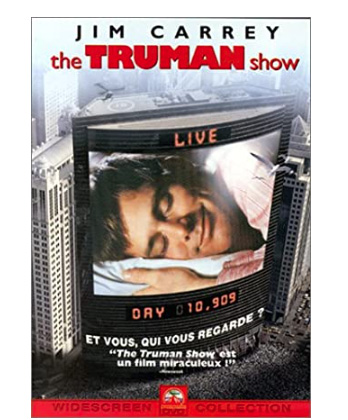
The Truman Show
Synopsis
Truman Burbank lives an apparently perfect life in the peaceful seaside town of Seahaven. He has a stable job, a loving wife and friendly neighbours, but strange events gradually make him question whether his world is genuine. Unbeknownst to him, his entire life has been broadcast as a television programme watched by millions of people. As Truman begins to investigate the inconsistencies around him, the people controlling the show struggle to prevent him from discovering the truth. His search for freedom becomes a challenge to the boundaries between reality, entertainment and personal identity.
The Making of the Film
The Truman Show was directed by Peter Weir from a screenplay written by Andrew Niccol. Niccol originally developed a story about a man whose life is secretly controlled and broadcast as entertainment. The concept explored the growing influence of television and the possibility that media could turn private experience into a commercial spectacle. Peter Weir was attracted to its philosophical questions about freedom, reality and the manipulation of human behaviour. Jim Carrey was cast as Truman Burbank, marking a significant departure from his familiar broad comedy roles. The production created the carefully designed town of Seahaven, using the planned community of Seaside, Florida, as an important visual inspiration. The filmmakers wanted the town to feel beautiful and reassuring while gradually revealing its artificial nature. Ed Harris played Christof, the creator of the television programme, while Laura Linney portrayed Truman's wife. The film combined comedy, drama and science-fiction ideas without relying heavily on futuristic technology. Its premise became increasingly relevant as reality television and constant media observation expanded in popularity.
Critical Reception
Professional critical response: The Truman Show received highly positive reviews from critics. Many praised its original premise, philosophical depth and Peter Weir's carefully controlled direction. Jim Carrey was widely recognised for demonstrating a more restrained and emotionally complex acting style. Ed Harris also received praise for his portrayal of the controlling television producer. Critics appreciated the film's ability to combine humour with serious questions about privacy, manipulation and freedom.
Audience reception: The film was a major commercial success and connected strongly with audiences around the world. Viewers were fascinated by its unusual premise and its gradual revelation of Truman's artificial world. Its themes encouraged discussion about television, surveillance and the influence of media on everyday life. Many audiences found the ending especially moving because it celebrates the courage required to leave a familiar environment. The film has continued to attract new viewers and is frequently discussed in connection with reality television and digital culture.
Awards and recognition: The Truman Show received three Academy Award nominations, including Best Director for Peter Weir, Best Supporting Actor for Ed Harris and Best Original Screenplay for Andrew Niccol. It won several Golden Globe Awards, including Best Actor for Jim Carrey and Best Supporting Actor for Ed Harris. The film also received recognition from critics' associations and international film organisations. Its screenplay and performances were particularly celebrated. Over time, it has become widely regarded as one of the most thoughtful mainstream films of the late 1990s.
Behind-the-Scenes Stories
Director's inspirations: Peter Weir was interested in the relationship between reality and representation, particularly the way television can shape public perception. The film also reflects concerns about privacy and the commercial exploitation of personal experience. He wanted Seahaven to appear almost impossibly perfect, creating a visual environment that would gradually become unsettling. The director used symmetry, carefully framed compositions and unusual camera angles to suggest that Truman is constantly being observed.
Production challenges: Creating Seahaven required a location that could convincingly represent an idealised American town while allowing the production to control the environment. The filmmakers used Seaside, Florida, whose planned architecture helped establish the film's artificial atmosphere. The camera work also had to suggest the presence of hidden surveillance equipment without making every shot obviously artificial. Jim Carrey needed to balance humour with emotional vulnerability as Truman gradually became aware of his situation. The production design and cinematography were essential to making the fictional world believable.
A memorable scene: Truman's final encounter with the edge of his artificial world is one of the film's most powerful moments. After navigating a dangerous storm created by the television producers, he reaches what appears to be the limit of the sea. His boat strikes a painted wall, revealing that the horizon he has always known is part of a constructed set. The scene transforms the film's central metaphor into a physical discovery. Truman's decision to continue towards the exit becomes a declaration of independence.
Originally considered casting: Jim Carrey was selected for the central role, despite the fact that the character required a very different performance from his earlier comedy work. Ed Harris ultimately played Christof after the production sought an actor capable of conveying both paternal warmth and authoritarian control. Laura Linney and Noah Emmerich completed the principal ensemble. The casting was important because the film depends on the contrast between Truman's sincere emotions and the artificial behaviour of the people surrounding him.
Themes Explored
The Truman Show explores freedom, surveillance, manipulation, privacy and the power of mass media. Truman's apparently perfect life becomes a prison because every choice he makes is monitored and controlled by others. The film questions whether comfort and security can ever justify the loss of personal freedom. It also examines the ethical consequences of turning another person's life into entertainment without their consent. Truman's growing awareness represents the human desire to discover truth, even when reality is frightening. The story remains especially relevant in a world where private experiences are increasingly shared, recorded and commercialised.
Explaining the Ending
Truman eventually discovers that the world he has known is an enormous television set and that his entire life has been controlled by Christof. Despite the danger and emotional uncertainty, he refuses to remain in the artificial environment created for him. Christof attempts to persuade him to stay, arguing that the outside world is no more genuine or safe than Seahaven. Truman nevertheless chooses freedom over comfort and walks towards the exit. His final words and familiar gesture bring the programme to a memorable conclusion. The audience inside the fictional television world reacts emotionally, while the viewers outside quickly begin searching for something else to watch. This contrast exposes the superficiality of entertainment culture and the limited attention given to another person's suffering. Truman's departure is a symbolic victory for individual autonomy and the right to shape one's own life.
The Meaning of the Title
The title The Truman Show refers to the television programme built around Truman Burbank's entire life. The word Truman also resembles the expression true man, suggesting a person whose authentic humanity exists inside an artificial environment. The title therefore has a double meaning: it identifies the fictional television spectacle while emphasising the genuine human being at its centre. It captures the contrast between a carefully manufactured performance and the sincere emotions of someone who does not know he is being watched.
The original score was composed by Burkhard Dallwitz, with additional music by Philip Glass. Glass's distinctive minimalist compositions contribute significantly to the film's dreamlike and philosophical atmosphere. The music reinforces the contrast between the apparent tranquillity of Seahaven and the growing unease experienced by Truman. Its restrained style helps create an emotional connection without overwhelming the story. The soundtrack is particularly memorable for its use of recurring musical themes that suggest the artificial construction of Truman's world.
Similar films include Dark City, directed by Alex Proyas, which explores an artificial reality; The Matrix, directed by the Wachowskis, which questions the nature of the world people inhabit; Pleasantville, directed by Gary Ross, which examines an idealised fictional community; and EDtv, directed by Ron Howard, which also explores the commercial exploitation of a person's private life.