

 Français
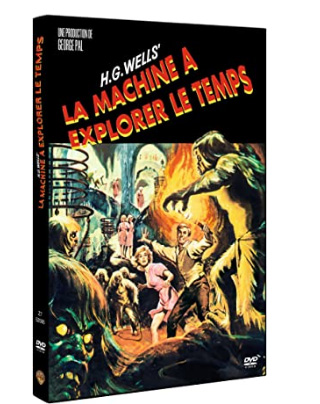
The Time Machine
Synopsis
In 1899 New York City, brilliant scientist Dr. Alexander Hartdegen is devastated by the tragic murder of his fiancée. Driven by grief, he dedicates years of his life to inventing a fully functional time machine to alter the past. When he tests the device by traveling into the far-flung future, he discovers that humanity has fractured into two distinct species: the peaceful Eloi and the monstrous underground Morlocks. Teaming up with a survivor named Mara, Alexander must find a way to escape the subterranean predators and return to his own time.
The Making of the Film
Director Simon Wells, who is the great-grandson of legendary science fiction author H.G. Wells, directed this second major cinematic adaptation of the classic 1895 novel. DreamWorks Pictures and Warner Bros. collaborated to finance the big-budget sci-fi adventure, incorporating modern computer-generated visual effects. The production aimed to modernize the Victorian classic while respecting its core philosophical themes.
Critical Reception
Critics gave the film mixed reviews upon its release, praising its stunning visual effects, elaborate set designs, and atmospheric opening sequences in 19th-century New York. However, many reviewers felt that the second half descended into a standard, noisy action-adventure movie that lost the sophisticated social commentary of H.G. Wells novel. Despite critical reservations, audiences found it to be an entertaining popcorn sci-fi adventure.
Public reception was solid, turning the science fiction film into a respectable box-office success worldwide during its theatrical run. Viewers enjoyed the thrilling time travel mechanics, impressive creature designs of the Morlocks, and the sweeping musical score. It remains a memorable early-2000s sci-fi blockbuster entry.
The film earned an Academy Award nomination for Best Makeup, recognizing the intricate prosthetic design of the underground Morlock creatures. It also received Saturn Award nominations for its visual effects and production design. Its technical achievements were widely praised by genre fans.
Filming Anecdotes
Director Simon Wells drew inspiration from H.G. Wells original literary masterpiece and classic cinematic science fiction design. He wanted the visual aesthetic to transition from Victorian industrial brass and mahogany into a desolate, overgrown future earth. His direction encouraged Guy Pearce to commit fully to the physical exhaustion of playing an obsessed scientist.
Production faced unexpected setbacks when director Simon Wells suffered from severe exhaustion midway through filming, requiring Gore Verbinski to step in and direct for a week. Guy Pearce underwent rigorous physical training and sustained minor injuries while performing several of his own action stunts. The construction of the massive time machine prop required months of detailed engineering.
A memorable sequence involves Alexander activating the time machine for the first time, watching his laboratory walls change rapidly as generations pass by. The scene utilizes stunning visual effects to capture the dizzying passage of time. Pearce expressive performance anchored the surreal moment.
The casting process brought together talented international actors to anchor the sci-fi epic. Guy Pearce was chosen as the lead scientist for his intense dramatic presence. Samantha Mumba was cast as Mara, bringing fresh screen presence to her feature film debut.
Themes Explored
The film explores grief, obsession, the irrevocable nature of time, human evolution, and technological hubris. It highlights how trying to alter past tragedies can blind individuals to the present. Social stratification is a central dystopian motif.
NULL
Title Significance
The title directly references the groundbreaking scientific invention created by the protagonist to travel through temporal dimensions. It highlights the central technological marvel driving the narrative.
NULL
NULL
Similar Films
Other similar films include The Time Machine (1960), Interstellar, and Planet of the Apes.