

 Français
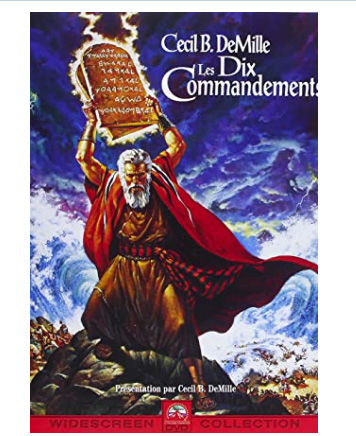
The Ten Commandments
Synopsis
Saved from the Nile as a baby, Moses grows up as a prince in the court of Pharaoh Seti, until he learns that he is in fact a Hebrew. Banished to the desert after defending a slave, he meets God in the form of a burning bush and is told to free his people. He returns to Egypt to confront his rival Ramses, now Pharaoh, and demands that he let the Israelites go. After the ten plagues and the parting of the Red Sea, he leads them to Mount Sinai, where he receives the Law.
The Making of the Film
Cecil B. DeMille had already directed a silent version of The Ten Commandments in 1923, and he wanted to make a new one with the full power of modern technology. By the early 1950s, he had enjoyed a major success with The Greatest Show on Earth and felt ready for one last gigantic epic. He drew on the Book of Exodus, but also on other sources, including the novel Prince of Egypt by Dorothy Clarke Wilson, the writings of Josephus and several ancient texts that filled in Moses' youth. A team of writers, including Aeneas MacKenzie, Jesse Lasky Jr., Jack Gariss and Fredric M. Frank, shaped the screenplay. DeMille was determined to present the story with the greatest possible scale and spectacle, while also delivering a message about freedom. The production was shot in VistaVision, a high-resolution format developed by Paramount. Part of the film was shot on location in Egypt, at a time when few Hollywood productions travelled that far. The result was a film of nearly four hours, designed as a monument to faith and to Hollywood showmanship.
Reviews and reception
Professional critics' summary
Critics of the time were generally impressed by the film's size and technical achievements, though some found the dialogue grandiose. They admired the performances of Charlton Heston and Yul Brynner, whose opposition gives the film its tension. The special effects, especially the parting of the Red Sea, were considered a landmark in cinema. Some reviewers felt that the film's length and melodramatic tone were excessive, but they conceded that it was a breathtaking spectacle.
Audience reception
The film was one of the biggest hits of its era, becoming the highest-grossing film of 1956 and one of the most successful films in Hollywood history at that time. Audiences flocked to see it in theatres, and it was re-released several times. Since 1973, it has been broadcast annually on American television around Easter and Passover, creating a tradition for many families. It remains one of the most-watched films in the United States.
Awards
The Ten Commandments received seven Academy Award nominations, including Best Picture. It won the Oscar for Best Special Effects, awarded to John P. Fulton for his work on the Red Sea sequence. It lost the Best Picture award to Around the World in 80 Days. The film has been preserved in the National Film Registry as a culturally significant work.
Filming anecdotes
Director's inspirations
DeMille was inspired by the stories of the Bible but also by classical painting and the grand tradition of historical spectacle. He regarded himself as a showman with a mission, bringing religious stories to a mass audience. He studied archaeology and Egyptian art in order to give the film a convincing look. The film's monumental sets and costumes were designed to recall the grandeur of ancient civilisation.
Production difficulties
The production was immense, with thousands of extras, hundreds of animals and gigantic sets built on the Paramount lot. Location filming in Egypt required complex logistics, including the construction of a huge city set for the Exodus scene. DeMille, who was already in his seventies, suffered a heart attack during the shoot but returned to work soon after. The film's budget soared to around thirteen million dollars, making it one of the most expensive of its day.
Anecdote about a particular scene
The famous parting of the Red Sea was achieved by combining water tanks, matte painting and a reversed film of water flowing back into place. It took months of work and remained one of the most remarkable visual effects in cinema for decades. Charlton Heston's own infant son, Fraser, played the baby Moses in the opening sequence. Heston was also asked to voice some of the divine lines, giving the film an unforgettable moment in the burning bush scene.
Originally planned casting
DeMille chose Charlton Heston for the role of Moses in part because of his resemblance to Michelangelo's famous statue of the prophet. Yul Brynner was cast as the proud and charismatic Ramses, in a performance that became legendary. Anne Baxter played Nefretiri, Edward G. Robinson played Dathan and Yvonne De Carlo played Sephora. John Derek, Debra Paget and Cedric Hardwicke completed an impressive cast.
Themes explored
The film is centred on the struggle between freedom and tyranny, illustrated by the liberation of the Hebrew slaves. It presents faith as a force capable of overcoming even the most powerful empire. The rivalry between Moses and Ramses adds a personal dimension, since the two men were raised as brothers. The story also explores the idea of destiny, as Moses must accept a mission that he did not choose. The Ten Commandments themselves are shown as the foundation of law and morality, a message that was particularly resonant in Cold War America. Another theme is the importance of leadership, with Moses guiding his people through doubt and rebellion. The film also looks at the consequences of pride and disobedience, notably in the episode of the golden calf. Ultimately, it is a meditation on the relationship between God, law and human responsibility.
Ending explained
After the Israelites cross the Red Sea and the Egyptian army is destroyed, Moses leads his people to Mount Sinai. While he receives the tablets of the law from God, the people lose faith and build a golden calf to worship. Moses returns and smashes the tablets in anger, then punishes those who turned away. The Israelites are condemned to wander the desert for forty years until a new generation can enter the Promised Land. In the final scenes, Moses, now an old man, hands over his authority to Joshua and gazes upon the land he will never enter. He delivers a last sermon to his people, then departs alone, fulfilling his role as God's servant. The conclusion emphasises that freedom must be accompanied by moral discipline. It leaves the audience with a sense of reverence and solemnity.
Meaning of the title
The Ten Commandments refers to the ten laws that God gave to Moses on Mount Sinai, which form the basis of Jewish and Christian moral teaching. The title announces that the film will culminate in this crucial moment, even though it covers a much longer story. It also highlights the central role of law in the construction of a free society. For DeMille, the commandments represented the foundation of human liberty and civilisation, a message he stressed in the prologue. The title is simple, direct and carries immense cultural weight. It also echoes the 1923 silent film, which used the same name. Together, the words promise a story about the origins of moral order.
Original Soundtrack
Elmer Bernstein composed the score, which was one of the first great works of his career. His music mixes grand orchestral themes with exotic touches that evoke ancient Egypt. The main theme and the music for the Exodus are among the most recognisable in the history of epic cinema. The score helped to set the standard for biblical epics that followed.
News
The film is still broadcast every year on American television around Easter and Passover, a tradition that began in the 1970s. It continues to attract millions of viewers and remains a cultural staple. Its influence can still be felt in modern epics and in popular references to the story of Moses.
Similar Films
Ben-Hur, with Charlton Heston, is the other great biblical epic of the era. The Prince of Egypt is an acclaimed animated retelling of the story of Moses. Cleopatra and Spartacus are other monumental spectacles from Hollywood's golden age. Exodus: Gods and Kings by Ridley Scott offers a modern interpretation of the same story.