

 Français
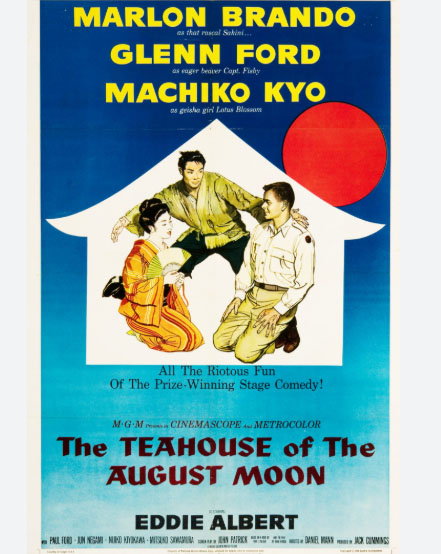
The Teahouse of the August Moon
Synopsis
Set in post-World War II Okinawa, earnest US Army Captain Fisby is assigned to the village of Tobiki to democratize the locals and oversee the construction of a Western-style Pentagon-shaped schoolhouse. Instead, assisted by a cunning local interpreter named Sakini, Fisby is seduced by the peaceful, charming local culture and traditions. The villagers convince him that what they really need is not a schoolhouse, but a traditional Japanese teahouse where they can brew sweet potato brandy and relax. When a pompous colonel arrives to inspect the progress, he is stunned to find a flourishing teahouse instead of military discipline.
The Making of the Film
Director Daniel Mann adapted the film from John Patricks hit 1953 Broadway play, which was based on Vern Sneiders bestselling satirical novel. Metro-Goldwyn-Mayer produced the comedy, aiming to balance gentle cultural satire with heartwarming humanist charm. The production made the controversial decision to cast Marlon Brando as the Okinawan interpreter Sakini using heavy prosthetic makeup, a notable casting choice of mid-century Hollywood.
Critical Reception
Critics gave the film positive reviews upon its release, praising its gentle humor, charming performances, and satirical look at American military bureaucracy abroad. Reviewers particularly lauded Glenn Ford for his straight-faced comedic timing and Marlon Brando for his surprisingly lighthearted, transformative comedic turn. The film was celebrated as a warm-hearted cross-cultural comedy.
Public reception was very strong, making the comedy a major box-office success worldwide for MGM. Audiences fell in love with the whimsical Okinawan village culture, picturesque scenery, and humorous clashes of military protocol. It remains a beloved classic of 1950s cinematic comedy.
The film earned Golden Globe nominations for Best Motion Picture - Musical/Comedy and Best Actor for Marlon Brando. It was also honored by the National Board of Review as one of the top films of the year. Its gentle cultural satire remains warmly regarded.
Filming Anecdotes
Director Daniel Mann drew inspiration from John Patricks Broadway production and authentic Okinawan cultural traditions. He chose location shooting in Japan to capture genuine Asian landscapes and architecture, blending studio soundstages with authentic outdoor scenery. His direction encouraged Marlon Brando to adopt an entirely different physical posture and vocal cadence.
Production faced unique challenges as Marlon Brando spent hours every morning in makeup chairs applying prosthetics to transform his facial features for the Asian role. Glenn Ford brought grounding, neurotic military authority to balance Brandos whimsical comedic performance. The supporting cast of local villagers added incredible authenticity.
A memorable sequence involves the entire village coming together to construct the traditional teahouse with joyful songs and community spirit, baffling the visiting colonel. The scene encapsulates the heartwarming cultural exchange at the heart of the story. Brandos charming narration frames the comedy.
The casting process was unusual for its time as major star Marlon Brando actively campaigned for the comedic supporting role of Sakini. Glenn Ford was cast as the bewildered Captain Fisby, bringing wonderful everyman charm. Machiko Kyo was brought in to play the enchanting geisha Lotus Blossom.
Themes Explored
The film explores cultural assimilation, military bureaucracy, cross-cultural understanding, simplicity versus modernization, and peace. It satirizes rigid government attempts to impose Western values on foreign cultures. Gentle wisdom triumphs over red tape.
NULL
Title Significance
The title refers to the traditional Okinawan teahouse built by the villagers under the moonlight, serving as a sanctuary of peace and community. It highlights the cultural heart of the narrative.
NULL
NULL
Similar Films
Other similar films include The King and I, Teahouse of the August Moon, and Mr. Roberts.