

 Français
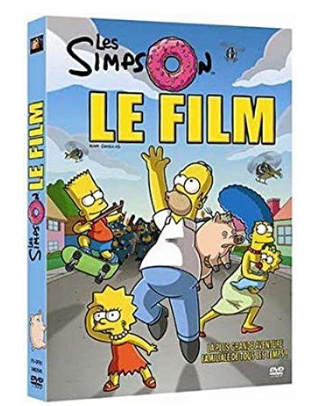
The Simpsons Movie
Synopsis
When Homer Simpson adopts a pig and dumps its waste into Lake Springfield, he unleashes an environmental catastrophe that threatens the entire town. The Environmental Protection Agency, led by the ruthless Russ Cargill, responds by sealing Springfield under a giant glass dome. The townspeople turn on Homer, who flees to Alaska with his family. As Marge, Bart, Lisa and Maggie lose faith in him, Homer has to find a way to make things right before Springfield is destroyed.
The Making of the Film
For years, fans of the show wondered when The Simpsons would make the leap to the big screen. Creator Matt Groening and producer James L. Brooks wanted to wait until they had a story that deserved a feature film rather than an extended episode. The screenplay took a long time to develop and involved a large team of veteran series writers, including Al Jean, Mike Scully, George Meyer and others, who produced countless drafts. The writers pushed to create a film with a bigger scale and a stronger emotional arc than a typical episode. The central idea, an ecological disaster caused by Homer's carelessness, allowed the film to satirize both environmental politics and the show's own habits. David Silverman, a longtime director of the series, took charge of the film, and the regular voice cast returned. The animation was produced with the show's traditional approach but a richer, more cinematic look. Fox also launched a promotional contest to find the real Springfield, and the film held its premiere in Springfield, Vermont. After nearly two decades on television, the family finally had a cinema release in July 2007.
Reviews and Reception
Critics gave the film a warm reception, praising its rapid-fire humor, its self-referential jokes and its willingness to poke fun at its own franchise. Reviewers noted that the story felt like a proper feature rather than a stretched-out episode, with real emotional stakes between Homer and his family. Some commentators felt the film did not reinvent the series, but most agreed that it captured the spirit of its golden years. Homer's foolishness and Marge's patience were highlighted as the emotional heart of the story.
Audiences responded enthusiastically, and the film became a major worldwide hit, earning more than 500 million dollars at the box office. It was one of the highest-grossing animated films of its year. Fans of the show appreciated the numerous references to long-running jokes, while newcomers found it easy to follow. The Spider-Pig sequence, in particular, became a pop-culture favorite.
The film was nominated for an Annie Award for Best Animated Feature. Its success also helped to confirm the show's cultural importance on a global scale. For many viewers, the real reward was simply seeing the Simpson family on the big screen at last.
Filming Anecdotes
The writers drew on the long history of the show, looking for a story that could use the full breadth of Springfield's characters. They also took inspiration from classic disaster and environmental movies, which they parodied with gusto. The central image of a dome over a town recalls stories of communities cut off from the world, but here it is played for comedy. The result is a film that mocks both its genre and the series itself.
The production took years, since the creative team wanted the film to meet the expectations of a huge fan base. Writing the screenplay involved many rounds of revisions, with new ideas added and old jokes cut. The team reportedly produced far more material than could fit into the final film. The decision to keep the story as strong as possible meant that the project was developed alongside the television series, with many of the same people working on both.
One scene that quickly became legendary shows Bart skateboarding naked through the streets of Springfield, a daring gag that pushed the limits of the film's rating. The Spider-Pig song, sung by Homer to his new pet, turned into an unexpected pop-culture phenomenon. Both sequences show the writers' willingness to blend silliness with sharp satire.
The core cast of the television series, including Dan Castellaneta, Julie Kavner, Nancy Cartwright and Yeardley Smith, returned to voice the main characters. Albert Brooks, who has voiced several characters on the show, played the villainous Russ Cargill. Tom Hanks makes a brief cameo as himself, and the band Green Day also appears in the film. These appearances gave the production the feel of a major event.
Themes Explored
The film uses humor to tackle environmental irresponsibility, showing how a single careless act can have enormous consequences. It also satirizes government overreach, with the EPA portrayed as a cold bureaucracy willing to sacrifice a town to protect its own image. At the family level, the story is about forgiveness and responsibility, as Homer must face the damage he has done and earn back the trust of his wife and son. The relationship between Homer and Bart is a recurring emotional thread, built on rivalry and a deep, unspoken affection. Small-town solidarity also plays a major role, since the people of Springfield turn from an angry mob into a community that fights for itself. Throughout, the film gleefully mocks television, politics and the movie industry, including itself.
Ending Explained
In the film's final stretch, Homer returns to Springfield after realizing he has let down his family and his community. With Marge, Bart and the others, he works to save the town from the destruction planned by Cargill. The dome that traps Springfield is breached, and the townspeople survive, with Homer proving that he can make a difference when it counts. Marge forgives him, Bart reconciles with his father, and the family is reunited. The ending combines big spectacle with a very familiar message, which is that Homer is a fool but a loving one.
Meaning of the Title
The title is simple and direct, announcing that the family known from television has finally been given a full-length film. The word movie signals a bigger production than a regular episode, with higher stakes and a larger canvas. It also winks at the show's own self-awareness, since the series has always joked about its place in popular culture. By keeping the name plain, the creators let the film stand as a celebration of nearly two decades of television history.
Original Soundtrack
The film uses Danny Elfman's unmistakable theme for the series, adapted for the big screen, and the score was composed by Hans Zimmer, who brought a cinematic grandeur to the comedy. Green Day contributed a version of the theme and appears in a memorable gag in the film. The music helps the film feel both familiar and larger than life.
Similar Films
- South Park: Bigger, Longer and Uncut (1999), Trey Parker
- Beavis and Butt-Head Do America (1996), Mike Judge
- Futurama: Bender's Big Score (2007), Dwayne Carey-Hill
- The Incredibles (2004), Brad Bird
- The Bob's Burgers Movie (2022), Loren Bouchard and Bernard Derriman